
Opinion|Videos|October 26, 2026
PFS, MRD, and Treatment Duration in Multiple Myeloma
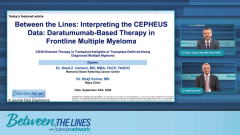
Dr. Saad Usmani and Dr. Shaji Kumar discuss how sustained MRD negativity and long-term progression-free survival may inform future treatment strategies for patients with newly diagnosed multiple myeloma.
Advertisement
Episodes in this series
Dr. Saad Usmani and Dr. Shaji Kumar discuss how sustained MRD negativity and long-term progression-free survival may inform future treatment strategies for patients with newly diagnosed multiple myeloma. They consider the relationship between sustained MRD negativity and durable disease control, particularly in transplant-ineligible patients, who represented approximately three-fourths of the CEPHEUS population. Dr. Kumar discusses the potential for MRD status to guide treatment discontinuation in future prospective studies, noting that standard-risk patients with sustained MRD negativity may be candidates for treatment cessation, while patients with high-risk disease may require deeper and more sustained MRD negativity before discontinuation can be considered. The experts emphasize that these approaches remain investigational and require prospective validation. The conversation then turns to the potential role of BCMA-directed therapies as consolidation or maintenance strategies and the evolving treatment approach for patients aged 65 to 80 years. They also discuss practical use of weekly bortezomib and treatment de-escalation when neuropathy or other tolerability concerns arise, while considering the long-term efficacy of daratumumab-based therapy.
Advertisement
Related to this article

Erik Bengtsen, MD, discussed meaning-centered therapy at the bedside, framing psychiatry referrals, and a more humanistic approach to care.
Erik Bengtsen, MD, described what sets psycho-oncology apart and how clinicians can open conversations on body image and sexual health.
Erik Bengtsen, MD, explained how antidepressants may improve quality of life and how he typically works with patients who decline favorable treatment.
Erik Bengtsen, MD, shares a key depression screening question and explains when oncologists can start a low-dose antidepressant.
Advertisement
Advertisement
Trending on CancerNetwork
1
Divarasib Improves Survival vs Sotorasib or Adagrasib in KRAS G12C+ NSCLC
2
Ivonescimab Combo Improves Survival in Advanced Biliary Tract Cancer
3
Osimertinib/Savolitinib Improves Survival in MET-Altered EGFR-Mutant NSCLC
4
Sonesitatug Vedotin Improves OS in Pretreated CLDN18.2+ Gastroesophageal Cancer
5