
Opinion|Videos|October 19, 2026
CEPHEUS Design and the Role of MRD in Multiple Myeloma
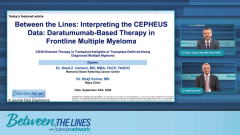
Dr. Saad Usmani reviews the design of the phase 3 CEPHEUS study in patients with transplant-ineligible or transplant-deferred newly diagnosed multiple myeloma, highlighting the importance of patient fitness and age in defining the study population.
Advertisement
Dr. Saad Usmani reviews the design of the phase 3 CEPHEUS study in patients with transplant-ineligible or transplant-deferred newly diagnosed multiple myeloma, highlighting the importance of patient fitness and age in defining the study population. He describes the randomized comparison of daratumumab plus bortezomib, lenalidomide, and dexamethasone followed by daratumumab plus lenalidomide versus bortezomib, lenalidomide, and dexamethasone followed by lenalidomide. The discussion emphasizes that CEPHEUS incorporated MRD negativity as its primary endpoint while also being powered to evaluate progression-free survival. Dr. Usmani and Dr. Shaji Kumar then discuss why MRD negativity has become increasingly important in frontline multiple myeloma clinical trials as conventional PFS endpoints require longer follow-up with increasingly effective therapies. Dr. Kumar reviews evidence supporting MRD negativity as a prognostic marker and potential surrogate endpoint for progression-free and overall survival, including large meta-analytic efforts and prospective validation initiatives. He also discusses the regulatory significance of these findings and the use of MRD negativity to support accelerated approval in multiple myeloma.
Advertisement
Related to this article

Erik Bengtsen, MD, discussed meaning-centered therapy at the bedside, framing psychiatry referrals, and a more humanistic approach to care.
Erik Bengtsen, MD, described what sets psycho-oncology apart and how clinicians can open conversations on body image and sexual health.
Erik Bengtsen, MD, explained how antidepressants may improve quality of life and how he typically works with patients who decline favorable treatment.
Erik Bengtsen, MD, shares a key depression screening question and explains when oncologists can start a low-dose antidepressant.
Al-Ola A. Abdallah, MD, explains a possible biological reason IMiD holding therapy benefited ide-cel but not cilta-cel recipients.
Advertisement
Advertisement
Trending on CancerNetwork
1
Meaning-Centered Therapy, Psychiatry Referrals, and Humanistic Cancer Care
2
How Psycho-Oncology Addresses Existential Distress, Body Image, and Intimacy
3
How to Work With a Patient Who Declines Cancer Treatment
4
Targeting Cyclin E1, KRAS, and DNA Repair Beyond PARP in Ovarian Cancer
5