
Opinion|Videos|October 19, 2026
Depth and Durability of Response in Multiple Myeloma
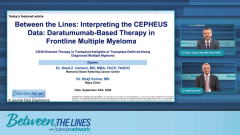
Dr. Saad Usmani and Dr. Shaji Kumar examine the CEPHEUS findings on response depth and durability in newly diagnosed multiple myeloma, with particular emphasis on MRD negativity and its potential implications for treatment duration.
Advertisement
Dr. Saad Usmani and Dr. Shaji Kumar examine the CEPHEUS findings on response depth and durability in newly diagnosed multiple myeloma, with particular emphasis on MRD negativity and its potential implications for treatment duration. Dr. Usmani reviews the higher rates of MRD negativity with D-VRd compared with VRd at the 10⁻⁵ and 10⁻⁶ thresholds and highlights the sustained MRD negativity observed at 12, 24, and 36 months. Dr. Kumar discusses how the greater difference in MRD negativity compared with conventional complete response rates illustrates the value of MRD as a measure for distinguishing treatment efficacy in contemporary multiple myeloma trials. The conversation then shifts to whether sustained MRD negativity could eventually help determine when treatment can be discontinued, particularly as deeper and more durable responses become achievable with modern regimens. Dr. Kumar references the Endurance study and ongoing response-guided treatment strategies while noting that prospective evidence is still needed to establish when therapy can safely be stopped. Dr. Usmani emphasizes that sustained MRD negativity may become an important factor in future treatment-duration studies.
Advertisement
Related to this article

Erik Bengtsen, MD, discussed meaning-centered therapy at the bedside, framing psychiatry referrals, and a more humanistic approach to care.
Erik Bengtsen, MD, described what sets psycho-oncology apart and how clinicians can open conversations on body image and sexual health.
Erik Bengtsen, MD, explained how antidepressants may improve quality of life and how he typically works with patients who decline favorable treatment.
Erik Bengtsen, MD, shares a key depression screening question and explains when oncologists can start a low-dose antidepressant.
Al-Ola A. Abdallah, MD, explains a possible biological reason IMiD holding therapy benefited ide-cel but not cilta-cel recipients.
Advertisement
Advertisement
Trending on CancerNetwork
1
Meaning-Centered Therapy, Psychiatry Referrals, and Humanistic Cancer Care
2
How Psycho-Oncology Addresses Existential Distress, Body Image, and Intimacy
3
How to Work With a Patient Who Declines Cancer Treatment
4
Targeting Cyclin E1, KRAS, and DNA Repair Beyond PARP in Ovarian Cancer
5