
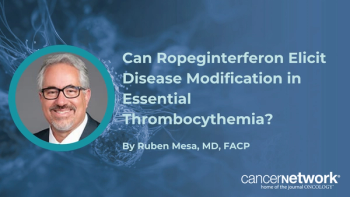
Ropeginterferon alfa may play an important role in future combination strategies in essential thrombocythemia, said Ruben Mesa, MD, FACP.
Ropeginterferon alfa may play an important role in future combination strategies in essential thrombocythemia, said Ruben Mesa, MD, FACP.

Beth Sandy, CRNP, said she would like to see more data on management strategies for blepharitis, eye toxicities, and mucositis in patients with lung cancer.

In the closing segment of this Cancer Network Face Off on advanced hepatocellular carcinoma (HCC), moderator and judge Rachna T. Shroff, MD, reflects on how dramatically the treatment landscape has expanded, recalling an era when sorafenib was the only systemic option.
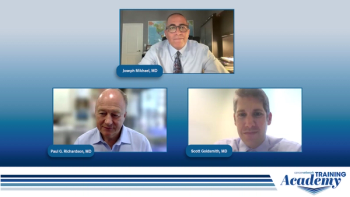
The discussion turns to the immunomodulatory effects of CELMoDs in multiple myeloma, with Dr. Goldsmith describing preclinical evidence suggesting that CELMoDs can enhance T-cell and NK-cell activity through effects on cytokine signaling and immune-mediated mechanisms.
In the second clinical scenario of this Cancer Network Face Off on advanced hepatocellular carcinoma (HCC), Team Chicago Hot Dog manages a 54-year-old man with NASH-related cirrhosis and BCLC stage C disease, excellent performance status, bulky bilobar disease with a 9.2-cm dominant lesion, Vp3 invasion, two lung metastases, Child-Pugh A5, ALBI grade 1, no varices on recent endoscopy, and a rapidly rising alpha-fetoprotein level.
Dr. Mikhael asks Dr. Goldsmith to further explain the clinical relevance of the differences in cereblon engagement between CELMoDs and established IMiDs for clinicians treating multiple myeloma.
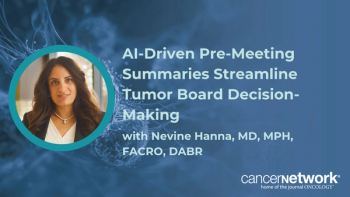
Nevine Hanna, MD, MPH, FACRO, DABR, explained how AI can aggregate patient data to enhance multidisciplinary tumor board collaboration.
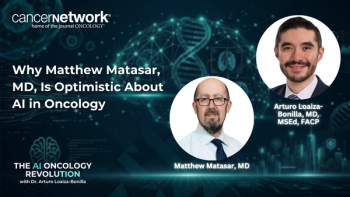
Matthew Matasar, MD, reflected on how quickly oncology has moved from skepticism to nimble adoption of AI, and what he expects from the field going forward.

Sandra Turner, MBBS, PhD, explained why September 7, radiotherapy’s first modern linac milestone, was chosen for World Radiotherapy Awareness Day.
The FDA approval of ropeginterferon alfa-2b may lead to longer and better outcomes in essential thrombocythemia, according to Ruben Mesa, MD, FACP.

Matthew Matasar, MD, weighed the optimism and uncertainty surrounding AI’s expanding role in cancer drug discovery and clinical practice.

Radiopharmaceutical therapy currently falls somewhere between localized treatment and systemic therapy, according to Mallika Marar, MD, MBA.

Panelists discuss overlapping toxicities and long-term needs in epidermal growth factor receptor (EGFR)-mutated non-small cell lung cancer (NSCLC), beginning with osimertinib consolidation after chemoradiation, where cough, dyspnea, fatigue, and esophagitis may predate targeted therapy.
Panelists discuss a case-based scenario involving a man in his seventies with an excellent, durable response to single-agent osimertinib for more than two years, managed in a community clinic, who has chronic low-grade dermatologic toxicity and fatigue, quietly skips doses when his rash flares, and says he is tired of taking pills.
Panelists discuss preparing the same patient for amivantamab plus lazertinib as an alternative to chemotherapy-containing first-line therapy in epidermal growth factor receptor (EGFR)-mutated advanced non-small cell lung cancer (NSCLC).
Panelists discuss a case-based scenario involving a woman in her late fifties with newly diagnosed epidermal growth factor receptor (EGFR) exon deletion metastatic lung adenocarcinoma, high disease burden, good performance status, and adequate organ function, whose team is intensifying beyond single-agent osimertinib.
Panelists discuss gastrointestinal management for patients receiving first-line therapy for epidermal growth factor receptor (EGFR)-mutated advanced non-small cell lung cancer (NSCLC).
Panelists discuss how grading drives treatment decisions across first-line regimens for epidermal growth factor receptor (EGFR)-mutated advanced non-small cell lung cancer (NSCLC).
Panelists discuss how nurse-driven telephone triage works for patients receiving first-line therapy for epidermal growth factor receptor (EGFR)-mutated advanced non-small cell lung cancer (NSCLC).
Panelists discuss how caregivers and families should be built into the education plan at the start of first-line therapy for epidermal growth factor receptor (EGFR)-mutated advanced non-small cell lung cancer (NSCLC).
Panelists discuss prophylactic versus reactive dermatologic management across first-line regimens for epidermal growth factor receptor (EGFR)-mutated advanced non-small cell lung cancer (NSCLC).

The faculty discuss the management of a patient with relapsed/refractory multiple myeloma (R/R MM) who has received four prior lines of therapy but faces significant logistical barriers to CAR-T treatment because of limited caregiver support and distance from a cellular therapy center.
The final FACE-OFF debate examines whether BCMA bispecific antibodies will retain a meaningful role in the management of relapsed/refractory multiple myeloma (R/R MM) as these therapies continue to move into earlier lines of treatment.

Rethinking dose fractions and managing subclinical renal and marrow toxicity represent ongoing challenges associated with the use of radiopharmaceutical therapy.
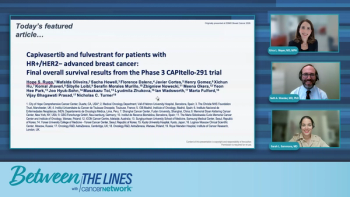
Erica L. Mayer, MD, MPH, of Dana-Farber Cancer Institute, closes with the competitive landscape around capivasertib plus fulvestrant in hormone receptor positive, human epidermal growth factor receptor 2 (HER2)-negative advanced breast cancer.
Erica L. Mayer, MD, MPH, of Dana-Farber Cancer Institute, reviews final safety data from CAPItello-291, the phase 3 trial of capivasertib plus fulvestrant in hormone receptor positive, human epidermal growth factor receptor 2 (HER2)-negative advanced breast cancer, reporting no new signals: diarrhea in nearly 80% of patients with about 10% grade 3 and no prophylactic antidiarrheal in the protocol, rash in about 40%, and all-grade hyperglycemia of 17% despite allowing hemoglobin A1c up to 8%.
Erica L. Mayer, MD, MPH, of Dana-Farber Cancer Institute, presents exploratory overall survival data from CAPItello-291 in patients with prior cyclin-dependent kinase (CDK) 4/6 inhibitor exposure, showing about a 7-month difference favoring capivasertib plus fulvestrant in the PIK3CA/AKT1/PTEN-altered population of this hormone receptor positive, human epidermal growth factor receptor 2 (HER2)-negative advanced breast cancer trial, without statistical significance.
Sarah L. Sammons, MD, of the University of Maryland Greenebaum Comprehensive Cancer Center, and Seth A. Wander, MD, PhD, of Massachusetts General Hospital, join Erica L. Mayer, MD, MPH, of Dana-Farber Cancer Institute, to debate how post-progression therapy shapes survival interpretation in hormone receptor positive, human epidermal growth factor receptor 2 (HER2)-negative advanced breast cancer.
Erica L. Mayer, MD, MPH, of Dana-Farber Cancer Institute, reviews final overall survival in the overall population of CAPItello-291, the phase 3 trial of capivasertib plus fulvestrant in hormone receptor positive, human epidermal growth factor receptor 2 (HER2)-negative advanced breast cancer.
Erica L. Mayer, MD, MPH, of Dana-Farber Cancer Institute, presents the key secondary endpoint of overall survival in the PIK3CA/AKT1/PTEN-altered population of CAPItello-291, the phase 3 trial of capivasertib plus fulvestrant in hormone receptor positive, human epidermal growth factor receptor 2 (HER2)-negative advanced breast cancer.