

This episode follows the path from a positive HER2 result to a patient starting treatment.
This episode follows the path from a positive HER2 result to a patient starting treatment.

The panel discusses the patient experience when transitioning between therapies and routes of administration in hormone receptor-positive, HER2-negative metastatic breast cancer (HR+/HER2− mBC).
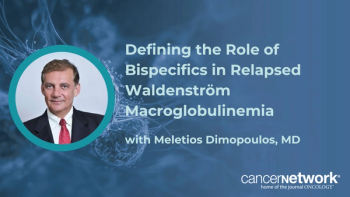
Meletios A. Dimopoulos, MD, discussed where bispecific antibodies such as teclistamab may fit for patients with relapsed Waldenström macroglobulinemia.
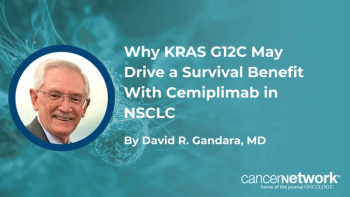
David R. Gandara, MD, explains what makes KRAS G12C biologically distinct from other KRAS subtypes in NSCLC immunotherapy response.

In this segment, Isabel Curtin, LCSW, emphasizes the importance of open communication between patients, families, and healthcare teams throughout the relapsed/refractory multiple myeloma journey.

COPERNICUS updates suggest subcutaneous amivantamab plus lasertinib fits real-world EGFR lung cancer care, with skin and clot prophylaxis.
New data show subcutaneous amivantamab plus lasertinib simplifies EGFR-mutant lung cancer care with proactive skin and clot prevention.
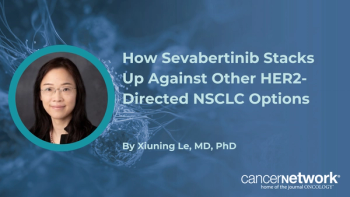
Xiuning Le, MD, PhD, weighs sevabertinib against zongertinib and trastuzumab deruxtecan in HER2-mutant non–small cell lung cancer.
In this segment, Isabel Curtin, LCSW, discusses how healthcare teams can reduce stigma and create a supportive environment where patients feel comfortable discussing sensitive concerns such as fatigue, bowel changes, body image, and emotional distress.

Xiuning Le, MD, PhD, explains how oncologists should approach HER2 biomarker testing following sevabertinib’s frontline approval in non–small cell lung cancer.

Estelamari Rodriguez, MD, MPH, of Sylvester Comprehensive Cancer Center walks through the mature overall survival data from the phase 3 MARIPOSA study of amivantamab plus lazertinib in epidermal growth factor receptor (EGFR)-mutated advanced non–small cell lung cancer (NSCLC).
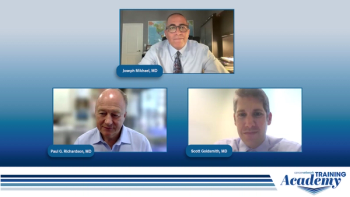
The second clinical scenario considers a 72-year-old patient with multiple myeloma who is triple-class exposed and has experienced disease progression after a BCMA-directed T-cell-engaging therapy.
The faculty synthesize the evidence into clinical positioning and outline the questions that remain open.
The discussion continues with the first clinical scenario involving lenalidomide-refractory multiple myeloma.
Estelamari Rodriguez, MD, MPH, of Sylvester Comprehensive Cancer Center opens this CancerNetwork Around the Practice discussion on first-line therapy for epidermal growth factor receptor (EGFR)-mutated advanced non–small cell lung cancer (NSCLC) with panelists Matthew Gumbleton, MD, PhD, of Huntsman Cancer Institute, and Siddhartha Devarakonda, MD, of Providence Swedish Cancer Institute.
Jasmine Zain, MD, described how preexisting CHIP mutations should inform preinfusion risk counseling and treatment selection.
Subcutaneous amivantamab is safer and more convenient for patients compared with the intravenous formulation, according to Misako Nagasaka, MD, PhD.
Mary Jo Lechowicz, MD, discussed how pre-transplant depth of response informs the choice between autologous and allogeneic HSCT in T-cell lymphoma.

Jasmine Zain, MD, described the molecular workup to determine whether a secondary malignancy after CAR T-cell therapy reflects direct insertional mutagenesis.
The panel explores treatment selection for patients with hormone receptor-positive, HER2-negative metastatic breast cancer (HR+/HER2− mBC) harboring both ESR1 and PI3K pathway alterations, emphasizing the need to individualize therapy according to disease biology, pace, symptoms, and treatment tolerability.
The panel shifts to treatment strategies for patients with hormone receptor-positive, HER2-negative metastatic breast cancer (HR+/HER2− mBC) who develop an ESR1 mutation after progression on an aromatase inhibitor plus CDK4/6 inhibitor.
Misako Nagasaka, MD, PhD, explains how subcutaneous amivantamab’s shorter administration time benefits patients and infusion centers.
Misako Nagasaka, MD, PhD, discusses PALOMA-2’s 70% 3-year survival rate compared with historical MARIPOSA data for intravenous amivantamab.
Adult T-cell lymphoma and leukemia may warrant up-front allogeneic transplant, according to Mary Jo Lechowicz, MD.
In this segment, Elizabeth Bohannon discusses practical strategies that helped her manage treatment-related challenges and maintain quality of life during her relapsed/refractory multiple myeloma journey.
In this segment, Isabel Curtin, LCSW, discusses how psychosocial support can help patients cope with treatment-related adverse effects that may not be visible to others but can still significantly affect emotional well-being, relationships, and daily life.

In the closing remarks, Dr. Shambavi Richard reflects on the key themes that emerged throughout the discussion on the evolving role of BCMA-directed therapies in relapsed/refractory multiple myeloma (R/R MM).
Amir T. Fathi, MD, explains which AML subgroups were excluded from PARADIGM and why chemotherapy remains standard for them.

Amir T. Fathi, MD, discusses how azacitidine/venetoclax’s lower toxicity and hospitalization burden should factor into treatment decisions.
Azacitidine/venetoclax improving EFS over chemotherapy in fit patients with AML is an “important outcome,” according to Amir T. Fathi, MD.