

Prolonging systemic therapy in patients with gastric or gastroesophageal junction cancers may offer better outcomes than radiation therapy.

Your AI-Trained Oncology Knowledge Connection!
Prolonging systemic therapy in patients with gastric or gastroesophageal junction cancers may offer better outcomes than radiation therapy.

James B. Yu, MD, MHS, FASTRO, believes that 2 of the most intriguing and growing areas of radiation oncology are reirradiation of the prostate and bladder chemoradiation.
Most adverse effects observed in combination therapies for gastric cancers are associated with chemotherapy, according to Yelena Y. Janjigian, MD.

“The idea is that the patients are informed of the long-term consequences [of the treatments] so they can have some [input in] decision making,” Clara Bodelon, PhD, MS, stated.

Christina Henson, MD, spoke about the impact negative trial results can have on advancing the head and neck cancer field forward.
Experts discuss future directions and key insights in treating large B-cell lymphoma (LBCL).
Experts discuss the PD-L1 combined positive score (CPS) and its influence on treatment decisions as well as the clinical significance of a high CPS in guiding the use of immune checkpoint inhibitors such as pembrolizumab in HER2-positive gastric cancer.
Experts discuss safety management and monitoring protocols for liso-cel in treating relapsed/refractory large B-cell lymphoma.
Experts provide a safety summary of the phase 3 TRANSFORM study, highlighting key safety findings for liso-cel in relapsed/refractory large B-cell lymphoma.
Experts discuss Megan’s journey with HER2-positive upper gastrointestinal (GI) cancer, highlighting key treatment strategies and challenges.
Select comorbidities, ECOG status, and the receipt of radiation were among the differences between a real-world cohort and the RUBY trial population.

Experts discuss how, nearly half of patients diagnoses with HER-2 positive metastatic brain cancer do develop brain metastasis. It is thought that larger molecule treatments such as the monoclonal antibodies likely do not cross an intact blood brain barrier which is often why patients develop brain metastases
“You have to come up with a novel twist in order to make an impactful study or get your own unique data set…” James B. Yu, MD, MHS, FASTRO, said in regard to creating interesting research.
Advances in perioperative targeted therapies may enable organ preservation and significantly enhance outcomes for patients with gastric cancers.
A lot of James B. Yu’s research begins with something as simple as a question from a patient regarding what aspects of treatment may be most beneficial.
Panelists discuss how next-generation sequencing is transforming precision oncology by enabling comprehensive genomic profiling that identifies actionable mutations, guides targeted therapy selection, and facilitates clinical trial enrollment while acknowledging challenges in data interpretation and implementation across diverse health care settings.
Panelists discuss how sequencing different therapies and personalizing care for their patients requires careful consideration of disease characteristics, prior treatment response, comorbidities, toxicity profiles, and patient preferences to optimize outcomes and quality of life.
Panelists discuss how recent clinical trials have shaped treatment algorithms for metastatic renal cell carcinoma (mRCC) by establishing the superiority of immunotherapy–tyrosine kinase inhibitor combinations over single-agent therapies across various risk groups.
Panelists discuss how immunotherapy–tyrosine kinase inhibitor (IO-TKI) combination regimens have revolutionized the treatment landscape for metastatic renal cell carcinoma (mRCC) by offering improved response rates, survival outcomes, and quality of life compared with traditional monotherapies.
Panelists discuss how multidisciplinary approaches involving surgical resection, active surveillance, and targeted therapies have evolved in managing localized renal cell carcinoma, with consideration of tumor size, patient comorbidities, and preservation of renal function guiding individualized treatment decisions.
Panelists discuss how recent data from the KEYNOTE-564 trial has changed their approaches to treating patients with renal cell carcinoma by implementing adjuvant pembrolizumab therapy for high-risk patients following nephrectomy, citing improved disease-free survival outcomes.
In radiation oncology, renal cancers are experiencing the greatest levels of change and growth, according to James B. Yu.

Panelists discuss key factors in chimeric antigen receptor T-cell (CAR T) sequencing for relapsed diffuse large B-cell lymphoma, including manufacturing success rates, production turnaround time, and real-world efficacy data. Treatment decisions weigh bridging therapy needs, patient fitness, and center-specific experience with different CAR T products and their reliability.
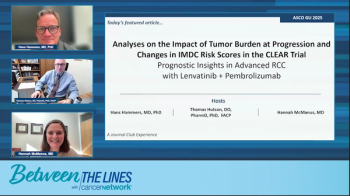
Experts discuss the clinical implications from CLEAR post hoc analyses, focusing on IMDC risk assessments and sequencing strategies.
Experts discuss optimizing renal cell carcinoma treatment strategies across the care continuum, from initial response to long-term outcomes.
Panelists discuss the comparison between clinical trial results and real-world outcomes for chimeric antigen receptor T-cell (CAR T) therapies like liso-cel and axi-cel. Clinical trials have shown promising efficacy and manageable safety profiles for both therapies in treating certain blood cancers. However, real-world evidence continues to emerge through ongoing clinical use and registry data collection.
Endocrine therapy as a treatment for breast cancer showed similar long-lasting physical health decline data as what was seen in women who did not have breast cancer.
“The better the systemic therapy, immunotherapy, or targeted therapy, the more important a non-invasive, local treatment will be,” James B. Yu stated.
Experts discuss clinical features and risk factors in navigating the decision between autologous stem cell transplant (ASCT) and chimeric antigen receptor T-cell (CAR T) therapy for patients with relapsed/refractory large B-cell lymphoma (R/R LBCL).