
The FDA approval of ropeginterferon alfa-2b may lead to longer and better outcomes in essential thrombocythemia, according to Ruben Mesa, MD, FACP.
The FDA approval of ropeginterferon alfa-2b may lead to longer and better outcomes in essential thrombocythemia, according to Ruben Mesa, MD, FACP.

Matthew Matasar, MD, weighed the optimism and uncertainty surrounding AI’s expanding role in cancer drug discovery and clinical practice.

Radiopharmaceutical therapy currently falls somewhere between localized treatment and systemic therapy, according to Mallika Marar, MD, MBA.

Panelists discuss overlapping toxicities and long-term needs in epidermal growth factor receptor (EGFR)-mutated non-small cell lung cancer (NSCLC), beginning with osimertinib consolidation after chemoradiation, where cough, dyspnea, fatigue, and esophagitis may predate targeted therapy.
Panelists discuss a case-based scenario involving a man in his seventies with an excellent, durable response to single-agent osimertinib for more than two years, managed in a community clinic, who has chronic low-grade dermatologic toxicity and fatigue, quietly skips doses when his rash flares, and says he is tired of taking pills.
Panelists discuss preparing the same patient for amivantamab plus lazertinib as an alternative to chemotherapy-containing first-line therapy in epidermal growth factor receptor (EGFR)-mutated advanced non-small cell lung cancer (NSCLC).
Panelists discuss a case-based scenario involving a woman in her late fifties with newly diagnosed epidermal growth factor receptor (EGFR) exon deletion metastatic lung adenocarcinoma, high disease burden, good performance status, and adequate organ function, whose team is intensifying beyond single-agent osimertinib.
Panelists discuss gastrointestinal management for patients receiving first-line therapy for epidermal growth factor receptor (EGFR)-mutated advanced non-small cell lung cancer (NSCLC).
Panelists discuss how grading drives treatment decisions across first-line regimens for epidermal growth factor receptor (EGFR)-mutated advanced non-small cell lung cancer (NSCLC).
Panelists discuss how nurse-driven telephone triage works for patients receiving first-line therapy for epidermal growth factor receptor (EGFR)-mutated advanced non-small cell lung cancer (NSCLC).
Panelists discuss how caregivers and families should be built into the education plan at the start of first-line therapy for epidermal growth factor receptor (EGFR)-mutated advanced non-small cell lung cancer (NSCLC).
Panelists discuss prophylactic versus reactive dermatologic management across first-line regimens for epidermal growth factor receptor (EGFR)-mutated advanced non-small cell lung cancer (NSCLC).

The faculty discuss the management of a patient with relapsed/refractory multiple myeloma (R/R MM) who has received four prior lines of therapy but faces significant logistical barriers to CAR-T treatment because of limited caregiver support and distance from a cellular therapy center.
The final FACE-OFF debate examines whether BCMA bispecific antibodies will retain a meaningful role in the management of relapsed/refractory multiple myeloma (R/R MM) as these therapies continue to move into earlier lines of treatment.

Rethinking dose fractions and managing subclinical renal and marrow toxicity represent ongoing challenges associated with the use of radiopharmaceutical therapy.
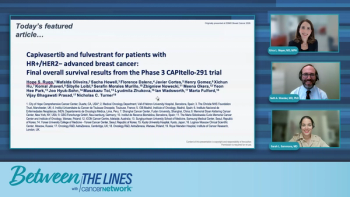
Erica L. Mayer, MD, MPH, of Dana-Farber Cancer Institute, closes with the competitive landscape around capivasertib plus fulvestrant in hormone receptor positive, human epidermal growth factor receptor 2 (HER2)-negative advanced breast cancer.
Erica L. Mayer, MD, MPH, of Dana-Farber Cancer Institute, reviews final safety data from CAPItello-291, the phase 3 trial of capivasertib plus fulvestrant in hormone receptor positive, human epidermal growth factor receptor 2 (HER2)-negative advanced breast cancer, reporting no new signals: diarrhea in nearly 80% of patients with about 10% grade 3 and no prophylactic antidiarrheal in the protocol, rash in about 40%, and all-grade hyperglycemia of 17% despite allowing hemoglobin A1c up to 8%.
Erica L. Mayer, MD, MPH, of Dana-Farber Cancer Institute, presents exploratory overall survival data from CAPItello-291 in patients with prior cyclin-dependent kinase (CDK) 4/6 inhibitor exposure, showing about a 7-month difference favoring capivasertib plus fulvestrant in the PIK3CA/AKT1/PTEN-altered population of this hormone receptor positive, human epidermal growth factor receptor 2 (HER2)-negative advanced breast cancer trial, without statistical significance.
Sarah L. Sammons, MD, of the University of Maryland Greenebaum Comprehensive Cancer Center, and Seth A. Wander, MD, PhD, of Massachusetts General Hospital, join Erica L. Mayer, MD, MPH, of Dana-Farber Cancer Institute, to debate how post-progression therapy shapes survival interpretation in hormone receptor positive, human epidermal growth factor receptor 2 (HER2)-negative advanced breast cancer.
Erica L. Mayer, MD, MPH, of Dana-Farber Cancer Institute, reviews final overall survival in the overall population of CAPItello-291, the phase 3 trial of capivasertib plus fulvestrant in hormone receptor positive, human epidermal growth factor receptor 2 (HER2)-negative advanced breast cancer.
Erica L. Mayer, MD, MPH, of Dana-Farber Cancer Institute, presents the key secondary endpoint of overall survival in the PIK3CA/AKT1/PTEN-altered population of CAPItello-291, the phase 3 trial of capivasertib plus fulvestrant in hormone receptor positive, human epidermal growth factor receptor 2 (HER2)-negative advanced breast cancer.
Erica L. Mayer, MD, MPH, of Dana-Farber Cancer Institute, explains the statistical framework behind the final overall survival analysis of CAPItello-291, the phase 3 trial of capivasertib plus fulvestrant in hormone receptor positive, human epidermal growth factor receptor 2 (HER2)-negative advanced breast cancer.
Erica L. Mayer, MD, MPH, of Dana-Farber Cancer Institute, recaps the primary analysis of CAPItello-291 in hormone receptor positive, human epidermal growth factor receptor 2 (HER2)-negative advanced breast cancer, in which capivasertib plus fulvestrant improved progression-free survival from 3.1 to 7.3 months (hazard ratio, 0.50) in the PIK3CA/AKT1/PTEN-altered population and from 3.6 to 7.2 months (hazard ratio, 0.60) overall, with benefit regardless of ESR1 alteration or prior cyclin-dependent kinase (CDK) 4/6 inhibitor exposure, findings that supported the original approval.
Erica L. Mayer, MD, MPH, of Dana-Farber Cancer Institute, reviews the design of CAPItello-291, a phase 3, double-blind, placebo-controlled trial in hormone receptor positive, human epidermal growth factor receptor 2 (HER2)-negative advanced breast cancer after endocrine progression, allowing up to 2 prior endocrine lines and 1 prior chemotherapy, requiring a majority of patients to have received a prior cyclin-dependent kinase (CDK) 4/6 inhibitor, permitting hemoglobin A1c up to 8%, and enrolling without biomarker selection.

Matthew Matasar, MD, discussed an AI-embedded deterioration index study, Epic’s patient-facing chatbot, and how AI is already absorbing routine documentation work.

Matteo S. Carlino, MD, PhD, FRACP, discussed immune-related adverse event rates with V940 added to pembrolizumab.

In this segment, Elizabeth Bohannon reflects on the challenges of living with relapsed/refractory multiple myeloma over the long term and emphasizes the importance of finding a supportive community.
In this segment, Isabel Curtin, LCSW, discusses how social workers and the broader multidisciplinary care team can help patients and families navigate uncertainty and complex treatment decisions in relapsed/refractory multiple myeloma.

Learn how liquid and tissue biopsies uncover ESR1 and PI3K mutations to personalize metastatic breast cancer second-line therapy choices.
Learn how biomarker testing guides second-line choices after CDK4/6 therapy in HR+ HER2- metastatic breast cancer, including PI3K/AKT/mTOR options.