
This episode takes up the practical mechanics of molecular testing in community oncology, beginning with turnaround time.
This episode takes up the practical mechanics of molecular testing in community oncology, beginning with turnaround time.
This episode opens with a distinction that matters more in lung cancer than many oncologists expect.
Matthew Matasar, MD, outlined his wish list for AI in oncology, and detailed AI-bolstered tools already active across his 14-hospital health system.
Matteo S. Carlino, MD, PhD, FRACP, reviewed efficacy data for V940 plus pembrolizumab in resected melanoma.
Panelists discuss how patient education should be timed and reinforced across first-line regimens for epidermal growth factor receptor (EGFR)-mutated advanced non-small cell lung cancer (NSCLC).
Panelists discuss the baseline workup nurses and advanced practice providers should complete before the first dose of first-line therapy for epidermal growth factor receptor (EGFR)-mutated advanced non-small cell lung cancer (NSCLC).
The panel reviews the KEYNOTE-966 long-term follow-up data.
Matthew Matasar, MD, explained why AI-assisted digital pathology may meaningfully improve diagnostic precision in hematologic malignancies.
Matthew Matasar, MD, provided practical advice for oncologists who want to start testing generative AI and RAG tools in their own practice.
Matteo S. Carlino, MD, PhD, FRACP, explains how the individualized neoantigen therapy V940 is designed and delivered in melanoma.
Matthew Matasar, MD, detailed how retrieval-augmented generation tools are already informing real tumor board decisions in hematologic malignancies.
The faculty discuss how to individualize the choice between chimeric antigen receptor (CAR) T-cell therapy and bispecific antibodies in relapsed multiple myeloma.
This opening segment introduces a discussion on ciltacabtagene autoleucel (cilta-cel) in multiple myeloma and frames the questions the program sets out to answer: how chimeric antigen receptor (CAR) T-cell therapy should be sequenced among the available options, and how care can be coordinated across a network spread between referring practices and treating centers.
Dr. Mikhael begins the scientific foundation by asking Dr. Richardson to define CELMoDs and explain how they engage the cereblon E3 ubiquitin ligase complex to promote targeted degradation of Ikaros and Aiolos, key transcription factors involved in myeloma-cell biology.
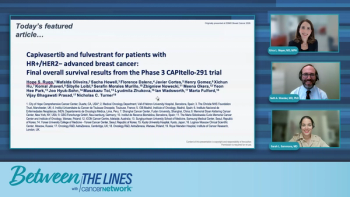
Erica L. Mayer, MD, MPH, of Dana-Farber Cancer Institute, reviews the rationale for capivasertib in hormone receptor positive, human epidermal growth factor receptor 2 (HER2)-negative advanced breast cancer, noting phosphatidylinositol 3-kinase (PI3K)/AKT pathway alterations in nearly half of patients, activation through PIK3CA or AKT alterations or PTEN loss, and guideline recommendations for capivasertib plus fulvestrant in altered disease after endocrine progression.
Experts unpack CAPITELLO‑291 survival data, guiding post‑CDK4/6 treatment choices with capivasertib, biomarkers, and evolving targeted options.
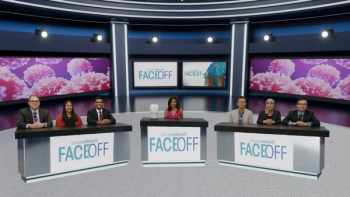
In the first clinical scenario of this Cancer Network Face Off on advanced hepatocellular carcinoma (HCC), Team Deep-Dish Pizza manages a 67-year-old woman with hepatitis B cirrhosis and BCLC stage C disease, multifocal bilobar tumors with branch portal vein invasion (Vp3), Child-Pugh A6, ALBI grade 2, and an elevated alpha-fetoprotein level.
Dr. Joseph Mikhael welcomes the audience to the Cancer Network Training Academy program and introduces Dr. Paul Richardson and Dr. Scott Goldsmith, who bring clinical and research expertise in multiple myeloma.
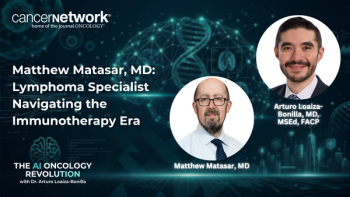
Matthew Matasar, MD, discussed his role leading the division of blood disorders at Rutgers Cancer Institute amid a transformative era in immunotherapy.
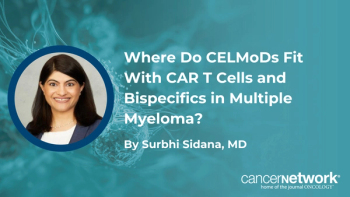
Surbhi Sidana, MD, discusses how CELMoDs like iberdomide could complement CAR T and bispecific antibody therapies.
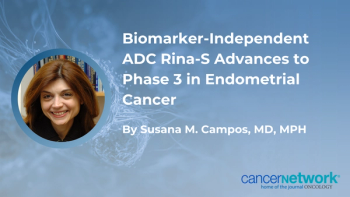
The FRα-directed ADC rinatabart sesutecan showed disease control regardless of biomarker status and is now under investigation in the phase 3 RAINFOL-03 trial.
Ayal Aizer, MD, MHS, describes an adaptive planning trial using synthetic CT to improve same-day treatment accuracy for anatomically unstable brain metastases.
The availability of iberdomide as an easy-to-give, orally available drug “is tremendous” for patients with multiple myeloma, according to Surbhi Sidana, MD.
The second FACE-OFF debate explores whether currently available BCMA bispecific antibodies should be considered a therapeutic class or whether meaningful clinical differences exist among individual agents used to treat relapsed/refractory multiple myeloma (R/R MM).
The program transitions to the first FACE-OFF debate, where the faculty discuss whether CAR-T cell therapy or BCMA bispecific antibodies should be prioritized as BCMA-directed therapies move into earlier lines of treatment for relapsed/refractory multiple myeloma (R/R MM).
Lizza Hendriks, MD, PhD, discussed why every patient with CNS metastases deserves a multidisciplinary team discussion.
Starting lenvatinib at 14 mg instead of the trial’s 20-mg dose helps patients remain on therapy, according to Susana Campos, MD, MPH.

In this segment, Elizabeth reflects on the period following her stem cell transplant, when she was able to maintain an active lifestyle for a time before her disease progressed again.

Ayal Aizer, MD, MHS, discusses radiation necrosis as the next major challenge in stereotactic radiosurgery for brain metastases and how clinicians can address it.
In this segment, Elizabeth Bohannon reflects on how her treatment goals and outlook evolved as she progressed through different stages of relapsed/refractory multiple myeloma.