

Dr. Joshua Richter reviews the EXCALIBER-RRMM study evaluating iberdomide in combination with daratumumab and dexamethasone in patients with relapsed/refractory multiple myeloma.
Dr. Joshua Richter reviews the EXCALIBER-RRMM study evaluating iberdomide in combination with daratumumab and dexamethasone in patients with relapsed/refractory multiple myeloma.

The faculty consider what level of follow-up they consider meaningful for a one-time therapy, pointing to the International Myeloma Working Group consensus benchmark of sustained minimal residual disease (MRD) negativity with imaging negativity.
Cancer Network’s FACE-OFF introduces the evolving role of cereblon E3 ligase modulators, or CELMoDs, in relapsed/refractory multiple myeloma.
The program opens with panelist introductions and an overview of ciltacabtagene autoleucel (ciltacel), a BCMA-directed autologous CAR T-cell therapy given as a single infusion and approved for adults with relapsed or refractory multiple myeloma who have received at least 1 prior line of therapy, including a proteasome inhibitor and an immunomodulatory agent, and are refractory to lenalidomide.
Dr. Thomas Martin presents the final and most challenging case: an older patient being evaluated for BCMA-directed therapy after progression on prior anti-CD38 therapy, with baseline neuropathy, mild gait instability, recurrent infections, and significant caregiver concern about neurologic toxicity, infection, and logistics.
Dr. Thomas Martin presents the second case: a younger, fit, lenalidomide-refractory patient with biochemical and radiologic progression after frontline therapy who is relatively asymptomatic with controlled disease burden and is an appropriate candidate for either CAR T-cell or bispecific therapy, with no urgency to treat.
Dr. Thomas Martin introduces the third section, a rapid case-based discussion applying the program's themes to real-world scenarios, and presents the first case: a fit, transplant-exposed patient progressing on lenalidomide maintenance with rapidly progressive, symptomatic, high-risk disease requiring prompt intervention.
The face-off debate continues with the second and third questions, moderated by Dr. Thomas Martin.
Dr. Thomas Martin opens the second section, the face-off debate, and introduces the first debate question on how clinicians should approach treatment selection between CAR T-cell therapy and bispecific antibody-based approaches in second-line disease.
Team Myeloma Mavericks presents the sixth abstract review, a real-world and safety-focused discussion of BCMA-directed therapies in earlier-relapse disease, closing out the data-and-landscape section.
Team Myeloma Mavericks presents the fifth abstract review, the updated long-term analysis of CARTITUDE-4 evaluating ciltacabtagene autoleucel against standard triplet therapy in earlier-relapse disease, framed by the durable remissions and cure signal seen in longer-term CARTITUDE-1 follow-up.
Dr. Thomas Martin introduces the fourth abstract review, and Team Myeloma Masters presents MajesTEC-9, the phase 3 study of teclistamab monotherapy versus investigator's choice of standard, non-CD38-containing regimens in patients who are both lenalidomide- and anti-CD38-refractory after prior lines of therapy.
Dr. Thomas Martin transitions the panel to the third abstract review, and Team Myeloma Masters presents real-world treatment patterns and outcomes in lenalidomide-refractory relapsed/refractory multiple myeloma drawn from the Flatiron registry.
Segment opens with the closing moments of the CAR T-cell therapy quality-of-life argument before Dr. Thomas Martin transitions to the second abstract review.

In this segment, Isabel Curtin, LCSW, discusses how patient communities and support organizations can complement clinical care by providing education, connecting patients and caregivers with others who have similar experiences, and helping normalize the challenges of living with relapsed/refractory multiple myeloma.
Wade T. Iams, MD, of Tennessee Oncology, walks through the design of COPERNICUS, a single-arm US study of subcutaneous amivantamab plus lazertinib in patients with exon 19 deletion or L858R epidermal growth factor receptor mutations.

DREAMM-7 reveals belantamab combo extends myeloma PFS, with reversible eye effects, REMS monitoring, and fewer severe infections.

Experts explain who benefits from menin inhibitors in AML, which tests to order at relapse, and how to choose revumenib vs ziftomenib.
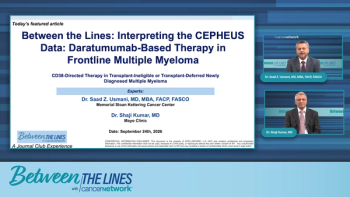
Dr. Saad Usmani and Dr. Shaji Kumar discuss how treatment goals and measures of clinical benefit have evolved in newly diagnosed multiple myeloma.
Experts explain how menin inhibitors target KMT2A and NPM1 AML, why retesting matters, and how to choose approved drugs or trials.
Dr. Saad Usmani and Dr. Shaji Kumar introduce the evolving treatment landscape for newly diagnosed multiple myeloma, focusing on the increasing role of CD38-directed therapy in frontline treatment.
In this segment, Isabel Curtin, LCSW, discusses the psychosocial, financial, and practical challenges that can accompany living with relapsed/refractory multiple myeloma, including repeatedly updating family and friends about treatment, managing work and financial responsibilities, and accessing community resources and support groups.
Wade T. Iams, MD, of Tennessee Oncology, and Luis E. Raez, MD, of Miami Cancer Institute, discuss anticoagulation after the 4-month window and what happens when patients stop skin prophylaxis early on amivantamab plus lazertinib.

Chih-Yi “Andy” Liao, MD, discusses how oncologists are sequencing pemigatinib, futibatinib, and lirafugratinib and how their tolerability differs.
Experts explain who benefits from belantamab in relapsed myeloma and how REMS eye exams and dose tweaks keep treatment on track.
Chih-Yi “Andy” Liao, MD, discusses the FDA approval of lirafugratinib and what the field has learned about resistance to FGFR2 inhibitors.
Ayal Aizer, MD, MHS, discusses patients for whom single-fraction SRS may remain reasonable after brain metastasis resection.
C. Ola Landgren, MD, PhD, discusses the FDA’s endorsement of MRD as an accelerated approval end point in multiple myeloma.
The faculty describe the approval of belantamab mafodotin with bortezomib and dexamethasone for patients who have had at least 2 prior lines of treatment including a proteasome inhibitor (PI) and an immunomodulatory drug (IMiD), noting the boxed warning for ocular adverse effects.
Ethan B. Ludmir, MD, explains why advanced radiation techniques like protons fit nonoperative cholangiocarcinoma better than the preoperative setting.