
CancerNetwork® sat down with Andrew Cook, MD, at the 2021 American Society for Radiation Oncology to discuss the potential role of gabapentin in head and neck cancer despite garnering negative results in oropharynx cancer.
CancerNetwork® sat down with Andrew Cook, MD, at the 2021 American Society for Radiation Oncology to discuss the potential role of gabapentin in head and neck cancer despite garnering negative results in oropharynx cancer.
Dr Morgans examines systemic treatment options for patients with metastatic castration-resistant prostate cancer.
An expert considers the role of BRCA1/2 mutations in metastatic prostate cancer.
Drs Lyudmila Bazhenova and Federico Albrecht comment on the pros and cons of real-world evidence to guide treatment decisions for patients with EGFR-mutant non–small cell lung cancer.
CancerNetwork® sat down with Andrew Cook, MD, at the 2021 American Society for Radiation Oncology to discuss outcomes with gabapentin compared with opioids for increasing quality of life and decreasing treatment-related pain in oropharyngeal cancer.
CancerNetwork® sat down with Andrew Cook, MD, at the 2021 American Society for Radiation Oncology to talk about using prophylactic gabapentin for those receiving chemoradiotherapy for oropharyngeal cancer.
John Kirkwood, MD, PhD, gives his opinion on duration of treatment for patients with melanoma.
Dr John Kirkwood explores the idea of taking drug holidays during melanoma treatment and whether it is helpful or harmful.
Brian Rini, MD, discussed abstracts presented during the 2021 ESMO Congress that will have an immediate impact on prostate cancer.
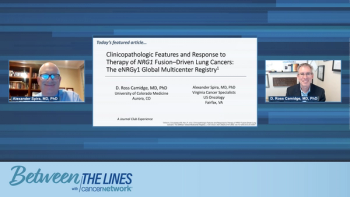
Experts Alexander Spira, MD, PhD, FACP, and D. Ross Camidge, MD, PhD, highlight the importance of global registries before sharing their closing thoughts on NRG1 fusions and the future treatment landscape of lung cancer.
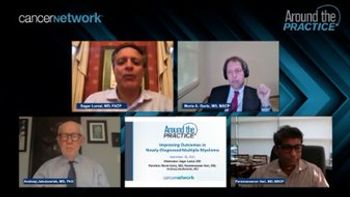
Shared insight on the evolving treatment landscape of transplant-ineligible newly diagnosed multiple myeloma.
Experts hold a discussion regarding the timing and onset of acute graft-vs-host disease and chronic graft-vs-host disease following allogeneic transplantation, and prophylactic strategies used to help protect patients.
Experts discuss differences between the clinical manifestations and symptoms of acute and chronic graft-vs-host disease.
Following presentation of a paper by Loupakis F, et al., Drs Liliana Bustamante and Richard Kim raise questions pertaining to the use of ctDNA as a biomarker when managing patients with metastatic colorectal cancer undergoing resection.
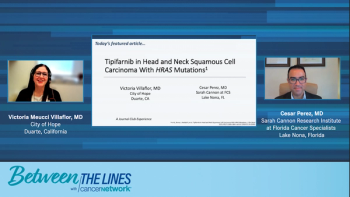
The significance of studying strategies that target HRAS mutations in head and neck squamous cell carcinoma.
Scott Tagawa, MD, spoke about the implications of the results from his research on treatment patterns of patients with metastatic castration-sensitive prostate cancer, as well as the need for further studies with other data sets.
Dr Morgans discusses biomarker testing protocols and signs to look for during testing.
Alicia Morgans, MD, MPH, explains the different testing that should be done when being diagnosed with metastatic prostate cancer.
Federico Albrecht, MD, reacts to limitations regarding the designs and outcomes of randomized controlled trials in EGFR-mutant non–small cell lung cancer and describes his interest in collecting real-world data.
A clinical pharmacy manager and a pharmacy resident detail the unique mechanism of action of tepotinib for metastatic non–small cell lung cancer with mutations in MET exon 14.
An expert in melanoma cancer treatment examines monitoring patients with melanoma using ctDNA.
Dr John Kirkwood discusses ctDNA as a new treatment option for patients with melanoma.
Roy S. Herbst, MD, PhD, shares insight on approaching clinical decision-making for the length of immunotherapy treatment and drug holidays for patients with NSCLC.
An expert in thoracic oncology provides an overview of ctDNA and discusses what ctDNA testing results can indicate about a patient’s likelihood of responding to immunotherapy in NSCLC.
CancerNetwork® sat down with Lyudmilia Bazhenova, MD, at the 2021 World Conference on Lung Cancer to discuss differences in outcomes with immunotherapy agents in patients with wild-type and EGFR exon 20 insertion–positive non–small cell lung cancer.
CancerNetwork® sat down with Luciano Costa, MD, PhD, at the 2021 International Myeloma Workshop to highlight key lessons that COVID-19 pandemic taught him.
CancerNetwork® sat down with Lyudmilia Bazhenova, MD, at the 2021 World Conference on Lung Cancer to talk about the feasibility of immunotherapy trials in wild-type and EGFR exon 20 insertion non–small cell lung cancer.
After reviewing the case of a patient with transplant-eligible newly-diagnosed multiple myeloma, experts consider optimal selection of first-line treatment.
Practical considerations regarding the role of NRG1 fusions in lung cancer management and how that has been informed by the eNRGy1 global registry study.
A specialist describes the advances being made in metastatic prostate cancer and provides some clinical pearls for community oncologists.