

Closing the discussion on advanced endometrial carcinoma, Dr David O’Malley shares his perspective on the future treatment landscape.
Closing the discussion on advanced endometrial carcinoma, Dr David O’Malley shares his perspective on the future treatment landscape.
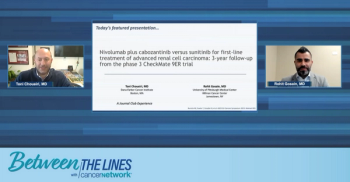
Drs Choueiri and Gosain review study design, patient demographics, and clinical characteristics from the CheckMate 9ER trial, including prior nephrectomy and PD-L1 status.
Toni Choueiri, MD, and Rohit Gosain, MD share their clinical experience treating patients with clear cell renal cell carcinoma (ccRCC) and provide a short summary of previously reported data from the CheckMate 9ER trial.
Lung cancer experts discuss how these real-world data comparing amivantamab with alternative therapies may impact their clinical practice.

Experts on HER2+ metastatic colorectal cancer review the MOUNTAINEER study on tucatinib plus trastuzumab.
An overview of the treatment landscape for HER2+ metastatic colorectal cancer and recent updates to the NCCN Guidelines.
Joshua K. Sabari, MD, and Helena A. Yu, MD, discuss real-world data comparing amivantamab with other therapies in EGFR exon 20–mutated non–small cell lung cancer.

According to an expert from University Hospitals, studying pathways related to inflammation, epigenetics, and the microbiome may elucidate how patients with kidney cancer respond to anti-cancer therapy.
The impact of the gut microbiome, and antibiotics and probiotics on immunotherapy outcomes are areas of research currently under investigation for patients with kidney cancer and other cancers, according to an expert from University Hospitals.
Panelists reflect on molecular markers and other clinical factors that aid in the selection of best therapy for a patient with metastatic hormone-sensitive prostate cancer.
Key opinion leaders in the field of prostate cancer management consider optimal molecular testing practices in a patient with metastatic hormone-sensitive disease.
Patients who use a recovery tracker tool appear to experience lower hospital readmission rates following gynecologic cancer debulking surgery compared with those who did not.
Expert oncologists give an overview of the BRUIN trial and discuss pirtobrutinib as a treatment for patients with mantle cell lymphoma.
Andre H. Goy, MD, and Andrew Ip, MD, discuss the ways in which treatment paradigms for mantle cell lymphoma (MCL) have recently shifted.

Key opinion leaders in the field of multiple myeloma review clinical data behind BCMA-targeting bispecific antibody elranatamab, followed by other T-cell engagers in the pipeline.
Opening its discussion on BCMA-targeting bispecific antibodies in multiple myeloma, a panel of expert oncologists highlights key clinical data behind teclistamab.
Medical oncologists and gynecologic oncologists alike have a shared responsibility to help treat symptoms of neuropathy in patients undergoing chemotherapy for gynecologic cancer, according to an expert from Duke University Medical Center.
David O’Malley, MD, an expert on advanced endometrial carcinoma, shares additional highlights presented at SGO 2023.
David O’Malley, MD, details patient tolerance and associated adverse events with lenvatinib plus pembrolizumab for advanced endometrial carcinoma.
Expert oncologists discuss the landscape surrounding HER2+ metastatic CRC, including recommendations for biomarker testing and an overview of scoring criteria.
A comprehensive overview of the methods utilized in a real-world analysis of amivantamab vs other therapies in patients with EGFR exon 20–mutated NSCLC.
Expert oncologists review the CHRYSALIS trial, which resulted in the approval of amivantamab in the second line for patients with locally advanced or metastatic NSCLC with exon 20 mutations.
A panel of expert oncologists present the case of a 46-year-old woman with HER2+ metastatic colorectal cancer, who is treated with tucatinib in the second-line setting.
Future research assessing cryocompression for those with gynecologic cancers will make use of different products to make the intervention easier and more accessible for patients.
An expert from University Hospitals touches on pain management guidelines that highlight moderate evidence in support of acupuncture, reflexology, and acupressure and massage as tools to manage general pain in patients with cancer.
Cryocompression demonstrates potential for preventing chemotherapy-induced neuropathy for those with gynecologic cancers, according to an expert from Duke University Medical Center.

Closing out their discussion on the management of metastatic renal cell carcinoma, panelists highlight the value of collaborative care in improving patient outcomes.
Investigators report that most patients with gynecologic cancers were able to tolerate cryocompression to help manage chemotherapy-induced neuropathy, according to an expert from Duke University Medical Center.

Polatuzumab vedotin-piiq plus R-CHP can reduce the need for any subsequent lines of therapy for patients with diffuse large B-cell lymphoma, according to an expert from The University of Texas MD Anderson Cancer Center.

An expert from Dana-Farber Cancer Institute describes which patients hormone receptor-positive, HER2-negative breast cancer will benefit most from treatment with sacituzumab govitecan.