
A prostate cancer expert discusses promising and emerging treatments for prostate cancer.
A prostate cancer expert discusses promising and emerging treatments for prostate cancer.
Dr Choudhury shares recent updates from 2021 meetings including ASCO GU, AUA, and ESMO.
Lori Wirth, MD, defines radioiodine-refractory differentiated thyroid cancer and discusses frontline treatment options for patients with the disease.
Hannah Choe, MD, guides the panel in a conversation on the protective effects of acute and chronic GVHD including the potential impact on leukemic relapse.
A panel of key opinion leaders in stem cell transplant and cellular immunotherapy reviews the hallmark signs and symptoms of acute GVHD.
At the 15th Annual Interdisciplinary Prostate Cancer Congress® and Other Genitourinary Malignancies, Peter Humphrey, MD, PhD, spoke about how the conference catered to the multidisciplinary audience, and what he learned from that.
Anjali Y. Hari, MD, speaks to the rationale for examining hyperthermic intraperitoneal chemotherapy in a population of frail and non-frail patients with ovarian cancer.
Expert perspectives on the use of LHRH agonists versus antagonists in the management of prostate cancer.
A comprehensive overview on androgen-deprivation therapy in prostate cancer and the various therapeutic agents it consists of.
In a discussion with CancerNetwork®, Ursula A. Matulonis, MD, describes the potential of mirvetuximab soravtansine (IMGN853) as a treatment for patients with folate receptor α (FRα)–high platinum-resistant ovarian cancer.
Ira Winer, MD, PhD, FACOG, spoke about patients with pretreated platinum-resistant ovarian cancer treated with nemvaleukin alfa plus pembrolizumab in the phase 1/2 ARTISTRY-1 trial.
Anjali Hari, MD, discusses survival and safety outcomes with hyperthermic intraperitoneal chemotherapy in frail and non-frail patients with ovarian cancer.
A review of the available first-line treatment options for transplant-ineligible multiple myeloma, as well as the design and findings of the MAIA study.
Experts explain how to determine treatment duration and a successful response to induction therapy for transplant-eligible multiple myeloma.
A look at the factors considered in choosing an appropriate combination treatment for advanced renal cell carcinoma.
Drs Rana McKay and Tom Powles debate the merits of different first-line combination treatment regimens for renal cell carcinoma.
Prostate cancer experts share exciting changes to the prostate cancer treatment landscape and how we are now better equipped to take care of patients with prostate cancer.
A prostate cancer expert reemphasizes importance of open communication between patients and healthcare providers.
A brief discussion on available treatment options after patients progress following frontline TKI/IO therapy with favorable-risk renal cell carcinoma.
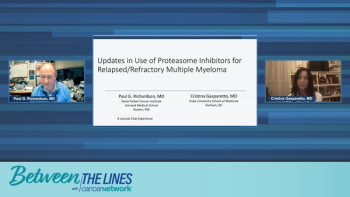
Insight on the ASH 2021 update highlighting response rates and discontinuation in patients who received in-class transition from bortezomib to ixazomib for multiple myeloma.
A comprehensive review of the adverse event profiles of TKI/IO regimens used in favorable-risk renal cell carcinoma and how these can be managed with dose adjustment.
Reflections on the patient-reported adherence and outcome data with IRd (ixazomib, lenalidomide, dexamethasone) therapy after an in-class transition from bortezomib to ixazomib for patients with multiple myeloma.
Sam Klempner, MD, spoke about utilizing ctDNA the treat nonmetastatic gastroesophageal cancers at 2022 IGCC.
Ursula A. Matulonis, MD, highlights the rationale behind studying mirvetuximab soravtansine (IMGN853) as a therapy for patients with folate receptor α (FRα)–high platinum-resistant ovarian cancer.
Cara Mathews, MD, spoke with CancerNetwork® about research examining dostarlimab vs doxorubicin for patients with mismatch repair–deficient endometrial cancers.
Marina Frimer, MD, spoke about the goals of a phase 2 trial and how it can impact patients with platinum-sensitive recurrent uterine serous carcinoma.
Thomas Hutson, DO, PharmD, and Scott Tykodi, MD, PhD, discuss their takeaways from the CLEAR trial and how risk category stratification affected the study.
Brian Shimkus, MD, shares his opinion of data on lenvatinib and pembrolizumab from the CLEAR trial.
Oncologists debate whether TKI monotherapy has a place in renal cell carcinoma treatment after the CLEAR trial.
A multidisciplinary panel of health care professionals and a patient advocate comment on their excitement about novel therapies in the pipeline for HER2-positive metastatic breast cancer.