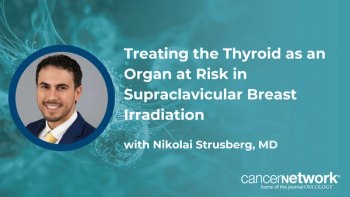
Nikolai Strusberg, MD, discussed other toxicities of proton vs photon breast RT, practice implications, and next steps in capsular contracture research.
Although older patients saw a greater rate of AE-related discontinuations, survival outcomes were similar between groups.
According to Antonio Ocejo, MD, patients with renal cell carcinoma (RCC) 70 years or older may derive similar overall survival (OS) benefit compared to those younger than 70 years when treated with nivolumab (Opdivo) plus ipilimumab (Yervoy) for the treatment of metastatic disease.
In a conversation with CancerNetwork® at the
Regarding tolerability, he explained that older patients generally experienced worse outcomes. A greater proportion of those 70 years or older did not complete 4 induction doses (P = .04) and experienced adverse effect (AE)–related discontinuations of study treatment (P = .001). However, Ocejo explained that the overall time on treatment was similar between groups.
Regarding key survival outcomes, a nonsignificant difference in OS was observed at 5.0 years for the older group vs 4.2 years in the younger group (P = .85). Finally, Ocejo suggested that despite the lower-dose completion rates, the combination is supported for use in this older metastatic ccRCC population based on its comparable efficacy.
Transcript:
We know that nivolumab/ipilimumab is one of the first-line treatment options that we have for metastatic clear cell RCC. What we know too is that the elderly patients are underrepresented in immunotherapy clinical trials, and there are a lot of things that we take into consideration that may affect the efficacy and tolerance of that regimen in the elderly—for example, comorbidities, polypharmacy, immunosenescence, [which is] how their immune system ages as we grow older.
There’s been mixed evidence—all retrospective cohort studies in small sample sizes, mostly from Europe and from Asia—that it appears to be the same efficacy comparing elderly and younger patients. There are some conflicting data in terms of clinical outcomes, OS, and time on treatment. What we wanted to do with this study, given that we have a large—the largest—cohort of patients with ccRCC…[is] we combined patients from MD Anderson Cancer Center and the Memorial Sloan Kettering [Cancer Center]. What we wanted to look at is the clinical efficacy and the treatment tolerance of ipilimumab/nivolumab in the elderly patients compared [with] the younger patients.
Out of the 500 patients, we had [19%] of patients who were 70 years or older. Only 1% or 2% were 80 years or older. The median age was 62 years. We stratified the population in the cutoff that we used, [which was] 70 years. We looked at an analysis comparison between the younger and the elderly group.
What we found is that the rates of induction completion, so the patients who were able to get all 4 induction doses of ipilimumab/nivolumab combined, were significantly [lower] in the elderly patients. When we looked at tolerability, we saw that there were more treatment discontinuation rates in the elderly patients compared [with] the younger patients. The elderly patients discontinued the treatment more because of AEs in a statistically significant way vs the younger patients, who tended to discontinue the treatment because of progression.
That leads me into the clinical outcomes, because even though we saw those differences, when we looked at OS, that was comparable across the 2 groups. That was particularly interesting. Also, the time on treatment was similar as well, even though the treatment tolerance and the discontinuation rates were different in the younger vs the older patients.
Ocejo A, Dizman N, Doshi SD, et al. Clinical outcomes and tolerability of ipilimumab/nivolumab in older (≥70 years) versus younger patients with metastatic clear cell RCC: a multi-institutional analysis of 514 patients. J Clin Oncol. 2026;44(suppl 7):444. doi:10.1200/JCO.2026.44.7_suppl.444