
Opinion|Videos|October 6, 2026
Discussing a ctDNA-Guided Treatment Switch With Patients
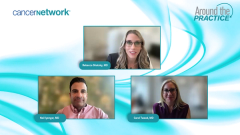
Rebecca Shatsky, MD, describes telling a patient with a clean scan but a new ESR1 mutation on ctDNA that treatment needs to change, saying she sets that expectation from the start of testing rather than presenting it as a surprise.
Advertisement
Episodes in this series
Rebecca Shatsky, MD, describes telling a patient with a clean scan but a new ESR1 mutation on ctDNA that treatment needs to change, saying she sets that expectation from the start of testing rather than presenting it as a surprise. She has not adopted routine testing on a fixed schedule and instead personalizes frequency based on tumor markers. Carol Tweed, MD, says she cannot identify a patient for whom she would not apply the SERENA-6 strategy once available, describing a patient who could not bear weight due to a femur lesion as the kind of clinical disaster earlier action could prevent. Dr. Shatsky adds a cost perspective from a recent debate, estimating the strategy could cost the United States health care system $75 million to $350 million depending on testing frequency, supporting a personalized monitoring interval over routine testing every 2 months for every patient.
Advertisement
Related to this article
Adding fixed-duration epcoritamab to R-CHOP reduced the risk of progression or death by 51% in patients with newly diagnosed DLBCL.

Chirag Jain, MBBS, discussed onco-anxiology, a proposed framework for identifying and managing anxiety at each stage of the cancer journey.
Natalie S. Callander, MD, discussed the rationale for combining selinexor, carfilzomib, subcutaneous isatuximab, and dexamethasone in relapsed/refractory myeloma.
Melody Rasouli, MD, MBA, FACOG, explained why male fertility preservation information trails female content online and how cancer centers can fix it.

Zachary L. Bercu, MD, RPVI, FSIR, explains how the Liberty endovascular robotic system works from the operator’s perspective and what went into becoming its first adopting site.
Dan Costin, MD, explains the rationale for testing a personalized mRNA vaccine after resection of high-risk stage I NSCLC.
Paul Rubinstein, MD, discussed how cooperative groups are expanding CAR T and bispecific antibody research for patients with HIV-associated lymphoma.

Data from RAINFOL-01 showed rinatabart sesutecan achieved responses in heavily pretreated platinum-resistant ovarian cancer with low or no FRα expression.
Advertisement
Advertisement
Trending on CancerNetwork
1
Expanding CAR T and Bispecific Antibody Research in HIV-Associated Lymphoma
2
Why High-Risk Stage I NSCLC Needs a Post-Surgical Vaccine Option
3
Rinatabart Sesutecan Elicits Responses in PROC Regardless of FRα Expression
4
NDA Submission Begins for Zipalertinib Combo in First-Line EGFR+ NSCLC
5