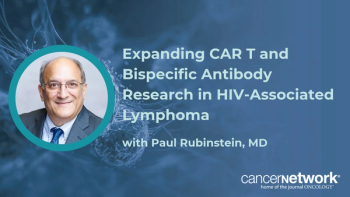
Paul Rubinstein, MD, discussed how cooperative groups are expanding CAR T and bispecific antibody research for patients with HIV-associated lymphoma.
Adding fixed-duration epcoritamab to R-CHOP reduced the risk of progression or death by 51% in patients with newly diagnosed DLBCL.
Adding fixed-duration epcoritamab-bysp (Epkinly) to standard rituximab (Rituxan), cyclophosphamide, doxorubicin, vincristine, and prednisone (R-CHOP) significantly improved progression-free survival (PFS) vs R-CHOP alone in patients with newly diagnosed diffuse large B-cell lymphoma (DLBCL) in the phase 3 EPCORE DLBCL-2 trial (NCT05578976), according to a news release from AbbVie and Genmab.¹
In the trial, the primary end point was PFS among patients with an IPI score of 3 to 5. In this population, epcoritamab plus R-CHOP reduced the risk of progression or death by 51% vs R-CHOP alone (HR, 0.49; 95% CI, 0.35-0.69; P <.0001). Results were consistent for the key secondary end point of PFS in all patients with an IPI score of 2 to 5 (HR, 0.49; 95% CI, 0.36-0.67; P <.0001).
The findings came from the first planned interim efficacy analysis. After that analysis, an independent data monitoring committee recommended unblinding the study. The safety profile of the combination was consistent with the known profiles of epcoritamab and R-CHOP individually. Full data will be submitted for presentation at a future medical meeting, and the developers plan to engage global regulatory authorities.
"The 51% reduction in the risk of progression or death is clinically meaningful and highly relevant to everyday practice," said Gilles Salles, MD, PhD, chief of the Lymphoma Service and holder of the Steven A. Greenberg Chair at Memorial Sloan Kettering Cancer Center, in the press release.1
The global, open-label, multicenter EPCORE DLBCL-2 trial enrolled patients with newly diagnosed large B-cell lymphoma and an IPI score of 2 to 5. Eligible histologies were:
Patients were randomly assigned 2:1 to one of 2 regimens: one group received subcutaneous epcoritamab plus R-CHOP for 6 cycles, followed by 2 cycles of epcoritamab alone; the other received R-CHOP for 6 cycles, followed by 2 cycles of rituximab. The trial began enrolling in February 2023 and is ongoing.
The frontline readout follows topline results from the
According to topline results announced in January 2026, epcoritamab improved PFS (HR, 0.74; 95% CI, 0.60-0.92). It also improved complete response rate, duration of response, and time to next treatment. However, overall survival did not differ significantly between arms (HR, 0.96; 95% CI, 0.77-1.20). In the release on the EPCORE DLBCL-1 trial data, the developers stated that further analysis was ongoing, including the potential effects of the COVID-19 pandemic and the increasing availability of novel antilymphoma therapies.
Epcoritamab is a subcutaneously administered IgG1 bispecific antibody that binds CD3 on T cells and CD20 on B cells, inducing T cell–mediated killing of CD20-positive cells. It has received regulatory approval for certain lymphoma indications in more than 65 countries.
In the US, epcoritamab is approved for relapsed/refractory DLBCL or high-grade B-cell lymphoma after at least 2 lines of therapy. That approval was granted based on response data, and confirmatory studies are ongoing. The