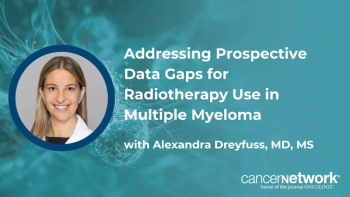
Alexandra Dreyfuss, MD, MS, explains why CAR T and bispecific populations are her priority for prospective radiotherapy studies in multiple myeloma.
Data from a phase 1b/2 study may support further assessment of AZD0120 in earlier treatment settings for patients with multiple myeloma.
At the
In a conversation with CancerNetwork®, Richard, associate professor of medicine (hematology and medical oncology) with the Center of Excellence for Multiple Myeloma at Mount Sinai, detailed the potential next steps and clinical implications of these results. Based on the agent’s “encouraging” preliminary data and next-generation manufacturing platform, she described how future research initiatives may prioritize exploring AZD0120 in earlier treatment settings, including those with newly diagnosed multiple myeloma.
“I’m encouraged that this product is showing good toxicity and efficacy. I would hope that we are able to accrue quickly to these clinical trials because initial impressions are a good start, but we need more patients and longer follow-up to see if this is indeed a CAR [chimeric antigen receptor] T product that may be preferentially used if patients have multiple options,” Richard stated. “We would like to see additional data and longer-term follow-up data, both for efficacy and safety.”
Richard: AZD0120 is a dual-targeted CAR T [product]. [First is] BCMA, which is…the most common antigen that is targeted in myeloma [via] CAR T cells [through] various T-cell–directed therapies. CD19, on the other hand, is much less common in myeloma. It’s usually expressed in most phases of B-cell development and is lower intensity in some subsets of myeloma cells and progenitor cells. The hypothesis behind putting these 2 antigens together in this dual CAR T product was that myeloma tends to be very clonally heterogeneous, and it’s an attempt to reduce the risk of antigen-negative relapses. Also, the hypothesis was that we are targeting a myeloma stem cell, so to speak—a progenitor to myeloma cells. There have been, in fact, in vitro studies that show that this combination seems to target more myeloma cells than either CAR T product individually.
This was the main reason for using this combination. The other thing with this product is that it uses a fast CAR manufacturing technology. While traditional manufacturing can take several weeks for the CAR T cells to be made, this particular one results in a fast turnaround, with CAR T cells being manufactured in [less] than 3 days.
Most of the other CAR T products currently target a single target, and the majority of them target BCMA. We know that although we have come far in the last 5 years with CAR T, we have not arrived at...that plateau in the survival curve and are trying to reduce relapses post CAR T. Having this fast manufacturing also results in this fast turnaround so that, potentially, it's available to more patients. That [also] reduces the requirement for bridging. Other things that we have noticed with this CAR T are that the toxicity seems to be much more manageable. All of these are very encouraging reasons to not only provide it to more patients who may be less robust but also to be able to administer this as an outpatient [option].
We've had 26 infused patients in phase 1b of the DURGA-1 trial. Of these patients, 23 were evaluable at the time of the data presentation. The overall response rate was 96%, and the complete response [CR] rate was an excellent 78%. This was even with a very short median follow-up of 3.9 months. We have noticed that the responses deepened, so we expect these to be even better with a longer follow-up.
Also, in terms of [measurable residual disease (MRD)] negativity, which has been measured by clonoSEQ next-generation sequencing at a sensitivity of at least 10–5, we have seen that of the 17 MRD-evaluable patients, 94% were MRD negative by month 1.
There were also 5 patients in that study who had a prior BCMA CAR T-cell [therapy], and even in this small group of patients, they had a response rate of 100% and a CR rate of 80%. We're hoping that this will be a good option even for patients who have had prior BCMA exposure.
In terms of safety, as with most CAR T therapies, hematologic treatment-emergent adverse events were the most common but very manageable. In fact, anemia and thrombocytopenia were just in about less than a quarter of the patients. This was very manageable in terms of most toxicities.
Overall, cytokine release syndrome was only seen in 62% of patients. The majority of CRS was grade 1. There was, in fact, only 1 patient who had grade 2 CRS, and there were no grade 3 or higher [events]. In terms of immune effector cell–associated neurotoxicity syndrome [ICANS], there was only 1 grade 1 ICANS event. There was 1 [instance of] grade 2 immune effector cell–associated hemophagocytic lymphohistiocytosis-like syndrome [IEC-HS] noticed. Then, in terms of infections, grade 3 infections were seen in less than 10% of patients. There were no grade 4 or higher infections. I should add in the toxicity profile that there was no delayed toxicity seen, and that's extremely important because the delayed neurotoxicities, the IEC-HS, colitis, and Guillain-Barré syndrome can be very difficult to reverse and may increase mortality as well. Overall, [it was] a very well-tolerated product.
Because it is so well tolerated and so efficacious, we're encouraged to move this product into earlier lines very quickly. It is now in phase 2 studies, and there are plans to quickly open earlier lines for 1 to 3 prior lines of treatment as well as in [patients with] newly diagnosed multiple myeloma.
Richard S, Gaballa M, Gregory T, et al. Safety and efficacy of AZD0120, a BCMA/CD19 dual-targeting CAR T-cell therapy, in relapsed/refractory multiple myeloma: preliminary results from the DURGA-1 phase 1b/2 study. Abstract presented at: 2026 Transplantation & Cellular Therapy Meetings of American Society for Transplantation and Cellular Therapy and Center for International Blood and Marrow Transplant Research; February 4-7, 2026; Salt Lake City, UT. Abstract 37.