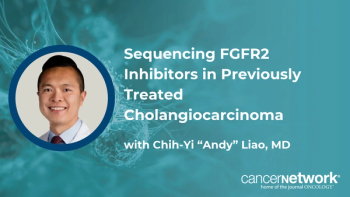
Chih-Yi “Andy” Liao, MD, discusses how oncologists are sequencing pemigatinib, futibatinib, and lirafugratinib and how their tolerability differs.
Seth M. Pollack, MD, discusses new strategies for converting immune-cold tumors, including the role of TLR4 agonists and IL-12–producing viral agents.
In the landscape of soft tissue sarcomas, the "immune-cold" tumor microenvironment remains one of the most significant hurdles to durable immunotherapy responses. For clinicians treating subtypes like synovial sarcoma, the challenge isn’t just activating T cells but ensuring they can effectively traffic into a hostile or indifferent tumor niche.
In this discussion, Seth M. Pollack, MD, Steven T. Rosen, MD, Professor of Cancer Biology and Director of the Sarcoma Program at Northwestern University, and co-leader of the Cancer Immunology and Immunotherapy Initiative at the Robert H. Lurie Comprehensive Cancer Center, dove into the pharmacological and physical strategies currently being tested to bridge this gap. Pollack explored the clinical utility of locally targeted agents—such as TLR4 agonists and IL-12–producing oncolytic viruses—while providing a look at his lab’s recent data on interferon-gamma and why initial combination trials with PD-1 inhibitors may have missed the mark.
Transcript:
A lot of people are using locally targeted agents to target big tumors; that would be oncolytic viral agents. Varun Monga, MD, had a great presentation at the Musculoskeletal Oncology and Sarcoma Symposium [MOSS] as well about that. That includes TLR4 agonists, which are something that we’ve been interested in. We’ve also been interested in IL-12–producing viral agents. Basically, you can inject the tumor with viruses, and we’ve done a lot of this with the TLR4 agonist. We had a trial with the IL-12 [therapy]. We’ve done a lot of preclinical work.
But in the metastatic setting, [where] so many of our patients have with, say, synovial sarcoma, it’s difficult. Our lab has been very interested in interferon gamma. We had a trial of interferon gamma. We showed that we could increase T cells coming into the tumor, and it had increased PD-L1 expression in the tumor. We also had a trial, and this is being written up right now, where we combined interferon with a PD-1 inhibitor, and it didn’t seem to help. We didn’t see any responses on that trial. We do have some new data in my lab about how we might be able to overcome the barriers to make interferon gamma an effective agent, or other interferons as well, [like] interferon alpha. That’s one of the things that I’m interested in and that my lab is interested in. I do think it has potential, even though we haven’t seen it break through in the clinic yet.
Reference
Monga V. Advances in oncolytic virus therapy for soft tissue sarcoma. Presented at the 2026 Musculoskeletal Oncology and Sarcoma Symposium (MOSS); January 22-23, 2026; Miami, FL.