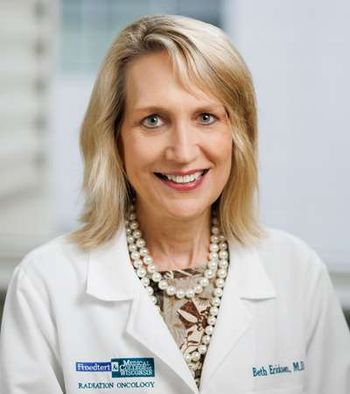
Beth Erickson, MD, FACR, FASTRO, FABS, discussed pioneering MRI-guided brachytherapy at MCW and her priorities as incoming ASTRO president-elect.
The future of radiation oncology will be largely affected by artificial intelligence and genomics, according to Sheila D. Rege, MD, FACRO.
A visionary is someone who can see beyond their years. They can look toward the future and anticipate where the world may be heading. Such a person can leave profound impacts on ecosystems, setting them up for immense future success. Visionary is precisely the word that Sheila D. Rege, MD, FACRO, used to describe Luther Brady, MD.
In 2001, Brady, in an interview, said, “I think that radiation oncology is at a very complicated and difficult point in its development. The emerging impact of other oncology specialties deriving protocols, which in many instances leaves radiation therapy out and oftentimes without even consultative advice, is very disturbing.”1
In the years since then, radiation oncology has grown, improving in accuracy, efficacy, and safety, among almost all other facets.
Brady, the founding president of the American College of Radiation Oncology (ACRO), has left a legacy and reputation that lives on even after his passing. For the past several years, at each ACRO summit, top physicians have given a lecture under his name—the Luther Brady Lecture—to address future road maps and considerations in radiation oncology.
At the 2026 ACRO Summit, that lecture was given by Rege. She focused on the “unseen horizons” of radiation oncology, from the evolution of the radiation oncologist’s role in treatment to patient education in an era of wearable technology. For one example, artificial intelligence and its effect on radiation oncology were discussed. Although it’s now mainly used as an aid for treatment planning, in the future, Rege pointed to Alpha DaRT, FLASH radiotherapy, and automated treatment planning as potential avenues of growth.
Following her lecture, Rege, a board-certified radiation oncologist and associate clinical professor at Washington State University’s Elson S. Floyd College of Medicine as well as a member of the American Medical Association’s Board of Trustees, spoke with CancerNetwork®. The highlights from that conversation are presented here.
Rege: Luther Brady was a visionary. He was the founder of ACRO, a great mentor, and always able to see beyond what's there. He was able to look into the future. He uplifted a lot of us. He inspired this generation—me—then asked us to inspire the next generation of physicians to adapt and to get the cure rates from what they were—50% in the 1970s to 70% now—to as close to 100% as we can get. Today, we have so many tools that he didn't have when he was practicing. He encouraged us on education and journal research. He encouraged us on mentorship and professional learning. When they asked me to do the Luther Brady talk, I thought about what all of us have seen in the last few years, not just as physicians but in our daily lives. We've seen technology change, precision medicine coming in, and the hope for the future. But at the same time, with our patients, they really want us to be there with them. They want us to hold their hand. [When] somebody comes in with cancer, they're scared. They don't want a computer. They want somebody to talk to them, be with their family, and be that human connection, even while technology is changing things. That's how I came up with the topic of unseen horizons.
We're seeing more and more patients coming in with wearables. They're coming in and telling us, “Hey, my heart rate was high, and I was more anxious.” We can talk about what caused it. We get a lot of information now that we may not have gotten before. Before, you'd come into the doctor's office, and oh my God, whose vital signs—whose heart rate or blood pressure—doesn't go up when you go see your doctor? You're walking in and wondering, “What am I going to find out? What is the doctor going to tell me about that scan?” But with all these wearables and [new technology], you're getting continuous data. The issue is going to be [that] all our charting and everything [else] is set up for one data point. How are you going to incorporate all that information when you're taking care of the patient?
I'm excited that patients are now taking control of their data and coming in. Especially with patients with cancer, we try to get them to exercise and eat healthy. They're coming in and saying, “I did this. But when I was looking at my watch, [this happened].” Patients with diabetes will say, “My continuous glucose monitor spiked.” Then I [can] make a change. Patients are taking control of their health, which is awesome.
As radiation oncology physicians, we use the tools we have, which are brachytherapy, external beam radiation, and radiopharmaceutical treatment, to cure the patient. I don't see a patient having a linear accelerator in their purse. It's just too complicated a machine to have it do something at home. We're always going to, unfortunately, have these big, scary machines that we're going to use to cure patients from cancer. We're always going to be the human physician there, helping.
What I'm looking for is the patients being more informed and being able to look up some of the articles we looked up in the past. [In the past], I would have to go into the library, open a book, and get a journal. I'd have to email or have the journal waiting and go open it. Then we got to where it was all digital. Now you can look at everything, even the newspaper, digitally. That's an evolution. Now patients will be able to say, “Well, what if I have this, this, and this?” They plan to tell their doctor tomorrow, even when it's happening now. They question, “Should I do something?”
However, the issue is that we don't want technology to scare patients, and some patients do come in and say, “I had so-and-so symptom, and I put it into ChatGPT, and it said I could have something really bad.” We don't want that, but we do want patients to use what they can with devices and routines to make themselves healthier. That's where the physician will participate with them.
My mother went through cancer. She’s got her daughter, who is a cancer doctor, but I still remember when we went into the doctor’s office—I was in the back—and the doctor held her hand and said, “We're going to get you through this.” Looking to this physician she trusted, my mother squeezed the hand and said, “Thank you.” Then we walked out. I looked at her, and she said, “I'm good.”
Now, when a person gets cancer, there's a lot of information that gets thrown at the patient, but it's [about] that trust when a doctor, at the end, says, “We're going to get you through this.” That's what radiation oncology clinics do. We're a team of the physician, the physicists, the therapists, the front desk, and the nurses; we all get together and help the patient through the journey. That's never going to change. We're going to use technology, like ambient listening in your rooms, to do the mundane—to take care of the note-taking that we do and make sure it's accurate. That human-to-human connection? That's always going to stay.
I was just in the hallway talking to some medical students. They come here; they present posters. The younger generation has grown up with these tools. At my age, I didn't have an iPhone. Today's medical students and residents have grown up digital, so they're used to it. What they're looking for is us with our education [while] incorporating that to help but not replace that humanity. During [the COVID-19 pandemic], when a lot of things turned to remote learning, even younger school students fell behind because human interaction encourages learning. We can't ever get rid of the human in learning. For the trainees in radiation oncology and accreditation for clinics, we've got to make sure that physicians create the guardrails and the governance for how technology should be implemented safely, to help the patients and to help trainees learn. But I don't see everything going completely remote. I think it will be hybrid, and our education programs are evolving for that.
I just talked to a second-year medical student who has decided to go into radiation oncology. That's just awesome. They don't have to decide till the third or fourth year, but they met a radiation oncologist who inspired them. Not just [for] trainees and accreditation, but in the training of residents, radiopharmaceutical treatments have become more prevalent and needed. We need to make sure that our radiation oncology residents have enough cases so they can be authorized users.
Rege SD. Unseen horizons: AI and genomics in radiotherapy’s future. Presented at: American College of Radiation Oncology 2026 Summit; February 4-7, 2026; Lake Buena Vista, FL.