Summary: Putting It All Together for 1L EGFRm NSCLC
Published: | Updated:
Clinicians share practical tips to prevent amivantamab-lazertinib rash, streamline orders, manage edema, and use short-term DOAC prophylaxis.
Clinicians share practical tips to prevent amivantamab-lazertinib rash, streamline orders, manage edema, and use short-term DOAC prophylaxis.
Learn how proactive prophylaxis makes subcutaneous amivantamab plus lazertinib more tolerable, cutting severe rash, nail issues and clot risk.
Learn how monthly subcutaneous amivantamab cuts clinic time, eases infusion capacity, and supports dose tweaks without sacrificing outcomes.
Monthly subcutaneous amivantamab plus lazertinib shows strong first-line EGFR NSCLC responses, fewer visits, and far fewer reactions.
Learn how clinicians choose first-line EGFR lung cancer therapy, weigh brain mets risk, and manage combo side effects for lasting benefit.
New data show amivantamab+lazertinib boosts survival vs osimertinib in EGFR lung cancer, with Q4W subcutaneous dosing and side-effect tips.
New data show amivantamab plus lazertinib boosts survival and brain control in EGFR+ lung cancer, with convenient Q4W injection tips.

Following a comprehensive debate on the treatment of patients with non–small cell lung cancer, Edward Kim, MD, presents the winning team with the title of victors of this CancerNetwork® Face-Off event.
Continuing discussion on the treatment of patients with EGFR-mutated NSCLC, Sandip P. Patel, MD, discusses the role of EGFR TKIs without chemotherapy.
Focusing on data from the FLAURA2 study, Erminia Massarelli, MD, PhD, MS, outlines the role of EGFR TKI plus chemotherapy for patients with EGFR-mutated NSCLC.
Teams from University of California San Diego and City of Hope debate whether neoadjuvant therapies will replace surgery plus adjuvant treatment for patients with resectable NSCLC.
Karen M. Yun, MD, discusses the role for neoadjuvant chemoimmunotherapy in patients with resectable non–small cell lung cancer.
Ramya Muddasani, DO, MS, leads a discussion on the treatment of a patient with metastatic NSCLC with a KRAS G12C mutation, highlighting the utilization of sotorasib and the CodeBreaK 100 trial.
Sandip P. Patel, MD, reviews the case of a patient with PD-L1–negative NSCLC and discusses treatment practices.
Ramya Muddasani, DO, MS, presents the case of a patient with EGFR-mutated NSCLC following osimertinib treatment and shares insights gleaned from the INSIGHT 2 trial.
Initiating a conversation on patient cases, Karen Yun, MD, presents the profile of a patient with metastatic ROS1 fusion-positive non–small cell lung cancer.
Jyoti Malhotra, MD, MPH, reviews data from the phase III POSEIDON study evaluating durvalumab with or without tremelimumab in combination with chemotherapy as first-line therapy for patients with metastatic NSCLC.
Amanda Herrmann, MD, discusses findings from the 5-year update from CheckMate-9LA investigating nivolumab, ipilimumab, and chemotherapy in patients with metastatic NSCLC.
Karen Yun, MD, opens the discussion by presenting data from the ALTA-1L and BRIGHTSTAR studies on advanced ALK-rearranged non–small cell lung cancer.
Erminia Massarelli, MD, PhD, MS, presents 5-year progression-free survival and safety data from the CROWN study comparing lorlatinib with crizotinib in treatment-naïve patients with advanced ALK+ NSCLC.
Edward Kim, MD, introduces a CancerNetwork® Face-Off program in which University of California San Diego and City of Hope will present clinical trial data and discuss treatment practices in non–small cell lung cancer (NSCLC).

Experts discuss the current continuum of care for patients with EGFR exon 20 non–small cell lung cancer and findings from studies including the phase 2 CHRYSALIS trial.
Closing out their discussion on EGFR Exon20+ non–small cell lung cancer, Joshua Sabari, MD, and Misako Nagasaka, MD, share excitement for future evolutions in the treatment paradigm.
A brief review of novel EGFR TKIs that may have stronger CNS penetration in patients with non–small cell lung cancer and brain metastases.
Following their review of data behind amivantamab and mobocertinib in EGFR Exon20+ non–small cell lung cancer, expert oncologists consider factors that help to inform treatment selection.
Joshua Sabari, MD, and Misako Nagasaka, MD, reflect on clinical trial data and experience with mobocertinib in patients with EGFR Exon20+ non–small cell lung cancer.
Expert perspectives on clinical trial data and personal experience with amivantamab in the setting of EGFR Exon20+ non–small cell lung cancer.
Key opinion leaders in non–small cell lung cancer management reflect on the current first- and second-line treatment options available to patients with EGFR Exon20+ disease.
Shared insight on uncommon EGFR mutations in patients with non–small cell lung cancer and how they fit into the larger disease paradigm.

October 21st 2024
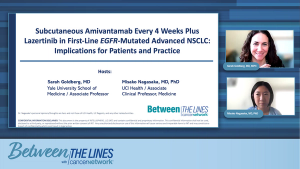
Published: June 2nd 2026 | Updated: May 12th 2026
October 21st 2024
October 21st 2024