






Kidney Cancer
Latest News
Advertisement
Latest Videos


CME Content











































Advertisement
More News

An expert from the University of Texas MD Anderson Cancer Center discussed kidney cancer treatment updates from a recent medical conference.

Contextualizing discussion with clinical trial data and real-world experience, expert hematologist-oncologists consider the role of adjuvant therapy in managing advanced RCC.

Shared insight from Ulka N. Vaishampayan, MBBS, and Moshe Ornstein, MD, on unmet needs in the setting of clear cell and non–clear cell renal cell carcinoma.

Data from a meta-analysis suggest that single-fraction stereotactic ablative body radiotherapy could result in a lower incidence of local failure than multifractionated radiation in patients with renal cell carcinoma.
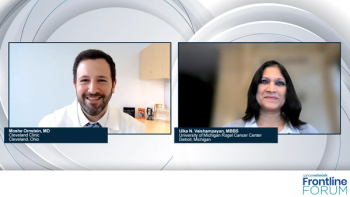
Key opinion leaders reflect on novel treatment modalities still under investigation for the management of advanced renal cell carcinoma.
Expert hematologist-oncologists share comprehensive perspective on an array of first-line clinical trials in the setting of advanced renal cell carcinoma.
A brief review of common adverse events inherent in the first-line management of advanced renal cell carcinoma and practical advice on how to mitigate treatment toxicity.
Opening their discussion on the advanced renal cell carcinoma treatment landscape, experts Ulka N. Vaishampayan, MBBS, and Moshe Ornstein, MD, identify cornerstone first-line regimens.

Future research must address ways to improve the prediction of kidney cancer recurrence to better inform patients, says an expert from the Royal Free London NHS Foundation Trust.
Despite the observed disease-free survival benefit associated with pembrolizumab in high-risk kidney cancer after surgery, the European Association of Urology guidelines maintain a weak recommendation for its use.

An expert from the University of Texas Southwestern Medical Center questions how providers are currently utilizing stereotactic radiation in the treatment of metastatic kidney cancer.
Patients with kidney cancer should be made aware of trials that have not read out positively in the adjuvant setting, according to an expert from the Royal Free London NHS Foundation Trust.
Ongoing clinical trials are exploring the cytoreductive properties and immunogenic potential of stereotactic radiation in the treatment of patients with metastatic kidney cancer, according to an expert from the University of Texas Southwestern Medical Center.
“Much more research” is needed to advance the adjuvant treatment of patients with kidney cancer, according to an expert from the Royal Free London NHS Foundation Trust.

Before closing out their discussion on the evolving treatment landscape of advanced renal cell carcinoma, Matthew Campbell, MD, MS, and Brian Rini, MD, highlight clinical trials in the adjuvant setting.

Shared insight on the results from triplet therapy–centered clinical trials in advanced renal cell carcinoma and how these might inform treatment strategies as the paradigm continues to evolve.

Experts Matthew Campbell, MD, MS, and Brian Rini, MD, provide a brief review of recent clinical data in the setting of relapsed/refractory renal cell carcinoma.
A broad look at the data from several recent first-line clinical trials in the setting of advanced renal cell carcinoma and considerations for how they may impact real-world practice.
Closing out their discussion on adverse event management in advanced renal cell carcinoma, Matthew Campbell, MD, MS, and Brian Rini, MD, consider overlapping toxicity in TKI/IO regimens.
Expert perspectives on the most common adverse events seen while managing advanced renal cell carcinoma, followed by advice on how best to manage these and counsel patients.

The findings indicate that nephron sparing management should be prioritized in elderly patients with kidney cancer when it is safe and feasible, according to the study authors.
An expert from the University of Texas Southwestern Medical Center in Dallas describes the efficacy of stereotactic radiation in the treatment of patients with metastatic kidney cancer.
An expert from the University of Texas Southwestern Medical Center in Dallas gives an overview of the multimodal use of stereotactic radiation for the treatment of patients with metastatic kidney cancer.

According to a retrospective chart review, there was no significant correlation between BMI and changes in renal function among patients who underwent partial nephrectomy for the treatment of kidney cancer.

The findings, according to the lead study author from UC San Diego School of Medicine, are a proof of concept and need to be confirmed in a phase 2 trial.
Advertisement
Advertisement
Trending on CancerNetwork
1
CELMoDs After T-Cell–Engaging Therapy in Multiple Myeloma
2
Key Takeaways for Multidisciplinary Lung Cancer Care From WCLC 2026
3
Neoantigen Vaccine Shows Encouraging Activity in Head and Neck Cancer
4
Pembrolizumab/Enfortumab Vedotin Earns Positive CHMP Opinion in MIBC
5