
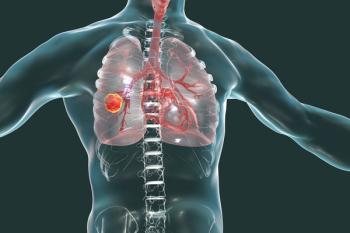
The MET inhibitor tepotinib demonstrated durable clinical activity in non‒small cell lung cancer tumors harboring MET exon 14 skipping mutations.
The MET inhibitor tepotinib demonstrated durable clinical activity in non‒small cell lung cancer tumors harboring MET exon 14 skipping mutations.

“Preliminary TRIDENT-1 data are very encouraging and support repotrectinib as a potential best-in-class treatment in ROS1-positive advanced NSCLC,” according to Byoung Chul Cho, MD, PhD.
Savolitinib plus osimertinib overcomes treatment resistance in non–small cell lung cancer with oncogenic driver mutations.

Multiple key efficacy end points continue to favor atezolizumab versus chemotherapy for patients with PD-L1–high, wild-type nonsquamous or squamous non–small cell lung cancer in the first line, according to a phase 3 trial follow-up.
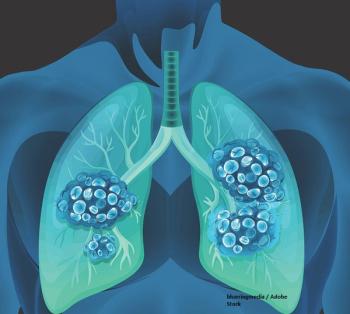
The investigational TROP-2–directed antibody-drug conjugate datopotamab deruxtecan will move forward in the treatment of relapsed/refractory non–small cell lung cancer, according to results from the 2020 World Conference on Lung Cancer Singapore.


Safety and antitumor activity of mobocertinib became evident after results of a trial involving EGFR exon 20 insertion–mutant non–small cell lung cancer were reported at the 2020 World Conference on Lung Cancer Singapore.
Liposomal irinotecan as second-line therapy for SCLC is feasible, safe after frontline platinum therapy failure.

Results from the phase 2/3 KEYNOTE-010 trial continue to favor pembrolizumab, including key survival end points.
Updated data from a phase 2 trial of apatinib added to single-agent chemotherapy for small cell lung cancer in patients with prior treatments indicate a good efficacy and safety for the combination.

Data presented at the 2020 World Conference on Lung Cancer Singapore reported gains in survival at the population and patient levels for those with SCLC treated with immunotherapy.

A Japanese study supports the use of nab-paclitaxel for previously treated non–small cell lung cancer based on noninferiority end points being met.
Trastuzumab deruxtecan treatment demonstrated strong antitumor activity for patients with HER2-overexpressing NSCLC, regardless of HER2 expression levels, according to interim findings from the phase 2 DESTINY Lung-01 trial.

Results of the phase 1 CHRYSALIS trial demonstrated the safety and efficacy of amivantamab in patients with previously treated non–small cell lung cancer harboring EGFR exon 20 insertion mutations.
This ongoing study supports the continued development of AXL inhibition with bemcentinib in order to extend the efficacy of immunotherapy in biomarker-selected refractory non—small cell lung cancer, according to Matthew G. Krebs, MB ChB, FRCP, PhD.
Follow up data from KEYNOTE-799 demonstrated a high overall response rate with no new safety signals for patients with unresectable, locally advanced, stage III non-small cell lung cancer.

Encouraging survival end points are observed with BMS-986012 plus nivolumab in immune checkpoint inhibitor–naïve SCLC, according to data presented at the 2020 World Conference on Lung Cancer.

Results from the 2020 World Conference on Lung Cancer Singapore demonstrated the feasibility of using STK11 mutations and immune-related adverse events as response predictors in patients with non–small cell lung cancer.
An updated analysis presented at the 2020 World Conference on Lung Cancer Singapore expanded on data investigating pembrolizumab in the treatment of patients with PD-L1–positive NSCLC without sensitizing EGFR/ALK alterations.
“With recent advances in early detection of lung cancer, biomarker testing, and personalized treatment planning, effective patient-provider communication is more important than ever for short- and long-term survivorship,” said Kelly Clark, MA.
Supporting previously reported data, updated results of the phase 3 KEYNOTE-189 trial indicate that overall survival is significantly improved when pembrolizumab is added to platinum-based chemotherapy in the frontline treatment of patients with metastatic nonsqamous NSCLC.

A new study presented at the International Association for the Study of Lung Cancer's 2019 conference may have found a model for lung cancer screening which improves on lung cancer screening guidelines from the U.S. Preventive Services Task Force.

In this phase III trial, investigators assessed the clinical efficacy and safety of durvalumab with or without tremelimumab with etoposide and carboplatin or cisplatin chemotherapy followed by durvalumab with or without tremelimumab maintenance therapy compared with EP alone as first-line treatment in extensive-stage small-cell lung cancer.

Video-assisted thoracic surgery (VATS) results in fewer in-hospital complications and a shorter length of stay compared with open surgery in patients with early-stage lung cancer.

In a phase I trial, researchers demonstrated that KRAS inhibitor AMG 510 demonstrated safety and antitumor activity in advanced NSCLC patients.

Combination immunotherapy with nivolumab plus ipilimumab was examined as a first-line therapy for patients with advanced non–small-cell lung cancer. Results were presented at the International Associate for the Study of Lung Cancer 2019 World Conference on Lung Cancer.

Data presented at the International Association for the Study of Lung Cancer 2019 World Conference on Lung Cancer suggested tumor mutational burden may not be associated with the efficacy of pembrolizumab plus chemotherapy or placebo plus chemotherapy.

Little research has been done on these complications commonly found in lung cancer.

Researchers focused on a subset of patients with high tumor mutational burden using a 20-mutation-per-megabase threshold and found significant improvement in progression-free survival and overall survival.

Findings from the upcoming International Association for the Study of Lung Cancer 2019 World Conference on Lung Cancer show camrelizumab and chemotherapy showed survival benefits for patients with metastatic or otherwise advanced non-squamous non–small-cell lung cancer.