
A phase 3 study presented at 2022 ESMO showed progression-free survival benefit of nirogacestat over placebo for patients with progressive desmoid tumors.

Your AI-Trained Oncology Knowledge Connection!
A phase 3 study presented at 2022 ESMO showed progression-free survival benefit of nirogacestat over placebo for patients with progressive desmoid tumors.

The addition of abemaciclib vs standard-of-care chemotherapy to trastuzumab numerically improved overall survival in women with hormone receptor–positive, HER2-positive advanced breast cancer.

Findings provided rationale to limit air pollution and highlighted the need for molecularly targeted lung cancer prevention due to particulate matter being revealed as a mechanistic driver for EGFR-positive NSCLC.
A randomized phase 3 trial presented at 2022 ESMO revealed better progression-free survival outcomes with tumor-infiltrating lymphocytes vs ipilimumab in stage IIIC/IV unresectable, treatment-refractory melanoma.
The CDK4/6 inhibitor dalpiciclib in combination with letrozole or anastrozole improved progression free survival in patients with treatment-naïve advanced breast cancer.

CLDN6-directed CAR T-cell therapy BNT211-01 showed clinical activity as monotherapy and in combination with a CLDN6-encoding mRNA vaccine in relapsed/refractory advanced solid tumors.
Results from the phase 2 SYNERGY trial suggest little or no benefit of adding oleclumab to durvalumab and chemotherapy for advanced frontline triple-negative breast cancer.
Abemaciclib prolonged overall survival when added to a nonsteroidal aromatase inhibitor in hormone receptor–positive, HER2–negative breast cancer, according to updated findings from the MONARCH 3 trial presented at 2022 ESMO.
Updated results from the phase 3 TROPiCS-02 study demonstrated that the novel therapy improved overall survival, objective response rate, duration of response and overall quality of life compared with treatment of physician’s choice.

Doses of Rhenium-186 nanoliposome above 100 Gy improved overall survival in recurrent glioma, according to results from the phase 1 ReSPECT-GBM trial presented at 2022 ESMO.

Results from the phase 2 NEOpredict trial showed that the primary end point of feasibility of treatment in patients with surgical resection of non–small cell lung cancer was reached in those given preoperative nivolumab plus relatlimab.

After 7 years of follow-up, results from the phase 3 SOLO1/GOG-3004 trial support maintenance olaparib to achieve long-term remission in women with newly diagnosed advanced ovarian cancer.

Results of the phase 3 ARIEL4 trial comparing rucaparib vs chemotherapy for patients with relapsed ovarian cancer and deleterious BRCA1/2 mutations were presented at 2022 ESMO and raised questions about optimal sequencing of PARP inhibitors in this setting.

The final analysis of the PAOLA-1/ENGOT-ov25 trial confirmed the benefit of olaparib plus bevacizumab as maintenance therapy following frontline treatment in women with HRD-positive advanced ovarian cancer.

Charles M. Rudin, MD, PhD, discussed results of the phase 3 SKYSCRAPER-02 trial examining atezolizumab with carboplatin and etoposide with or without tiragolumab in untreated extensive-stage small cell lung cancer.
Results from a phase 2 trial of temozolomide or temozolomide plus capecitabine showed promising efficacy of the regimens for patients with advanced pancreatic neuroendocrine tumors.

At ASCO 2022, Jonathan S. Zager, MD, spoke about the phase 3 FOCUS trial which analyzed patients with hepatic-dominant ocular melanoma receiving percutaneous hepatic perfusion with melphalan or best alternative care.

Guidelines from the American Society for Radiation Oncology on the use of radiation therapy for patients with IDH-mutant glioma included strong recommendations for close surveillance in IDH-mutant, 1p/19q codeleted, WHO grade 2 oligodendroglioma with no high-risk features and adjuvant radiotherapy for those with WHO grade 3 disease.
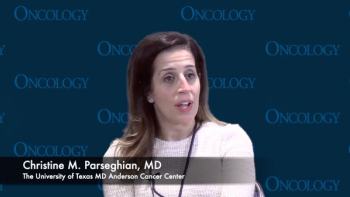
At the 2022 ASCO Annual Meeting, Christine Parseghian, MD, reviewed results from a phase 2 trial assessing efficacy of panitumumab plus or minus trametinib in patients with RAS/BRAF wild-type colorectal cancer and compared EGFR rechallenge strategies with available agents in the third-line setting.

Findings from a pooled analysis indicated that reductions in ctDNA were associated with improved clinical benefit across multiple end points in patients with non–small cell lung cancer treated with immune checkpoint inhibitors.

Akihiro Ohba, MD, discussed the potential benefits of T-DXd in HER2-expressing biliary tract cancer.
Ulka N. Vaishampayan, MBBS, discussed the potential benefits of oral docetaxel plus ritonavir in metastatic castration-resistant prostate cancer.
Phillip H. Kuo, MD, PhD, spoke about incorporating prostate-specific membrane antigen–PET imaging into multidisciplinary care for patients with metastatic castration-resistant prostate cancer.
Ranjit Nair, MD, discusses the promise of sugemalimab, both as a single-agent and as part of a combination regimen, in patients with relapsed/refractory extranodal natural killer/T-cell lymphoma.

Eric J. Sherman, MD, discussed the effects of using the MEK inhibitor trametinib in combination with paclitaxel in metastatic anaplastic thyroid cancer.
Results from a phase 2 study highlighted a tolerable safety profile when patients with mismatch repair proficient endometrial cancer were treated with avelumab plus talazoparib.
Treatment with adagrasib monotherapy yielded an overall response rate of 42.9% in patients with KRAS G12C–mutated advanced/metastatic non–small cell lung cancer, according to Alexander I. Spira, MD, PhD, FACP.
Superior survival were observed across all efficacy outcomes for patients with relapsed/refractory follicular lymphoma treated with tisagenlecleucel compared with standard of care.

Results from the phase 2 ExIST trial indicated that the addition of galunisertib to neoadjuvant chemoradiotherapy for patients with locally advanced rectal cancer resulted in an improvement in responses.

Community health worker–led interventions appeared to improve outcomes among patients with newly diagnosed advanced-stage or recurrent solid and hematologic cancers.