
The rising incidence of colorectal cancer among younger populations may be due to environmental factors, according to Marc Greenwald, MD.
The rising incidence of colorectal cancer among younger populations may be due to environmental factors, according to Marc Greenwald, MD.

Panelists debate whether the treatment paradigm in relapsed/refractory LBCL has fundamentally shifted from salvage chemotherapy and autologous transplant toward novel immune-based strategies. The discussion centers on CAR T-cell therapy versus bispecific antibodies, examining differences in outcomes. Faculty explore how emerging data, sequencing considerations, and real-world constraints are redefining treatment decision-making.

Experts weigh EGFR lung cancer combo therapies, cautioning against cross-trial comparisons and prioritizing CNS efficacy for brain metastases.
Panelists debate how to select between axicabtagene ciloleucel and lisocabtagene maraleucel for patients with rapidly progressive second-line DLBCL. Key arguments examine differences in efficacy signals, vein-to-vein time, and toxicity profiles and how these factors influence urgency of treatment. Faculty explore how real-world experience, institutional infrastructure, and patient-specific risk factors and lifestyle shape optimal CAR T product selection.
Experts unpack new EGFR-mutant lung cancer first-line options, weighing survival, CNS control, and toxicity as combo regimens reshape practice.

Dr. Krina Patel reviews a real-world comparative analysis showing improved progression-free and overall survival with idecabtagene vicleucel versus teclistamab in triple-class–exposed relapsed or refractory multiple myeloma, and discusses its implications for treatment sequencing and individualized care.
According to Marwan G. Fakih, MD, neutropenia may be a biomarker of benefit for patients with metastatic colorectal cancer receiving trifluridine/tipiracil and bevacizumab.
Although older patients saw a greater rate of AE-related discontinuations, survival outcomes were similar between groups.

An updated analysis of the eNRGy trial showed that zenocutuzumab may provide meaningful benefit beyond initial disease progression.
Patients with metastatic colorectal cancer who desire better disease control are best served with trifluridine/tipiracil plus bevacizumab, according to Marwan G. Fakih, MD.

Panelists discuss how high-risk disease biology and recent bispecific therapy heighten the need for timely, individualized sequencing and rigorous safety planning around infections, cytopenias, and early monitoring.
Panelists discuss how recent bispecific exposure does not necessarily preclude CAR T, but timing, disease tempo, infection/immune assessments, and realistic scheduling expectations shape readiness and planning.
Diane Simeone, MD, explained that shifting diagnosis toward earlier stages could raise the pancreatic cancer survival rate from 13% to over 80% for certain patients.

The majority of patients experiencing recurrence of their MIBC within 6 months of study start had high concentrations of ctDNA at baseline.
Several differences arise between community oncology centers and institutional oncology centers regarding the tools available and requirements of patients with cancer.
An effective regimen that partly incorporates oral therapy may be favorable from a patient convenience perspective, said Sagar Lonial, MD, FACP, FASCO.

CAR T-cell therapies and T-cell engagers may produce an “exciting” benefit on the radiosensitization of prostate tumors.

The phase 2 study aimed to compare the safety of pembrolizumab and radiation with or without olaparib in this high-risk population.

Despite differences in treatment tolerance across different RCC subgroups, survival outcomes were similar in a retrospective study.
Sarah Poland, MD, discussed the divergence between the IMpassion130 and IMpassion131 trials and the critical role of confirmatory trials in oncology.
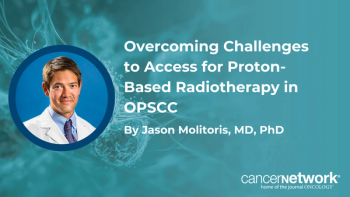
The expansion of clinical trials evaluating proton-based radiotherapy could elucidate its benefits and increase its access across the US.

Retrospective data show that relapse-free survival outcomes were worse for patients with MDS/MPN compared with those who had other types of MDS.
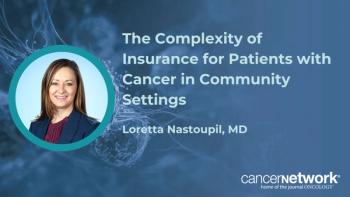
Often, patients in middle-income settings, are the patients who are impacted most by insurance deductibles, according to Loretta Nastoupil, MD.
Panelists debate whether high-risk disease biology should accelerate referral for CAR T-cell therapy in second-line DLBCL. Key arguments consider patient-specific sequencing approaches, emphasizing individualized assessments before committing to CAR T. The opposing argument supports early referral for CAR T in biologically high-risk patients. Faculty weigh the balance between urgency and personalization, exploring how disease kinetics, logistical barriers, and real-world practice patterns influence optimal timing of referral.
Panelists discuss how clinicians set expectations for the acute toxicity window and monitoring while also considering how rising disease burden or prior BCMA exposure can influence efficacy and reinforce urgency of referral.
Panelists discuss real-world data from the US ABC Consortium evaluating axicabtagene ciloleucel, tisagenlecleucel, and lisocabtagene maraleucel in relapsed/refractory LBCL. Faculty discuss key differences in manufacturing, review outcomes, and consider toxicity profiles for each of the CAR T products in clinical practice.
Panelists discuss how older patients with cardiac/renal comorbidities may still be appropriate CAR T candidates when conditions are well-managed, and why early evaluation protects eligibility and aligns care with patient goals.
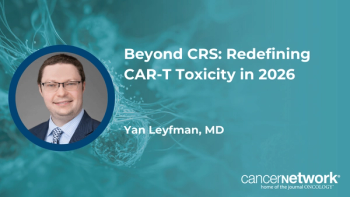
Yan Leyfman, MD, reviewed how toxicity management in hematologic oncology is shifting to phenotype- and mechanism-informed intervention.

Sarah Poland, MD, discussed the transition of breast cancer from an "immunologically cold" tumor to a target for checkpoint inhibitors, highlighting the pivotal role of the KEYNOTE-012 trial.
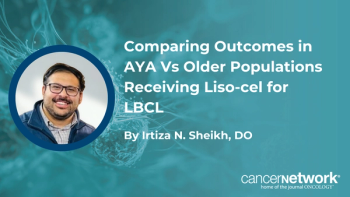
Irtiza Sheikh, DO, sought to assess the impact of age and clinical setting on liso-cel efficacy in patients with large B-cell lymphoma.