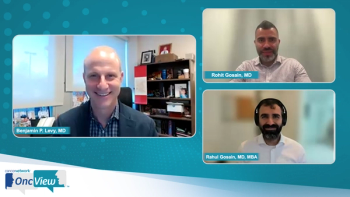
Ruth M. O'Regan, MD, and Anna Weiss, MD, join the Oncology Brothers, Rahul Gosain, MD, and Rohit Gosain, MD, to discuss the treatment of early-stage node-negative triple-negative breast cancer (TNBC).

Your AI-Trained Oncology Knowledge Connection!


Ruth M. O'Regan, MD, and Anna Weiss, MD, join the Oncology Brothers, Rahul Gosain, MD, and Rohit Gosain, MD, to discuss the treatment of early-stage node-negative triple-negative breast cancer (TNBC).

Treatment with toripalimab does not yield the same vascular toxicity seen with pembrolizumab in patients with advanced or metastatic nasopharyngeal carcinoma, according to Barbara Burtness, MD.

Noa Biran, MD, addresses unmet needs in relapsed/refractory multiple myeloma, focusing on reducing treatment burden and exploring fixed-duration therapies post-transplant, and highlights potential consolidation approaches with CAR-T cells or novel agents.

Noa Biran, MD, discusses the potential sequencing of selinexor with newer B-cell maturation antigen (BCMA)-directed therapies like CAR-T cells and bispecific antibodies, and explores optimizing treatment sequences to maximize efficacy, minimize resistance, and manage toxicity profiles.

Gregory Gan, MD, briefly outlines the available treatment strategies for stage III unresectable NSCLC, and Alykhan Nagji, MD explores the characterization of patients with unresectable stage III NSCLC, underscoring the crucial role of accurate staging in guiding treatment decisions.

Oncology experts from the University of Kansas discuss treatment strategies for both resectable and unresectable non-small cell lung cancer (NSCLC) following progression on adjuvant immunotherapy, providing valuable insights into navigating the challenges posed by this evolving clinical scenario.

Present real-world data on the efficacy and safety of the ixazomib-lenalidomide-dexamethasone combination in patients with relapsed/refractory multiple myeloma outside of clinical trials.

Examine outcomes such as overall survival, progression-free survival, and response rates in multiple myeloma patients who have experienced biochemical or clinical progression after prior lines of therapy.

Experts dive into the complexities of defining and treating high-risk Multiple Myeloma (MM) and discuss the role of ASCT in newly diagnosed MM and weigh the considerations for recommending transplants, including insights on the selection criteria for tandem transplantations.

Philippe Moreau, MD, discusses recent data from the IFM 2018 trial which evaluated Dara-KRd induction and consolidation plus double transplants in high risk, TE NDMM.

Overall survival also appears to improve with toripalimab compared with chemotherapy among patients with metastatic or advanced nasopharyngeal carcinoma.

An expert briefly reviews the role of GPRC5C-targeting bispecifics in Relapsed/Refractory Multiple Myeloma (R/R MM) following four previous lines of therapy, comparing its efficacy and characteristics with other treatment options like BCMA and CAR-T therapies. She also provides insights into the benefits, risks, and potential challenges related to the access and utilization of GPRC5D-targeting bispecifics, providing a comprehensive overview of considerations in the advanced R/R MM treatment landscape.

Dr. Costello explores the mechanism of action (MOA) of talquetamab and its distinctive role in Relapsed/Refractory Multiple Myeloma (R/R MM), drawing comparisons with other bispecific therapies.

Expert faculty highlight key updates from trials evaluating combination therapy approaches using venetoclax plus a BTKi in the frontline setting.

A panel of experts discuss the role of fixed duration therapy with venetoclax and obinutuzumab, outlining their general approach for patient selection.

Developing novel regimens may continue to improve survival outcomes of patients with advanced cervical cancer following the FDA approval of pembrolizumab and chemoradiation, says Jyoti S. Mayadev, MD.

Treatment with pembrolizumab plus chemoradiation appears to be well tolerated with no detriment to quality of life among those with advanced cervical cancer.

Noa Biran, MD, delves into the phase II STOMP study, highlighting selinexor’s efficacy with various backbones like pomalidomide, carfilzomib, daratumumab, and reviews dosing strategies and proactive management of associated toxicities.

Noa Biran, MD, discusses how selinexor targets nuclear export, inducing apoptosis in multiple myeloma cells. Its synergistic potential with approved agents makes it suitable across refractory cases, bridging therapy options and improving patients' quality of life.

Vinay Raja, MD, explores the crucial role of adjuvant immunotherapy in resectable stage III NSCLC, providing insights into patient selection criteria, considerations for choosing among available treatment options, and the impact of recent trial data updates on informing treatment decisions in this evolving therapeutic landscape.

Oncology experts from the University of Kansas discuss the evolving role of neoadjuvant/perioperative immunotherapy in resectable stage-III NSCLC, analyzing recent trial data and addressing the nuanced factors that inform their decisions between neoadjuvant and perioperative treatments in clinical practice.

Alykhan Nagji, MD, provides an overview of the institutional approach to determining eligibility for surgical resection, delving into the pivotal role of the multidisciplinary tumor board in the decision-making process and exploring the crucial factors that must be considered when evaluating resectability.

A summary of key discussion points and an overview of the evidence presented to inform the dialogue.

Black male patients with breast cancer appear to experience worse survival outcomes compared with White patients when controlling for clinicopathological variables, according to Jason (Jincong) Q. Freeman, MPH, MS.

Sagar Lonial, MD, and Ellen Marin, PA-C, discuss the impact and key takeaways from their study as well as study limitations and future directions.

Jyoti S. Mayadev, MD, says that pembrolizumab in combination with chemoradiation will be seamlessly incorporated into her institution’s treatment of those with FIGO 2014 stage III to IVA cervical cancer following the regimen’s FDA approval.

Joshua Richter, MD, of Mount Sinai, and other hematologic cancer experts join CancerNetwork following the 2023 ASH Annual Meeting & Exposition to share their closing thoughts before the 2-Minute Drill winner is announced.

Joshua Richter, MD, of Mount Sinai, and other hematologic cancer experts join CancerNetwork following the 2023 ASH Annual Meeting & Exposition to provide shameless plugs from this year's conference.

Joshua Richter, MD, of Mount Sinai, and other hematologic cancer experts join CancerNetwork following the 2023 ASH Annual Meeting & Exposition to discuss the biggest winner from the 2023 meeting.

Three medical oncologists explore the influence of MRD negativity rates on treatment decisions and discover the ideal patient profile for quadruplet regimen.