
Amer Zeidan, MBBS, MD, and Raji Shameem, MD, discussed sequencing options like luspatercept after ESA failure in RS-negative lower-risk MDS.
Amer Zeidan, MBBS, MD, and Raji Shameem, MD, discussed sequencing options like luspatercept after ESA failure in RS-negative lower-risk MDS.

Dr. Lipsky addresses the framework for interpreting real-world data and cross-trial comparisons in the absence of head-to-head trials.

Clinicians weigh earlier T‑DXd use in breast cancer by preventing nausea, managing fatigue via dose reductions, and closely monitoring ILD risk in curative settings.
Experts discuss evolving care for HER2-positive metastatic breast cancer brain metastases, highlighting CNS-active drugs, earlier MRI screening, and smarter treatment decisions.
Dr. Lipsky outlines MRD testing utility across the three major treatment approaches.
Imetelstat may be considered as a frontline option for patients with a high transfusion burden, said Amer Zeidan, MBBS, MD.
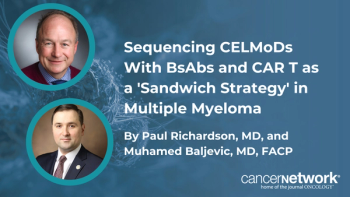
Muhamed Baljevic, MD, FACP, and Paul Richardson, MD, discuss using CELMoDs to debulk tumor or restore T-cell fitness between T-cell–redirecting therapies in relapsed/refractory multiple myeloma.

Dr. Binod Dhakal leads a discussion on the increasingly complex treatment landscape of relapsed/refractory multiple myeloma (RRMM), focusing on how clinicians navigate sequencing decisions among BCMA-directed therapies, including CAR T-cell therapy and bispecific antibodies.

The TOP trial, a phase three study focused exclusively on TP53-mutant EGFR-mutant non-small cell lung cancer, validated the FLAURA2 findings in this high-risk subset, showing a striking PFS benefit of 34.0 versus 15.6 months (HR 0.44) for osimertinib plus chemotherapy over monotherapy, with a favorable duration of response of 32.7 versus 15.9 months, though overall survival data remain immature.

Dr. Park addresses management of low-grade immune-related adverse events (irAEs), the most common toxicities encountered with checkpoint inhibitors, including dermatitis, pruritus, and GI symptoms.
Dr. Ajai Chari and NP Samantha Shenoy discuss practical considerations for long-term management of newly diagnosed multiple myeloma (NDMM), focusing on treatment duration, ongoing therapy, and patient-centered care. The faculty explore the rationale for continuous treatment approaches and how response depth, including minimal residual disease (MRD) negativity, may continue to evolve with extended therapy. The conversation emphasizes that treatment duration decisions should be individualized based on tolerability, patient preferences, comorbidities, and long-term management goals. Dr. Chari and NP Shenoy also review real-world follow-up strategies, highlighting the importance of multidisciplinary collaboration, symptom management, patient education, and shared decision-making throughout the treatment journey. Practical insights are provided regarding the role of advanced practice providers in supporting adherence, monitoring treatment-related toxicities, and helping patients navigate prolonged therapy while maintaining quality of life and optimizing clinical outcomes in NDMM.
Dr. Hamid presents a 71-year-old male smoker with coronary artery disease and a 3.5 cm cervical CSCC lesion that has recurred after multiple surgical resections and adjuvant radiation therapy.

Dr. Iyengar addresses common patient fears about vision loss, noting this represents a primary concern when discussing ocular toxicity. Dr. Sunshine provides reassurance that these represent reversible changes with appropriate monitoring and early intervention, emphasizing the importance of early detection through regular examinations.
The FLAURA2 phase three trial demonstrated that adding platinum-based chemotherapy to osimertinib significantly improved outcomes over osimertinib monotherapy in first-line EGFR-mutant non-small cell lung cancer, with a median PFS of 29.4 versus 19.9 months and a statistically significant overall survival benefit of 47.5 versus 37.6 months.
Dr. Zager outlines a monitoring strategy for the Case 1 patient who is NED following surgery and radiation.
NP Schollenberger addresses how she interprets and communicates efficacy data to patients.
Dr. Binod Dhakal and Dr. Carol Ann Huff discuss how anti-CD38 exposure versus true anti-CD38 refractoriness influences treatment selection in relapsed/refractory multiple myeloma (RRMM).
Dr. Ajai Chari and NP Samantha Shenoy review the CEPHEUS trial and discuss its contribution to the evolving frontline treatment landscape in newly diagnosed multiple myeloma (NDMM). The faculty summarize the study design and examine the rationale for incorporating daratumumab into a quadruplet regimen for patients without planned upfront transplant. The discussion focuses on the achievement of deeper responses and higher rates of minimal residual disease (MRD) negativity observed with the daratumumab-containing regimen, as well as the clinical relevance of sustained MRD negativity and response depth over time. Dr. Chari and NP Shenoy explore how MRD assessment may provide additional insight into long-term disease control and discuss the potential implications of these findings for treatment duration and future management strategies. The conversation emphasizes interpretation of emerging data while considering how evolving evidence may influence clinical decision-making in patients with NDMM.
Dr. Sunshine provides ophthalmologic perspective on Dato-DXd's unique ocular surface events, representing a new toxicity profile for breast oncology practitioners. The management approach begins with baseline patient education and ophthalmologic examination, establishing foundation for both patient awareness and professional monitoring.
Amer Zeidan, MBBS, MD, and Raji Shameem, MD, discussed using IPSS-M criteria to detect hidden high-risk biology in lower-risk MDS.

Muhamed Baljevic, MD, FACP, and Paul Richardson, MD, discuss how sparing patients from IMiD-related GI toxicity and neutropenic infections with CELMoDs may extend treatment duration and progression-free survival.
Paul Richardson, MD, and Muhamed Baljevic, MD, FACP, discuss the immunologic and mechanistic synergy between CELMoDs and standard myeloma backbone therapies.
Amer Zeidan, MBBS, MD, and Raji Shameem, MD, discuss how long-term COMMANDS data support the use of luspatercept.
Paul Richardson, MD, and Muhamed Baljevic, MD, FACP, explain how mezigdomide’s complete cereblon E3 ligase engagement overcomes IMiD resistance in heavily pretreated multiple myeloma.

Dr. Ajai Chari and Dr. Rahul Banerjee review the clinical development of talquetamab in relapsed/refractory multiple myeloma (RRMM), focusing on key findings from the MonumenTAL-1 study and the evolution of GPRC5D-directed therapy.
Dr. Ajai Chari and Dr. Rahul Banerjee discuss the growing need for therapeutic targets beyond BCMA in relapsed/refractory multiple myeloma (RRMM) and examine the rationale for GPRC5D-directed therapies.
Amer Zeidan, MBBS, MD, discussed when to start luspatercept at the full 1.75 mg/kg dose in lower-risk MDS based on the MAXILUS trial.
Nicholas Hornstein, MD, PhD, ranks RASolute 302, BREAKWATER, MATTERHORN, and more in a real-time discussion on Double Blind.

At EHA, Benoit Tessoulin, MD, PhD, shared data showing the epcoritamab/R² combination benefitted all relapsed/refractory follicular lymphoma subgroups.
Asciminib reshapes frontline CML care with fewer side effects and deeper molecular responses, while clinicians watch long-term safety and TFR results