
The panel discusses triplet and quadruplet regimen options for transplant-eligible NDMM, and the clinical implications of the DETERMINATION study.
The panel discusses triplet and quadruplet regimen options for transplant-eligible NDMM, and the clinical implications of the DETERMINATION study.
Closing out their discussion, the panel highlights unmet needs in multiple myeloma that clinicians and patients still face.
Drs Cowan and Anderson review whether older agents such as isa-based regimens still have a place in R/R MM treatment after the introduction of bispecific agents and CAR-T therapy.
Ghassan K. Abou-Alfa, MD, spoke about the recent approval of tremelimumab plus durvalumab for patients with unresectable hepatocellular carcinoma, based on results from the phase 3 HIMALAYA trial.
Shonali Midha, MD, highlights data from the DREAMM-5 study during her presentation on the use of belantamab mafodotin for late relapse multiple myeloma.
The Dana-Farber team puts Memorial Sloan Kettering to the test and questions the panel on the presented abstracts.
Dr Michael Mauro continues his presentation with a look at an analysis of the arterial occlusive events in the PACE trial in CML.
Dr Clifton Mo fields questions from the Memorial Sloan Kettering team about his presentation on IRd in relapsed/refractory multiple myeloma.
Comprehensive insight on induction therapy regimens in transplant-eligible newly diagnosed multiple myeloma based on the GRIFFIN, MASTER, and DETERMINATION clinical studies.
Expert panelists review the case of transplant-eligible newly diagnosed multiple myeloma and consider optimal selection of induction therapy.
The panel reviews a clinical scenario of metastatic urothelial carcinoma where the patient is not eligible for cisplatin treatment.
A comprehensive review of maintenance therapy strategies following chemotherapy in the context of optimizing patient outcomes.
The 12-month progression-free survival rates among patients with high-risk locally advanced cervical cancer were comparable with durvalumab plus chemoradiotherapy vs placebo plus radiotherapy.
Dr. Joyce O’Shaughnessy closes the discussion with considerations for clinicians on monitoring patients with HER2-psotive breast cancer.
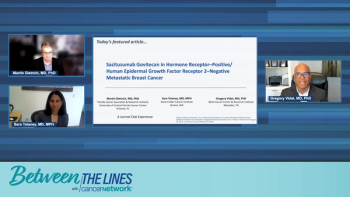
Experts discuss progression-free survival (PFS) and overall survival (OS) data from the TROPiCS-02 trial on SG versus treatment of physician’s choice.
Dr Tolaney discusses the TROPiCS-02 study design and comments on the key baseline characteristics of the patients with HR+/HER2- mBC who were enrolled in the trial.
A panel of experts discusses whether all patients with multiple myeloma should undergo transplant, and how to select the optimal treatment regimens for the treatment of transplant-eligible newly-diagnosed multiple myeloma.
Amrita Krishnan, MD, presents the case of a 63-year-old woman with transplant-eligible newly-diagnosed multiple myeloma, and Caitlin Costello, MD, describes the design and outcomes of recent trials in the transplant eligible setting.
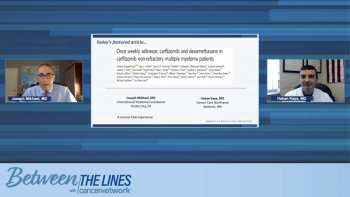
Dr Joseph Mikhael and Dr Hakan Kaya provide advice for community oncologists who use selinexor and discuss the future of selinexor in patients with R/R MM.
At 2022 IGCS, Ursula A. Matulonis, MD, spoke about the toxicity profile observed with mirvetuximab soravtansine monotherapy in patients with folate receptor α–high platinum-resistant ovarian cancer reported from the phase 3 SORAYA study.
Teclistimab and similar bispecifics can have a prolific impact on patients with heavily relapsed multiple myeloma in the short term and possibly in earlier relapses in the long term, according to Joseph Mikhael, MD.
Dr Silbermann continues her discussion of BCMA-targeting agents with a look at data on the use of bispecific agents for R/R MM treatment after a patient has already received a BCMA therapy.
Key opinion leaders compare the overall benefits of CAR-T therapy and share some advice for managing the toxicities of CAR-T therapy as a patient transitions back to their local doctor.
Joseph Mikhael, MD, discussed the need for increased diversity in clinical trials, specifically in the hematology space.
Ursula A. Matulonis, MD, spoke about the updated results of the phase 3 SORAYA trial with mirvetuximab soravtansine in patients with folate receptor α–high platinum-resistant ovarian cancer presented at 2022 IGCS.
Clifton Mo, MD, presents data from the INSURE study, a pooled analysis evaluating patients with relapsed/refractory multiple myeloma treated with Ixazomib-Lenalidomide-Dexamethasone (IRd).
Michael Mauro, MD, presents data on a phase 2 ponatinib dose-ranging study in chronic-phase CML.
Steven Frommeyer introduces the two teams of competing physicians participating in Cancer Network® Face-off.
Steven Frommeyer introduces the two teams of competing physicians participating in Cancer Network® Face-off.
Centering discussion on a clinical scenario of metastatic urothelial carcinoma, panelists determine which first-line regimen they would utilize prior to maintenance therapy.