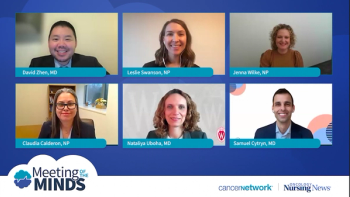
Experts on chronic myeloid leukemia delve into the important role of informed shared decision-making in the optimal treatment of patients with CML.

Your AI-Trained Oncology Knowledge Connection!


Experts on chronic myeloid leukemia delve into the important role of informed shared decision-making in the optimal treatment of patients with CML.

Jorge E. Cortes, MD, details clinical scenarios that indicate a need to switch therapies for patients with chronic myeloid leukemia.

The phase 3 Gliofocus trial aims to meaningfully improve survival and quality of life with niraparib among patients with newly diagnosed glioblastoma.

Findings from a proof-of-concept study show a potential survival benefit with niraparib/radiotherapy in patients with newly diagnosed glioblastoma.

Experts address the unique challenges in managing adverse events associated with GPRC5D therapies compared to other cancer treatments, while Samantha will discuss strategies for preparing and educating patients undergoing GPRC5D therapy.

Experts give an overview of safety data from the MonumenTAL-1 study.

Ellen Marin, PA-C, provides an overview of adverse effects associated with BCMA-directed bispecific therapy in multiple myeloma.

Surbhi Sidana, MD, spoke about multiple myeloma developments with the potential to impact clinical practice, particularly early line use of bispecific antibodies.

A panel of experts on multiple myeloma discuss long-term follow-up data from the MajesTEC-1 and MagnetisMM-3 clinical trials.

The panel analyzes how patient characteristics from the IMbrave 150 trial compare to those in other hepatocellular carcinoma studies.

Medical experts specializing in hepatocellular carcinoma (HCC) provide a detailed analysis of the IMbrave 150 study design.

It can be hard to get exposure for a new field, but Jessica Cheng, MD, has big plans on how to advance the field of cancer rehabilitation.

Surbhi Sidana, MD, discussed LINKER-MM1 trial efficacy findings, in which linvoseltamab was evaluated in patients with relapsed/refractory multiple myeloma.

Anyone undergoing cancer treatments could benefit from cancer rehabilitation, according to Jessica Cheng, MD.

Surbhi Sidana, MD, discussed outpatient supportive care for patients following immunotherapy treatment for hematologic cancers.

Jessica Cheng, MD, noted that working with patients in the field of cancer rehabilitation to improve recovery times brings her joy.

Jorge Cortes, MD, provides clinical insights on the utilization of TKIs in CML and outlines associated adverse events.

The Oncology Brothers and Jorge Cortes, MD, discuss treatment practices for patients with accelerated phase chronic myeloid leukemia.

An expert on chronic myeloid leukemia provides clinical insights on treatment practices following progression.

A hematologist-oncologist and the Oncology Brothers outline treatment paradigms for chronic phase CML and discuss patient monitoring practices.

Jorge Cortes, MD, joins Rahul Gosain, MD, and Rohit Gosain, MD, to discuss patient workup and risk stratification practices in chronic myeloid leukemia (CML).

Claire Saxton shares insights on how physicians and caregivers can best assist patients with CML who have switched therapies.

A panel of experts on chronic myeloid leukemia discuss common patient concerns, adverse effect considerations, and best practices for setting clear expectations.

Experts give an overview of long-term follow-up efficacy data from the MonumenTAL-1 study.

Medical experts give an overview of relapsed/refractory multiple myeloma, focusing on diagnosis and current management strategies

Medical oncologists discuss the overall research landscape in advanced EGFR-mutant NSCLC, highlighting exciting trials and emerging data in the evolving treatment space.

Martin Dietrich, MD, PhD, shares expert perspectives on recent data from TROPION-Lung05 and HERTHENA-Lung01 in advanced EGFR-mutant NSCLC.

Wade T. Iams, MD, provides clinical insights on proactive management strategies for patients receiving amivantamab for advanced EGFR-mutant NSCLC.

Focusing on treatment practices for patients with advanced EGFR-mutant NSCLC, Martin Dietrich, MD, PhD, discusses how the availability of subcutaneous amivantamab can potentially address current treatment barriers.

Wade T. Iams, MD, outlines insights gleaned from recently presented data from the PALOMA-3 trial in advanced EGFR-mutant non–small cell lung cancer.