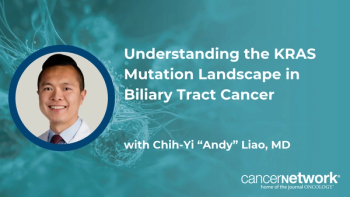
Andy Liao, MD, discusses the distribution of KRAS mutations in biliary tract cancer and the different classes of KRAS inhibitors in development.
The primary end point of ORR was met in the CAR-like T-cell arm for patients with gastric/GEJ cancer.
The combination of CAR-like T-cells, PD-1 inhibitor, and S-1 plus oxaliplatin (SOX) demonstrated clinical activity in patients with previously untreated metastatic gastric or gastroesophageal junction (GEJ) adenocarcinoma, according to results of a randomized phase 2 (ChiCTR2200061306) at the
The primary end point of objective response rate (ORR) was 76.0% (95% CI, 61.8%-86.9%) in the CAR-like T-cell group vs 50.0% (95% CI, 35.5%-64.5%) in the control group (P = .007). The disease control rate was 96.0% (95% CI, 86.3%-99.5%) vs 76.0% (95% CI, 61.8%-86.9%) between both arms respectively (P = .008).
The best response rates between the CAR-like T-cell group vs the control group was a partial response in 76% vs 50%, stable disease in 20% vs 26%, progressive disease in 4% vs 20%, and were not evaluable in 0% vs 4%. The median duration of response (DOR) was 10.3 months (95% CI, 6.6-14.0) vs 6.0 months (95% CI, 0.0-18.4; P = .414).
The median progression-free survival (PFS) was 10.3 months (95% CI, 9.3-11.3) in the CAR-like T-cell group vs 7.4 months (95% CI, 6.5-8.3) in the control group (HR, 0.64; 95% CI, 0.40-1.02; P = .0505). The subgroup analysis showed that the CAR-like T-cells was more effective in those who had 2 or more metastatic sites (HR, 0.385), peritoneum metastases (HR, 0.289), and a PD-L1 combined positive score (CPS) of 5 or more (HR, 0.221).
Any-grade adverse effects of any grade occurred in both groups The most common included thrombocytopenia, lymphopenia, leukopenia, elevated aspartate aminotransferase/alanine aminotransferase, anemia, neutropenia, and hypoproteinemia. Treatment-related adverse effects of grade 3 or higher, as well as serious adverse effects, were comparable between both arms.
Regarding exploratory outcomes, patients in the CAR-like T-cell group were stratified to either group A, having a PFS of at least 1 year, or group C, having a PFS of less than 6 months. In the CAR-like T-cell group, there was a more favorable efficacy in patients with tumors that had high levels of PD-L1, integrin αvβ3, and neuropilin 1.
“CAR-like T cells are cytokine activated T lymphocytes engineered with the tumor-targeting and penetrating peptide iRGD, which is anchored to the T-cell surface via lipid insertion, eliminating the need for genetic manipulation,” Qin Liu, MD, PhD, Department of Oncology, Nanjing Drum Tower Hospital & Group’s Suqian Hospital, in Nanjing China, said during the presentation. “In preclinical studies, we demonstrated that these cells showed synergistic antitumor effects with PD-1 blockade.”
Patients were randomly assigned 1:1 to either the CAR-like T-cell plus 1 Gy of radiation therapy plus PD-1 monoclonal antibody plus SOX for 6 cycles or less followed by PD-1 monoclonal antibody plus S-1 (n = 50) or PD-1 monoclonal antibody plus SOX for 6 cycles or less followed by PD-1 monoclonal antibody plus S-1 (n = 50). The primary end point was ORR, with secondary end points of PFS, DOR, and overall survival. Key eligibility criteria included having previously untreated, unresected, or metastatic gastric/GEJ adenocarcinoma; no known HER2-positive status; and an ECOG performance status of 0 to 1.
The data cutoff was November 3, 2025. The median follow-up was 15.8 months.
Overall, 75% of patients were male, 76% were younger than 70 years old, 63% had an ECOG performance status of 1, and 93% had gastric cancer. Additionally, 58% of patients had 2 or more metastatic sites, 43.5% had peritoneum metastasis, 39% had a PD-L1 CPS of less than 1, and 99% had microsatellite stable/mismatch repair–proficient disease.
Liu Q, Zhang L, Shao J, et al. SOX (tegafur plus oxaliplatin) plus anti-PD-1 antibody with or without CAR-like T cell immunotherapy in the treatment of patients with previously untreated metastatic gastric cancer/gastroesophageal junction adenocarcinoma: a multicenter, open-label, randomized, controlled, phase II trial. J Clin Oncol. 2026;44(suppl 2):291. doi:10.1200/JCO.2026.44.2_suppl.291