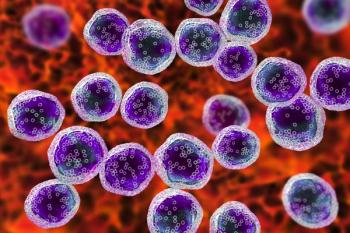
Peter Forsyth, MD, discusses a first-in-human trial of intrathecal dendritic cell therapy for leptomeningeal disease from breast cancer.
Germline platelet polygenic risk score predicted a 37% higher risk of death in patients with renal cell carcinoma, mediated by sustained thrombocytosis.
At the
Crucially, the researchers found that this genetic signal "washed out" when adjusted for clinical platelet levels, confirming that the survival impact is directly mediated through sustained thrombocytosis. This finding suggests that elevated platelets in RCC are not merely reactive to the tumor or therapy but are partially driven by a patient’s baseline genetic set point. Although higher platelet counts are already an established component of the International Metastatic RCC Database Consortium (IMDC) risk score, these findings add a layer of inherited predisposition to the prognostic landscape. However, the authors noted that the study was restricted to patients of European ancestry, highlighting the need for future validation across diverse ethnic populations to ensure the PRS platform’s global portability and utility.
Barrios is a postdoctoral fellow and medical oncologist at the Dana-Farber Cancer Institute. Saleh is a postdoctoral fellow at the Dana-Farber Cancer Institute.
Barrios: We know that polygenic risk scores in kidney cancer have already been established [as] predictive of incidents previously, but we have not yet seen any inherited germline data predicting outcomes before. That was part of the rationale that [partially] triggered all of this; something well established is that higher platelet counts are associated with worse prognosis in kidney cancer. Platelet counts are a risk factor at the IMDC risk score that's well established.
To this day, we already have hundreds of polygenic risk scores that are associated with hematologic blood traits, circulated blood traits. The whole idea was to combine all of [these traits] and try to answer a simple question: If we look at inherited germline determinants of hematologic blood traits, could that be associated with survival in kidney cancer? That's the whole background. That's how we got there.
Saleh: Going into the methods of what we did in the study, we compiled a cohort of 495 patients with kidney cancer. These patients had undergone tumor sequencing at the Dana-Farber Cancer Institute. And we used the pipeline called STITCH, which was developed by our mentor, Alexander Gusev, PhD, which imputes germline genetics from targeted sequencing using a reference genome. We end up with a cohort of patients who have germline genetics and specific outcomes that were measured and collected through clinical data operation. And we tested the association of multiple polygenic risk scores that Barrios mentioned in the literature—more than 300 polygenic risk scores—with the outcome of interest, which was overall survival.
Two polygenic risk scores met significant results, and this was also confirmed with false discovery rate, and most interesting was the polygenic risk score of platelets. And it tells us the results are that patients who have higher polygenic risk scores of platelets have 37% higher risk of death, and this is specifically the main result. Other things that we also studied are looking at the adjustment of platelet levels in these patients. What happens after we adjust for the platelet counts that we have? And when we adjusted for this platelet level, we interestingly saw that the polygenic risk score signal that we were seeing washed out. And this tells us that this effect that we're seeing of polygenic risk score with overall survival is mediated through platelet counts and it's not another pathway that's being involved in here.
This is very important, because we have the IMDC score that already has platelet counts involved. This adds to this another layer to how we look at thrombocytosis in patients with kidney cancer. And it tells us from the beginning, from baseline, germline DNA, how this can affect survival in these patients who have kidney cancer.
All in all, it's telling us that [for] patients who have thrombocytosis, it's not only due to the therapy that the patient is receiving and it's not only due to the cancer diagnosis that patients have; it's also due to the germline characteristics that they have that influence thrombocytosis and have impact on the platelet levels and survival. Basically, patients with a higher risk score have higher platelet levels, and therein, they have worse survival.
Saleh: We didn't get into this specific analysis, but that's something we could potentially do in the future. One way we could look at it is stratifying the patients based on [those] who have a higher polygenic risk score vs the patients who have low scores based on a median cutoff and looking at how patients’ platelet levels differ after therapy and before therapy.
Barrios: We need to have pre- and postlevels.
Saleh: [That’s a question] that we didn't tackle in the paper, but that's a good question, because…this cohort of patients whom we used was patients with European ancestry, and we did a PCA [principal components analysis], and we restricted to patients with European ancestries. What we're looking at is only the association of patients from European ancestry.
If you would look at other ancestries, that would be also a great aspect to look at it, because what we're seeing in the germline genetics for it right now is that not all polygenic risk score results that we're seeing are seen in other ancestries, and this is what we call portability of polygenic risk scores: if we're able to actually take this polygenic prescript to another ancestry and see the same result that we're seeing. We didn't tackle this in our study, but this is something very relevant to look at.
Barrios: Next steps are validating [this platform] into bigger [populations] in the independent cohorts. We'll see if that's coming up.
Saleh: Another thing that would be interesting to look at is progression-free survival, if it can predict response to therapy, and, as well, disease-free survival. [We’ll] see patients who had surgery and see if it can predict recurrence after surgery. Another thing that I got from the poster session that would be interesting is to look at another cohort of patients who would be a control of patients without cancer and see their polygenic risk from the UK Biobank. That would be a great cohort to work with.
Saleh M, Saad E, Barrios P, et al. Germline platelet polygenic risk score to predict renal cell carcinoma survival via sustained thrombocytosis. J Clin Oncol. 2026;44(suppl 7):543. doi:10.1200/JCO.2026.44.7_suppl.543
![“[E]ven if patients relapse following an allogeneic transplant, donor lymphocyte infusions can be incredibly helpful,” said Mary Jo Lechowicz, MD.](https://cdn.sanity.io/images/0vv8moc6/cancernetwork/06df696db42b151710c58727b1333ee098de6453-1200x800.jpg?w=350&fit=crop&auto=format)


!["Patients [with cancer] and physicians would rather have a fixed-duration treatment, if possible," said Julie M. Vose, MD, MBA, at SOHO 2026.](https://cdn.sanity.io/images/0vv8moc6/cancernetwork/1cfb57db416943d8f8690afb0bc0d13aa3d90683-400x400.jpg?w=350&fit=crop&auto=format)