

Opinion|Videos|January 23, 2025 (Updated: January 23, 2025)
Updates and Clinical Implications of DESTINY-Lung02 and DESTINY-Lung03 Trials
Author(s)Misako Nagasaka, MD, PhD
Panelist discusses how the DESTINY-Lung02 trial was a dose optimization study where patients with HER2-mutated non–small cell lung cancer (NSCLC) were randomly assigned to a starting dose of 5.4 mg/kg vs 6.4 mg/kg of trastuzumab deruxtecan (T-DXd). DESTINY-Lung03 was a frontline study for HER2 overexpression in NSCLC looking at different combinations of treatment with T-DXd and immunotherapy agents with or without chemotherapy.
Advertisement
Episodes in this series
Video content above is prompted by the following:
- Review updates and discuss the clinical implications from the following trials:
- DESTINY-Lung02 (Janne PA. 2024 American Society of Clinical Oncology Annual Meeting. Abstract 8543)
- DESTINY-Lung03 part 1 (Planchard D. World Conference on Lung Cancer 2024. Abstract 730)
- Please highlight any other trials of note in NSCLC and share your approach to clinical decision-making.
Advertisement
Related to this article
Chinmay Jani, MD, describes how he counsels patients with and without a smoking history on a lung cancer diagnosis.
Chinmay Jani, MD, discusses ASCO 2026 data on lung cancer trends in younger adults and why this group has been overlooked.

Chinmay Jani, MD, explains how air pollution and asbestos contribute to lung cancer deaths beyond tobacco.

Chinmay Jani, MD, highlights non-smoking risk factors, the impact of lung cancer on younger populations, and the value of comprehensive molecular testing.
Dwight H. Owen, MBBCh, MS, discussed why severe immune-related toxicities remain hard to predict as immunotherapy combinations expand in lung cancer.

Presentations at ESMO Congress 2026 detailed how surgery, radiation oncology, and supportive care can contribute to the treatment of patients with NSCLC.
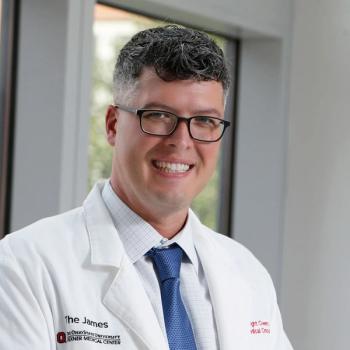
"As we combine more treatments…they have overlapping toxicities, and they may have the ability to synergize in a negative way," said Dwight H. Owen, MBBCh, MS.
Advertisement
Advertisement
Trending on CancerNetwork
1
What Separates a Next-Generation Liver Tumor Board From the Traditional Model?
2
Weighing Immunotherapy for Bridging and Downstaging Before HCC Transplant
3
BOT+BAL Yields Long-Term Survival in Patients With Refractory MSS mCRC
4
MASLD Raises Liver and Other Cancer Risks, Supporting Selective HCC Surveillance
5