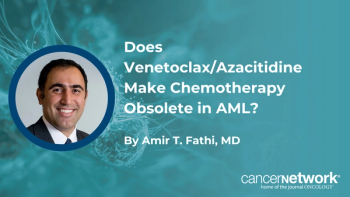
Amir T. Fathi, MD, explains which AML subgroups were excluded from PARADIGM and why chemotherapy remains standard for them.
Patients with AML will experience different toxicities based on the treatment they receive, whether it is intensive chemotherapy or targeted therapy.
Currently, patients with acute myeloid leukemia (AML) often receive 7+3 standard intensive chemotherapy, and the toxicities associated with it are the same as what is commonly shown in media, Daniel Peters, MD, stated. When prompted about toxicities that patients with AML might experience during treatment, Peters, an assistant professor of Hematology and Oncology in the Department of Medicine at the Medical College of Georgia of Augusta University and bone marrow transplant & cellular therapy faculty member at Georgia Cancer Center, spoke at length about the possibilities.
As he said, patients who receive 7+3 chemotherapy may experience nausea and vomiting because they have prolonged periods of myelosuppression or low blood counts; they are also at a high risk of infection. Often, these patients are admitted to a hospital.
With the current standard of care, azacitidine (Vidaza) plus venetoclax (Venclexta), there are similar adverse effects compared with what is experienced with 7+3 chemotherapy; however, the most common toxicity with this standard is febrile neutropenia. Regarding immunotherapy, although they aren’t very common in AML, the most common toxicity is hepatic dysfunction. Lastly, with targeted therapies, Peters made note of differentiation syndrome as well as fever, shortness of breath, weight gain, and fluid retention.
This conversation occurred as part of a CancerNetwork® site visit to Georgia Cancer Center.
Transcript:
For the standard intensive chemotherapy, we’re still stuck, for the most part, with 7+3, which is an anthracycline along with cytarabine. These are the [adverse] effects and toxicities that most patients will think about in movies or TV shows. You have prolonged periods of myelosuppression or low blood counts. You have things like nausea and vomiting requiring frequent transfusional support with red blood cells/platelets. You’re at high risk for infection when the blood counts are low, so you’re at risk for fever. For the most part, these patients are going to be admitted to the hospital, and [we]...support with transfusions of red blood cells/platelets; getting IV antibiotics; and [mitigating] the nausea, vomiting, hair loss, and [other] types of [adverse] effects.
Going down the lower intensity treatment pathway, the standard of care in this day and age is the combination of azacitidine plus venetoclax. With the toxicities, there’s some overlap. This is a pretty myelosuppressive regimen, so patients are increasingly being treated with this regimen as an outpatient. The most common things that we’ll see with this are myelosuppression [and] febrile neutropenia. It’s about a coin flip in patients who are treated with this regimen, so there’s a high likelihood that patients treated with this will have fever and end up back in the hospital. They’re also going to need intensive transfusional support with red blood cells and platelets for the first cycle or 2 until the leukemia is under control. Those are the main toxicities in broad strokes.
Unfortunately, there aren’t a ton of immunotherapies approved yet. In this day and age, for AML, we don’t have immune checkpoint inhibitors like in solid tumors. We don’t have a lot of good CAR T-cell options yet, but probably the most notable immunotherapy, at least in AML, is going to be gemtuzumab ozogamicin [Mylotarg], which is commonly given in the upfront setting to patients who have favorable or core binding factor leukemia. The most notable toxicity with that is going to be hepatic dysfunction, or liver dysfunction, so just watch the liver enzymes.
The other toxicity I’ll mention would be those associated with some of the targeted agents that we have available. Circling back to what we talked about at the beginning, “How are we treating our patients up front if they have one of these molecular mutations that has a targeted agent?” [There are] FLT3 inhibitors, [like] quizartinib [Vanflyta] or midostaurin [Rydapt], [for] one of the IDH1/2 mutations, and now, newly approved, there are some inhibitors of menin that are also out there. With these targeted agents, the big toxicity to think about or look out for is differentiation syndrome, which, in short, is where the leukemic blasts are released from their primitive stage, and they differentiate. They can cause a lot of problems. The big things to look out for are fever, shortness of breath, weight gain, and fluid retention. That’s important for both the clinician to know, but also [for] patients being treated with these regimens to be aware of, so that they can look out for them and have them addressed quickly.