




Multiple Myeloma
Latest News
Advertisement
Latest Videos




























































Advertisement
More News

Eye-related adverse effects after treatment for relapsed/refractory multiple myeloma in DREAMM-7 appear manageable with dose and schedule changes.
Giving tocilizumab before step-up dosing of teclistamab may mitigate cytokine release syndrome in relapsed/refractory multiple myeloma.
Responses occurred in patients with relapsed/refractory multiple myeloma who are refractory to daratumumab but received retreatment with the agent.
Triplet therapies containing belantamab mafodotin may fulfill an unmet need for patients with multiple myeloma following the first relapse.

Surbhi Sidana, MD, provides clinical insights on treatment sequencing strategies for patients with relapsed/refractory multiple myeloma.

Experts on multiple myeloma provide their impressions of the CARTITUDE-4 and KarMMa-3 studies, which led to the approval of cilta-cel and ide-cel in earlier lines of treatment for patients with relapsed/refractory disease.
Myeloma specialists have a comprehensive discussion on CAR T-cell therapy, highlighting treatment selection considerations, adverse event management strategies, unmet needs, and ongoing research.

Myeloma specialists discuss clinical trials investigating CAR T-cell therapies in patients with relapsed/refractory disease.

The FDA has set a Prescription Drug User Fee Act Date of September 27, 2024, for the isatuximab combination in transplant-ineligible NDMM.

Despite increased education on autologous HCT, a lower rate of Black patients with multiple myeloma undergo treatment.
The panel discusses recent updates on bispecific antibodies for patients with relapsed/refractory multiple myeloma, highlighting studies investigating talquetamab, teclistamab, and elranatamab.
Focusing on later lines of therapy for patients with relapsed/refractory multiple myeloma, the panel provides key takeaways on the CARTITUDE-1 and KarMMa trials that investigated cilta-cel and ide-cel.
A panel of experts on multiple myeloma introduce themselves and discuss recent CAR T-cell therapy approvals in earlier treatment lines for patients with relapsed/refractory disease.
Yi Lin, MD, PhD, provides insights on the impact of CAR T-cell therapy on the evolving multiple myeloma treatment landscape.

Advanced practice providers focus on the case of a patient diagnosed with multiple myeloma who lives in a rural area with limited access to care.
Rahul Banerjee, MD, FACP, discusses how the emergence of CAR T-cell therapy has impacted the multiple myeloma treatment landscape by addressing unmet needs and improving patients’ quality of life.
A panel of experts on multiple myeloma discuss the rationale for CAR T-cell therapy, highlighting BCMA as a target and treatment administration practices.
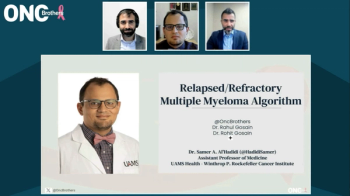
Samer Al'Hadidi, MD, offers advice to community oncologists who treat patients with relapsed/refractory multiple myeloma, and the Oncology Brothers recap the entire discussion.
Rohit Gosain, MD, and Rahul Gosain, MD, are joined by Samer Al'Hadidi, MD, to discuss treatment decision-making strategies for patients with relapsed/refractory multiple myeloma.
In a discussion with the Oncology Brothers on the treatment of patients with relapsed/refractory multiple myeloma, Samer Al'Hadidi, MD, discusses adverse effects associated with CAR T-cell therapy and bispecific antibodies.
An expert on the treatment of multiple myeloma discusses the role of CAR T-cell therapy in relapsed/refractory disease.
Samer Al'Hadidi, MD, discusses monitoring strategies for patients with relapsed/refractory multiple myeloma who are receiving lenalidomide.
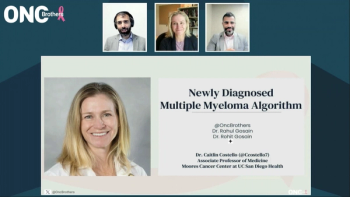
Caitlin Costello, MD, offers concluding remarks and guidance to healthcare providers on optimizing multiple myeloma patient care.
A medical expert shares her treatment approach for a high-risk multiple myeloma patient, considering transplant eligibility, dose escalations, and maintenance therapy based on induction regimen and patient risk factors.
Caitlin Costello, MD, shares insights on the role of minimal residual disease (MRD) assessment in the multiple myeloma treatment process, including its impact on induction therapy and disease monitoring.
Advertisement
Advertisement
Trending on CancerNetwork
1
Meaning-Centered Therapy, Psychiatry Referrals, and Humanistic Cancer Care
2
How Psycho-Oncology Addresses Existential Distress, Body Image, and Intimacy
3
FDA Approves Dostarlimab in Previously Untreated Locally Advanced Rectal Cancer
4
Targeting Cyclin E1, KRAS, and DNA Repair Beyond PARP in Ovarian Cancer
5