




Multiple Myeloma
Latest News
Advertisement
Latest Videos






























































Advertisement
More News
CancerNetwork® sat down with Luciano Costa, MD, PhD, at the 2021 International Myeloma Workshop to highlight key lessons that COVID-19 pandemic taught him.

After reviewing the case of a patient with transplant-eligible newly-diagnosed multiple myeloma, experts consider optimal selection of first-line treatment.

After reviewing implications of the MAIA study in multiple myeloma, experts consider unmet needs and future directions in care.
Panelists discuss the case of a 77-year-old man with newly diagnosed multiple myeloma who wishes to discontinue therapy after achieving a very good partial response.
CancerNetwork® sat down with Luciano Costa, MD, PhD, at the 2021 International Myeloma Workshop to talk about how the COVID-19 pandemic affected his work and how they adapted.
CancerNetwork® sat down with Luciano Costa, MD, PhD, at the 2021 International Myeloma Workshop to discuss the benefit of treatment with daratumumab, carfilzomib, lenalidomide, and dexamethasone and the population of patients with newly diagnosed myeloma who will best benefit from treatment.

Patients with high-risk smoldering myeloma who were treated with carfilzomib, lenalidomide, and dexamethasone and lenalidomide maintenance experienced an improvement in minimal residual disease–negative complete response and could have delayed end-organ disease.
CancerNetwork® sat down with Fredrik Schjesvold, MD, PhD, at the 2021 International Myeloma Workshop to talk about minimal residual disease and its importance in the treatment of multiple myeloma.
A panel of hematologists/oncologists conclude a discussion about transplant-ineligible multiple myeloma (MM) by reacting to current treatment gaps that need to be addressed.
Experts review the case of a 75-year-old woman with newly diagnosed multiple myeloma and discuss treatment selection, continuation, reduction, and duration.
In-depth considerations for available frontline therapy regimens for patients with transplant-ineligible multiple myeloma.
Recommendations when talking with patients with transplant-ineligible multiple myeloma (MM) who request to stop receiving treatment.
The phase 1b/2 CARTIRUDE-1 study found deep and durable responses, along with a tolerable safety profile with the recommended phase 2 dose of ciltacabtagene autoleucel for patients with relapsed or refractory multiple myeloma.
CancerNetwork® sat down with Luciano Costa, MD, PhD, at the 2021 International Myeloma Workshop to discuss key implications from the phase 2 MASTER trial, utilizing daratumumab, carfilzomib, lenalidomide, and dexamethasone.
Triggers that may lead a hematologist/oncologist to consider reinstituting therapy for a patient with transplant-ineligible multiple myeloma (MM) who received prior therapy but was not treated to progression.

A panel of experts reflects on appropriate actions to take after a patient achieves adequate response to therapy for transplant-ineligible multiple myeloma.
Shared insight on how best to assess a patient’s response to therapy for transplant-ineligible multiple myeloma.
The rationale behind treating patients with newly diagnosed transplant-ineligible multiple myeloma (MM) until disease progression rather than stopping therapy at a designated point in time.
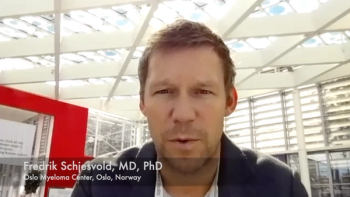
CancerNetwork® sat down with Fredrik Schjesvold, MD, PhD, at the 2021 International Myeloma Workshop to talk about how he would like to see the OCEAN trial and Melflufen progress for relapsed/refractory multiple myeloma.
CancerNetwork® sat down with Luciano Costa, MD, PhD, at the 2021 International Myeloma Workshop to talk about the most common adverse effects experienced from the quadruplet drug treatment for patients with multiple myeloma.
CancerNetwork® sat down with Fredrik Schjesvold, MD, PhD, at the 2021 International Myeloma Workshop to discuss the differences in safety profiles between melflufen/dexamethasone and pomalidomide/dexamethasone in relapsed/refractory multiple myeloma.
Take-home points from the MAIA trial of daratumumab plus lenalidomide and dexamethasone as therapy for patients with newly diagnosed transplant-ineligible multiple myeloma, and recommendations regarding maintenance therapy following the use of a triplet regimen.
CancerNetwork® sat down with Fredrik Schjesvold, MD, PhD, at the 2021 International Myeloma Workshop to talk about importance of subgroups when administering melflufen and dexamethasone to patients with relapsed/refractory multiple myeloma.
CancerNetwork® sat down with Luciano Costa, MD, PhD, at the 2021 International Myeloma Workshop to talk about the most important data from the phase 2 MASTER trial in newly diagnosed multiple myeloma.
Panelists elucidate how to determine transplant ineligibility and the goals of therapy while managing a patient with multiple myeloma.
Advertisement
Advertisement
Trending on CancerNetwork
1
Meaning-Centered Therapy, Psychiatry Referrals, and Humanistic Cancer Care
2
How Psycho-Oncology Addresses Existential Distress, Body Image, and Intimacy
3
How to Work With a Patient Who Declines Cancer Treatment
4
Acid Reducers, Drug-Drug Interactions, and Setting Expectations for Response
5