


Multiple Myeloma
Latest News

Advertisement
Latest Videos






























































Advertisement
More News

During a discussion at ASCO 2021, Mounzer Agha, MD, talked about mitigation strategies used by the investigators from the CARTITUDE-2 trial to prevent cognitive and neuro-movement disorders commonly associated with CAR T-cell therapy.

The FDA has requested a partial clinical hold on all trials featuring melflufen following the updated results of the phase 3 OCEAN study in relapsed/refractory multiple myeloma.

Moreau detailed the patient characteristics of those enrolled on the CASSIOPEIA trial, which investigating bortezomib, thalidomide and dexamethasone plus daratumumab in patients with newly diagnosed multiple myeloma.
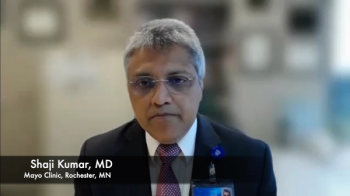
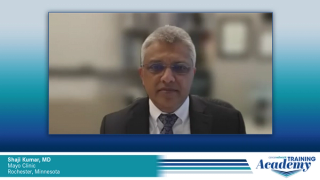
At EHA 2021, Shaji Kumar, MD, reflects on the significance of 5-year data from the MAIA study of a daratumumab combination in patients with multiple myeloma.

Agha emphasized that the annual conference allows investigators to set the foundation for what’s to come in the treatment of multiple myeloma and other hematologic malignancies.

Final overall survival results from TOURMALINE-MM1 failed to show statistical significance of an ixazomib combination for relapsed/refractory multiple myeloma overall.
Usmani detailed the primary results from CARTITUDE-1, focusing on overall response rate and stringent complete responses.
Moreau discussed the implications of the second part of the CASSIOPEIA trial at the 2021 ASCO Annual Meeting.
At EHA 2021, Shaji Kumar, MD, reflects on the significance of 5-year data from the MAIA study of daratumumab plus lenalidomide/dexamethasone in patients with newly diagnosed multiple myeloma.

Ixazomib plus daratumumab and low-dose dexamethasone yielded a high response rate and improved quality of life in frail patients with newly diagnosed multiple myeloma.
Moreau highlighted important updates in the field of multiple myeloma, including the CARTITUDE-1 trial, which yielded promising results with ciltacabtagene autoleucel and read out at the 2021 ASCO Annual Meeting.
Shaji Kumar, MD, talks about 5-year follow-up data regarding the use of daratumumab, lenalidomide, and dexamethasone in patients with multiple myeloma who are not eligible for transplant.
Usmani highlighted the FORTE study as one of the trials investigating the high-risk cohort of patients.
Usmani discussed the common adverse events observed from CARTITUDE-1, including hematologic events and cytokine release syndrome.
At the 18-month follow-up, the CAR T-cell therapy led to early, deep, and durable responses with a manageable safety profile in patients with relapsed/refractory multiple myeloma.
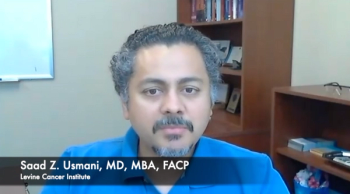
Usmani noted the strong overall response and stringent complete response rates observed with ciltacabtagene autoleucel for multiple myeloma at a median follow-up of 18 months.
An end-of-study analysis of the LYRA trial found that patients with treatment-naïve and relapsed multiple myeloma achieved durable responses to daratumumab plus CyBorD induction followed by daratumumab maintenance therapy.

Agha detailed updated findings from CARTITUDE-2 investigating cilta-cel for previously treated patients with multiple myeloma.
Close monitoring for neurologic toxicity resulted in no long-term effects in a patient cohort treated with ciltacabtagene autoleucel for relapsed/refractory multiple myeloma.

After almost 5 years of follow-up, results strongly support upfront daratumumab with lenalidomide and dexamethasone as a new standard of care for patients with transplant-ineligible newly diagnosed multiple myeloma.

Patients with myeloma who received bortezomib, thalidomide, and dexamethasone with autologous stem cell transplant had better response duration when daratumumab was used as maintenance therapy.
Treatment with the CAR T-cell therapy ciltacabtagene autoleucel significantly improved outcomes for patients with relapsed or refractory multiple myeloma when compared with conventional therapies.

Data from the OPTIMUM/MUKNINE trial presented at 2021 EHA Congress show promise for daratumumab plus CVRd as induction in patients with multiple myeloma and certain high-risk disease factors.

Cilta-cel Improved Responses and Survival Over SOC Regimens in Triple-Class Exposed Multiple Myeloma
The standard of care cohort comprised of patients across 3 global trials acted as a comparator for treatment with cilta-cel in patients with triple-class exposed multiple myeloma.

Further investigation will determine if initial results regarding the use of anakinra as prophylaxis for orvacabtagene autoleucel in multiple myeloma is efficacious enough for use in the real-world setting.
Advertisement
Advertisement
Trending on CancerNetwork
1
Meaning-Centered Therapy, Psychiatry Referrals, and Humanistic Cancer Care
2
How Psycho-Oncology Addresses Existential Distress, Body Image, and Intimacy
3
Acid Reducers, Drug-Drug Interactions, and Setting Expectations for Response
4
How to Work With a Patient Who Declines Cancer Treatment
5