



Oncology
Latest News

Advertisement
Latest Videos




































































Advertisement
More News

Expert oncologists look toward future utilization of circulating tumor DNA testing and consider how the field of oncology may evolve.

Shared insight on how circulating tumor DNA may be used in real-world clinical practice to improve the value of cancer care.
Primary and secondary end points from the phase 2 PIONEER trial assessing avapritinib in nonadvanced systemic mastocytosis were met.

Focusing broadly on breast cancer, expert oncologists detail how ctDNA may impact patient monitoring and treatment decisions moving forward.
Moving on to the second patient scenario, panelists elucidate the value of ctDNA in patients with triple-negative breast cancer.

ONCOLOGY Co-Editor-in-Chief Julie M. Vose, MD, MBA, explores high drug costs and financial toxicity.
In the context of clinical trial data and personal experience, experts weigh the value of circulating tumor DNA as a tool in cancer care.
Experts share their perspective on clinical trial data driving the use of circulating tumor DNA in various settings of cancer care.
Focusing on breast cancer, lung cancer, and GI cancers respectively, expert oncologists review the utility of circulating tumor DNA assays.
Expert panelists elucidate the mechanisms of ctDNA and MRD testing, providing a broad perspective on how they are used in cancer care.

Patients with solid tumors undergoing treatments with chemotherapy, immunotherapy, or chemoimmunotherapy mounted an adequate antibody response to the mRNA-1273 COVID-19 vaccine.
Looking toward the future management of solid tumors with NRG1 fusions, expert panelists consider how the availability of seribantumab therapy may impact their practice.
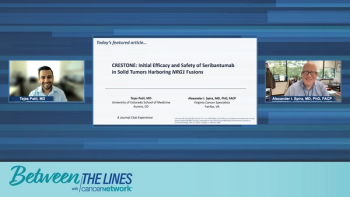
A brief review of key takeaways from the CRESTONE clinical trial of seribantumab therapy in solid tumors with NRG1 fusions.
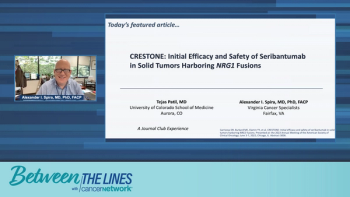
Closing out their review of data from the CRESTONE clinical trial, expert panelists highlight the duration and depth of response with seribantumab therapy.

Patients with ALK-positive inflammatory myofibroblastic tumors can now receive treatment with crizotinib following the agent’s approval by the FDA.
Shared insight on key efficacy data from the CRESTONE clinical trial of seribantumab therapy in solid tumors with NRG1 fusions.
Expert perspectives on the trial design of and safety data from CRESTONE, which analyzed seribantumab therapy in solid tumors with NRG1 fusions.
Treatment strategies might be better tailored through the use of next-generation sequencing to detect NRG1 fusions.
Patients with TRK fusion–positive disease experienced promising survival outcomes following treatment with larotrectinib vs standard of care.
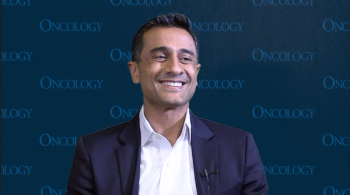
Shubham Pant, MD, spoke to the potential of ELI-002 2P as a treatment for minimal residual disease positivity in patients with KRAS-mutant solid tumors.
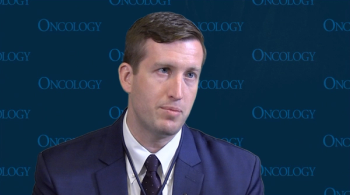
Benjamin Cooper, MD, discussed potential future studies exploring TAK-676 plus pembrolizumab after radiation for those with solid tumors.
Patients with RET fusion–positive solid tumors continued to experience benefit from treatment with selpercatinib, according to extended follow-up from the phase 1/2 LIBRETTO-001 basket study.

Key leaders in the oncology space discuss unique cancer risk factors, barriers to care, and ways in which institutions and organizations are creating more welcoming environments for individuals within the LGBTQ+ community.

Suneel D. Kamath, MD, spoke with CancerNetwork® about the latest research from the journal ONCOLOGY® on how financial conflicts of interest correlate with success of early-career academic oncologist.
Benjamin Cooper, MD, discussed an ongoing trial examining TAK-676 in combination with pembrolizumab after radiation therapy for patients with non–small cell lung cancer, head and neck cancer, and triple-negative breast cancer.
Advertisement
Advertisement
Trending on CancerNetwork
1
Sequencing Bispecifics and CAR T-Cell Therapy in Myeloma and AL Amyloidosis
2
Clinical Applications and the Future of Remote Endovascular Procedures
3
Building a Low-Dose Radiation Therapy Program for Benign Disease
4
FDA Approves Atezolizumab/Chemo for Stage III dMMR Colon Cancer
5