





























































Patients treated for RCC with atezolizumab plus bevacizumab reported fewer impacts to daily function and quality of life than those on sunitinib.
Patients treated for RCC with atezolizumab plus bevacizumab reported fewer impacts to daily function and quality of life than those on sunitinib.
In the randomized phase III iNNOVATE trial, adding ibrutinib to rituximab significantly improved PFS in patients with Waldenström macroglobulinemia.
Administering pembrolizumab before EGFR TKIs may be inappropriate for TKI-naive patients with EGFR-mutant NSCLC.
In TRANSCEND NHL 001, the CD19-directed 4-1BB CAR T-cell product lisocabtagene maraleucel yielded durable responses in heavily pretreated R/R DLBCL.
Adding pembrolizumab to pemetrexed and carboplatin for advanced nonsquamous NSCLC is associated with improved overall survival at 24 months.
Pembrolizumab represents a new standard first-line treatment option for PD-L1–expressing advanced/metastatic NSCLC, according to KEYNOTE-042 investigators.
In MMY1001, median PFS was 14.1 months and median OS was 21.1 months in patients with lenalidomide-refractory myeloma treated with daratumumab/carfilzomib.
Combining the ALK inhibitor with this immunotherapeutic agent had an acceptable safety profile and yielded an ORR of 85.7%, South Korean investigators reported.
The addition of atezolizumab to chemotherapy was associated with superior PFS but did not improve preliminary OS.

In this podcast, ASCO Educational Book contributor Dr. Shilpa Grover, from Brigham and Women’s Hospital, describes GI and hepatic AEs encountered in patients on ICI therapy.
Obese patients survived longer during immune checkpoint blockade for metastatic lung cancer compared with underweight patients and those who lost weight during treatment.
Pembrolizumab has shown activity against some lung cancer metastases in the brain, but responses can be discordant with extracranial tumor responses.
Activating oncogene mutations do not predict lung tumor responses to immune checkpoint blockade, ImmunoTarget investigators found.
TPIV200 stimulates T cells to attack ovarian and triple-negative breast tumor cells that over-express the folate receptor alpha protein.
Investigators concluded further investigations are warranted in elderly patients with either stable or responsive disease after bortezomib induction therapy.
Activating CD40 is “a key to initiating a T-cell response to tumors,” says Dr. Robert Vonderheide, MD, director of U Penn’s Abramson Cancer Center.
A retrospective study of ICIs by French investigators found manageable toxicity in patients over age 70, and survival outcomes comparable to younger patients.

In this podcast, Dr. Debra Patt discusses trends in cancer care, including how treatments are becoming more personalized and less toxic.
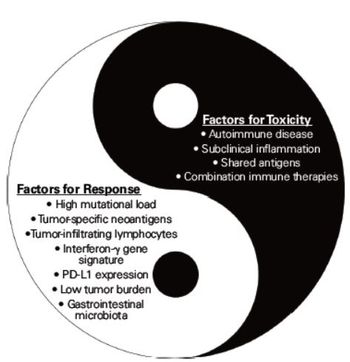
In this article, we detail the experience with immune checkpoint inhibitors in patients with autoimmune disease.

Drs. Kato and Kurzrock discuss the potential reasons why some cancer patients experience hyperprogression of disease while on immunotherapy treatment.
Given disconcerting low success rates overall in immunotherapy, some leading oncologists are calling for greater scientific rigor in clinical trial design.

Dr. Stephen Baylin discusses his 2018 AACR meeting presentation on SU2C research into using epigenetic therapy to boost immune checkpoint therapy.
A phase III study by Dr. Robert Motzer and colleagues in NEJM found significantly higher OS and ORRs with the immunotherapy combination.
A significant number of patients receiving immune checkpoint inhibitor therapy have developed myocarditis, but the reasons behind it are still unclear.

Medicial oncologist and melanoma expert Dr. Jeffrey Weber discusses the role of adjuvant immunotherapy in the setting of stage III melanoma.