Immunohistochemistry presents a solution to the obstacles that the different identified cellular neighborhoods in pancreatic tumors create.

Your AI-Trained Oncology Knowledge Connection!


Immunohistochemistry presents a solution to the obstacles that the different identified cellular neighborhoods in pancreatic tumors create.

Panelists discuss how ongoing trials may reshape the treatment landscape for HER2-altered NSCLC, particularly regarding the roles of ADCs and TKIs in managing both HER2-mutated and HER2-overexpressing NSCLC.

Researchers are trying to figure out how to create immune memory with immunotherapy in patients with pancreatic cancer.

Medical use of AI increases every day, and in the future, will be exponentially greater and many forms of treatment will be improved, according to Russell C. Langan, MD, FACS, FSSO.

Performing ablation and injecting tumor sites with immunotherapy may be “synergistic”, according to Jason R. Williams, MD, DABR.

Shubham Pant, MD, MBBS, highlights an “exciting time” in the treatment of patients with RAS-mutated pancreatic cancer.

Panelists discuss how community centers can effectively implement bispecific antibody therapy for patients with relapsed/refractory multiple myeloma, addressing challenges such as staff training, patient monitoring, and managing potential adverse events in a non-academic setting.

Greater direct access to academic oncologists may help address challenges associated with a lack of CAR T education in the community setting.

A computational linguistics model designed to locate pancreatic cysts that started to locate pancreatic cancer has the potential to lead to more efficient treatment.

Brett L. Ecker, MD, discusses the importance of multidisciplinary collaboration in improving patient outcomes in neuroendocrine tumors.

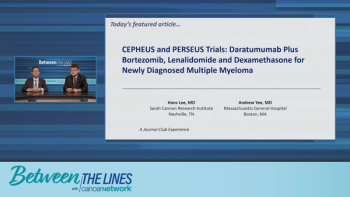
Panelists discuss how the CEPHEUS trial’s demonstration of improved progression-free survival with daratumumab-VRd versus VRd alone in transplant not-preferred NDMM provides compelling evidence for quadruplet therapy in this setting, though considerations of cost, toxicity management, and patient selection remain important factors in implementation.

A computational linguistics model has mitigated disparities in surveillance of the pancreas that primarily affected racial and ethnic minorities.

Panelists discuss key data from the HER2CLIMB study, which evaluates the efficacy of tucatinib (Tukysa) in combination with trastuzumab (Herceptin) and capecitabine (Xeloda) for patients with advanced HER2+ breast cancer, highlighting outcomes across patient subgroups and the clinical significance of findings related to patients with measurable baseline intracranial disease.

Panelists discuss how the use of CAR T-cell therapy in earlier lines of treatment for relapsed/refractory multiple myeloma could potentially improve long-term outcomes, considering factors such as patient selection, optimal timing, and the impact on subsequent treatment options.

Panelists discuss a high-level overview of systemic therapies for advanced HER2+ breast cancer, outlining the roles of HER2-targeted monoclonal antibodies, tyrosine kinase inhibitors (TKIs), and antibody-drug conjugates (ADCs) in treatment, as well as treatment strategies for patients with brain metastases. They also explore the shared decision-making process that informed the recommendation of the HER2CLIMB regimen.

Panelists discuss how IDH inhibitors such as ivosidenib could potentially reshape the treatment approach for low-grade gliomas, while also exploring what further clinical evidence would be necessary to confidently integrate these novel agents into standard care protocols.

Genetic consultation and next-generation sequencing can also complement treatment strategies for patients with pancreatic cancer.

An advanced computation linguistics model that can detect pancreatic cysts can help patients prevent pancreatic tumors from forming.

Brett L. Ecker, MD, focused on the use of de-escalation therapy, which is gaining momentum in neuroendocrine tumors.

Immunotherapy options like CAR T-cell therapy and antigen-presenting cell-directed agents are currently being evaluated in the pancreatic cancer field.

Certain bridging therapies and abundant steroid use may complicate the T-cell collection process during CAR T therapy.

Pancreatic cancer is projected to become the second-leading cause of cancer-related deaths by 2030 in the United States.

Panelists discuss how to manage talquetamab-associated adverse events, such as skin toxicities and dysgeusia, sharing their clinical experience with toxicity timing, frequency, and key strategies for fellow oncologists implementing bispecific antibodies in relapsed/refractory multiple myeloma.

Panelists discuss how they dose talquetamab in clinical practice, comparing its administration schedule to other bispecific antibodies and addressing dosing-related challenges they encounter.

Panelists discuss how looking ahead, key takeaways from the CARTITUDE-4 study underscore the transformative potential of ciltacabtagene autoleucel in managing lenalidomide-refractory multiple myeloma, highlighting its efficacy, safety, and implications for future treatment strategies.

Panelists discuss how they approach treatment strategies and challenges for relapsed/refractory multiple myeloma patients with CNS involvement, sharing case details and preferences among available therapeutic options.

Panelists discuss how addressing unmet needs and future directions for enhancing bispecific therapy care transitions in multiple myeloma requires focusing on standardized protocols, technology integration, personalized patient support, and continuous education for both patients and healthcare providers across academic and community settings.

Panelists discuss how the evolving treatment landscape for HER2-overexpressing NSCLC, particularly with the introduction of trastuzumab deruxtecan, influences therapeutic strategies and decision-making based on recent clinical trial data.

Educating community practices on CAR T referral and sequencing treatment strategies may help increase CAR T utilization.

The FirstLook liquid biopsy, when used as an adjunct to low-dose CT, may help to address the unmet need of low lung cancer screening utilization.