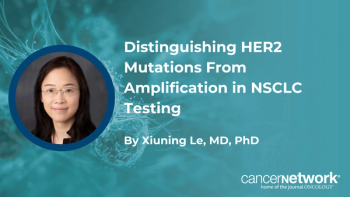
Xiuning Le, MD, PhD, explains how oncologists should approach HER2 biomarker testing following sevabertinib’s frontline approval in non–small cell lung cancer.
Emphasizing critical thought over a conformity of thought in oncology may help prioritize and advocate for patients with cancer.
As a greater understanding of cancer is attained and science evolves, a greater need emerges to resist suggesting that “the science is settled” in oncology care, according to Nathan Goodyear, MD.
Goodyear, an integrative oncologist at the Williams Cancer Institute, discussed how his team might navigate potentially cynical perspectives from conventional oncology regarding therapies that are deemed alternative as well as steps that his team has taken to ensure that patients understand the difference between evidence-based integrative support and unproven alternative regimens.
He began by emphasizing that as an integrative oncologist, he shares the same credentials as a conventional oncologist, with both being medical doctors. Goodyear further explained that science is never “settled” and evolves as a greater understanding of the oncologic field is attained. Moreover, he suggested that despite this science’s innate propensity to evolve, many oncologists have resorted to insults and othering when addressing integrative oncologists, which ultimately do not help patients.
Highlighting his experience at the Williams Cancer Institute, Goodyear explained that he attempts to build bridges with different camps of oncology, including conventional oncology, and does so through a debate of the science. He concluded by suggesting that this productive discourse can help bolster advocacy for patients and ensure that they remain the top priority as science continues to evolve.
Transcript:
I am a medical doctor; I am an MD. I was a pelvic floor surgeon in my primary training. Conventional oncologists are medical doctors as well. The one thing we have to understand about science is [that it] is always evolving as we uncover and discover new concepts [and] new ideas. With that, we have to be careful about saying science is settled. We have to [realize] that our understanding about a scientific point may evolve. Although some of the scientific points that we have known for a long time stay, they are modifiable or new understandings will adjust how we perceive [them].
What we see in a lot of medicine right now is a lot of doctors [from] different camps—different sides, if you will—yelling insults at each other: “You’re alternative. You’re just trying to hurt patients. You’re just trying to take money because you do not take insurance. You’re just following protocols.” How does that help patients? It does not. The patient is left to say, “OK, I am going to learn this on my own.”
What we need is less play school riffing at each other; we need to build bridges. What we try to do at the Williams Cancer Institute is build bridges with all sides. That means it could be natural and holistic [care] that we are building a bridge with. It could be conventional oncology that we are building a bridge with. But the way we build a bridge is via evidence…science. Let’s talk about the science, and then let’s be honest about the science that we are discussing.
It’s about an open dialogue and debate of the science. Right now, in science, there is great pressure for conformity of thought rather than critical thought. What happens is it squashes debate and discourse. What we need to say is, “Here’s the science. Now let’s debate and discourse it in the public arena. Let’s talk about the pros. Let’s talk about the cons.” And if a conventional oncologist says, “Well, I have problems with this conclusion,” you can say, “Hey, I will give you that, because that is from preclinical findings. But what about this possibility being transposed to humans, if we can get that done?” It’s a way to understand that our priority and our advocacy are for the patient only. We are to serve patients and to be advocates for patients, and the way we do that is we build bridges and allies, but we build them through the science.