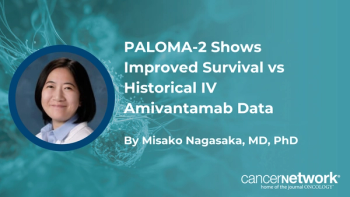
Subcutaneous amivantamab is safer and more convenient for patients compared with the intravenous formulation, according to Misako Nagasaka, MD, PhD.
Tissue samples collected from patients with breast cancer during treatment may help explore therapy selection and predict toxicities.
Although there are data for fam-trastuzumab deruxtecan-nxki (T-DXd; Enhertu) as a treatment for HER2-positive, HER2-low, and HER2-ultralow breast cancer, data are still emerging for patients with HER2-negative disease, according to Adriana Kahn, MD.
Kahn, an assistant professor of medicine (medical oncology) at the Center for Breast Cancer and the Drug Development Department at Yale Cancer Center in New Haven, Connecticut, discussed how her presentation of the phase 2 HER2 PARADIGM trial (NCT06750484) evaluating patients with previously treated advanced breast cancer with HER2 immunohistochemistry score of 0 ties into and builds upon prior research investigating T-DXd in patients with HER2-mutated disease. She presented these findings at the
She highlighted 3 studies that are investigating T-DXd in this HER2-negative population. One included a Yale-led initiative, and another was the European phase 2 DAISY trial (NCT04132960).2 The latter, Kahn expressed, has results posted, but biomarker specificity has not been established based on the data.
Furthermore, she emphasized that ongoing studies are examining biomarkers that may inform the benefit of T-DXd, highlighting them as the key difference between trials examining the agent among patients with HER2-negative disease. Kahn concluded that subsequent data may help inform these benefits.
Transcript:
We have data on HER2-positive, HER2-low, and HER2-ultralow [disease]. We are adding data to the HER2-[negative] population. The [phase 2] DAISY study was a trial in Europe that treated patients in that setting, and they have released results, yet we do not know any specific biomarkers based on their data. We have our study with our Yale-born tests that we are doing plus additional partners that joined…in the university and academic setting. And the company AstraZeneca is doing its own study now, which is a later event, after our study has been planned. [It] is a larger-scale study for the same [HER2-negative] population.
[Results are] coming from our study, prior studies, and future studies, but each of us is looking through different biomarkers. What makes a difference [between] all these studies is, individually, what can be done with those patients’ tissues and patients’ biomarkers to explore the potential biomarkers of selection and biomarkers [predicting] toxicity. We do not yet know how these are going to play with these patients. Gathering more data can help us understand that better.