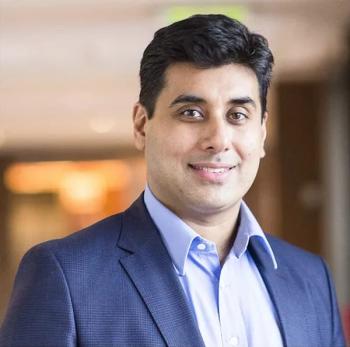
“Cardiovascular assessment should begin when the patient is being selected for treatment, not after the toxicity emerges,” said Faisal Mehmud, MD, MRCP.
Described as a “doctor’s office on wheels,” the mobile unit is equipped with Wi-Fi and includes point-of-care PSA/imaging tests to help bring care to patients.
Despite initially setting out to screen 1000 to 2000 patients for prostate cancer in the first year a mobile prostate cancer testing unit was deployed, a greater number of patients underwent testing, and after 3 years, more than 13,000 patients have undergone testing.
In an interview with CancerNetwork®, Ash Tewari, MBBS, MCh, FRCS, professor and chair of the Milton and Carroll Petrie Department of Urology at the Icahn School of Medicine at Mount Sinai, discussed the initial reception of a prostate cancer mobile testing unit, as well as its inspiration behind the Million Strong Men Initiative, which is seeking to screen 1 million patients within 10 years.
He began by highlighting the efforts from sponsors Robert F. Smith and Arthur M. Blank, whose contributions have helped to initiate the deployment of these units in New York, as well as in Atlanta. Likening them to a “doctor’s office on wheels,” Tewari explained that the units come equipped with all the tools used for prostate cancer screening in the office, including point-of-care prostate-specific antigen (PSA) and imaging tests, as well as Wi-Fi, to help deliver care to patients to circumvent issues concerning access to health.
Tewari also explained that, despite reaching more than 13,000 people over a course of 3 years, surpassing his initial goal of more than 1000 a year, he considered the possibility of collaborating with up to 10 additional institutions to ultimately test and educate 1 million people regarding their risk of prostate cancer. He concluded by explaining that not all patients may need testing but that through their use of the mobile unit, early detection and an awareness of the risks of prostate cancer can materialize.
Transcript:
We combined our resources, our knowledge about this cancer, our tools about diagnosing it with philanthropist Robert F. Smith, and then later on with Arthur M. Blank, to create mobile units that…could be a doctor’s office on wheels, equipped with high-tech equipment, equipped with every tool which we normally use in an office, equipped with a point-of-care PSA [test], equipped with point-of-care imaging, and all interconnected within a network and on Wi-Fi, so that we can go to the places where people live. It bypasses the element of an access-to-health issue.
My goal about 3 years ago [was being] able to reach 1000 or 2000 patients, so that I will reach out to them––go to the community centers, go to the churches, go to the sports events––exactly [where] they are, bring up a discussion about prostate cancer awareness, and then see if they are interested in finding out what’s their risk. [Then] doing it in point-of-care PSA, if that PSA is abnormal, then taking it to the next level of imaging and next-level care. That initiative of a few thousand people [was] successful, and we [surpassed] 13,000 men in the last 3 years.
That [raised] people’s interest, so we thought, why are we stopping [at] 13,000? Why not expand it to a larger pool of patients? That’s where the Million Strong [Men] Initiative started. I came up with a mindset that if I partner with the right group of people, if we have any scalability, if we have the right tools, this mechanism, this entity, this program, has potential to be very successful.
And it does not need to all be [managed] by me. It could be partnering with other institutions. And that partnership mindset led me to reach out to Arthur Blank and then Emory to create something in Atlanta. If Atlanta is going to do the same thing, and then if we find 10 other institutions, my goal is, in the next 10 years, to reach out to 1 million people, and that’s the 1 Million Strong [Men initiative], so that we can find the cancer early [and] we can educate them.
We minimize the [adverse] effects of biopsy. We do not have everyone do the biopsy. We do not need to intervene in everyone, but [we can] do the right thing for the right patient based on their own unique risk assessment. And that’s the goal; that’s the main mission [of] the Million Strong Man initiative.