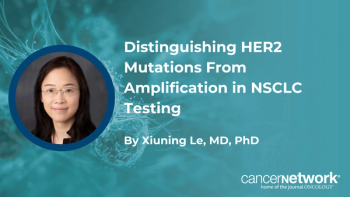
Xiuning Le, MD, PhD, explains how oncologists should approach HER2 biomarker testing following sevabertinib’s frontline approval in non–small cell lung cancer.
A study published in JAMA Network Open showed that patient trust in physicians and hospitals dropped from 71.5% in April 2020 to 40.1% in January 2024.
To combat patient mistrust in physicians and hospitals, a greater emphasis must be made on reengaging them through public debate and discourse about the science surrounding oncology, according to Nathan Goodyear, MD. Goodyear spoke with CancerNetwork® about the impact of deeming certain oncology practices alternative as well as strategies for reengaging patients in evidence-based medicine.
Goodyear first touched upon the negative impact of uncivil discourse among different factions of medicine, which he believes may correlate with low trust in hospitals among patients. He cited an article from JAMA Network Open, which pointed out that 40.1% of patients surveyed in the US trusted hospitals in 2024 vs 71.5% in 2020. Goodyear expressed that this mistrust leads patients to use unvetted social media platforms or Google to conduct their own medical research.
To ameliorate this circumstance, he emphasized a need to reengage discourse and debate in the public sphere by “building bridges” with evidence. By fostering a more productive discourse, Goodyear believes that patients may reengage with evidence-based medicine and give their trust to physicians, which will, in turn, enhance medicine and patient outcomes.
Transcript:
What’s happened right now, because of the different factions basically yelling insults at each other, is the patient has stepped back. They no longer trust doctors. They no longer trust hospitals. That was a recent [JAMA] online review published last year: 40% trust them, and I’m surprised it was that high. What happens? They turn to platforms—social media, Google—because doctors have turned their back on them because they are fighting. They are saying, “Well, that’s alternative.” It’s a marginalizing term. It’s saying, “It’s alternative. I don’t understand it, [and] because I label it alternative, I no longer have to engage in it.” It ends debate. It ends discourse.
We need to reengage that in the public arena. [We must] build bridges and restore patients to the center of the advocacy, and that’s going to help us to restore that. But—and this is what we do at the Williams Cancer Institute—always lead with the evidence. Even if the evidence is preclinical, talk about it. If the evidence then builds in clinical [findings], talk about it. That’s the way we as scientists, as doctors, then bring this into the public arena, and it’s going to reengage the patient, [who] is now left to their own resources on social media, Google, Instagram, X, take your pick. They are basically following whatever rabbit hole they want because we have disengaged with them.
We must reengage with them through the science, through public debate and discourse with other doctors, and that will reengage the patient. More importantly, I think that will reengage the patient’s trust in doctors. When we restore a doctor-patient relationship, medicine is going to get better and patients are going to get better. That’s the way we try to restore that and how we try to approach that: build bridges, lead with science, open debate [and] discourse, and always keep the patient first.
Perlis RH, Ognyanova K, Uslu A, et al. Trust in physicians and hospitals during the COVID-19 pandemic in a 50-state survey of US adults. JAMA Netw Open. 2024;7(7):e2424984. doi:10.1001/jamanetworkopen.2024.24984