






Endometrial Cancer
Latest News
Advertisement
Video Series
Latest Videos









Shorts

0:56
Potential Immunotherapy After Immunotherapy in Select Endometrial Cancer Populations
6 months ago
by
Dana Chase, MD

0:55
Prior Interstitial Lung Disease and Ocular Toxicity Pose ADC Treatment Risks
6 months ago
by
Dana Chase, MD

1:25
The Four Types of Therapy for Second-Line Endometrial Cancer
6 months ago
by
Dana Chase, MD

0:56
Sequencing Radiation With Systemic Therapy in Inoperable Endometrial Cancer
9 months ago
by
Dominique Rash, MD
Podcasts


CME Content













































Advertisement
More News

The phase 3 KEYNOTE-C93 trial met its primary end point of PFS with pembrolizumab monotherapy vs chemotherapy in dMMR advanced or recurrent endometrial cancer.

The 48-month OS rate was 78.6% with pembrolizumab vs 60.4% with placebo among patients with advanced or recurrent endometrial cancer.

Long-term follow-up from the phase 3 RUBY trial revealed a 54% estimated cure rate with the dostarlimab combination in dMMR/MSI-H primary advanced or recurrent endometrial cancer.

Sac-TMT was shown to be the first TROP2 ADC to improve survival vs chemotherapy in patients with endometrial cancer who progressed on chemo- and immunotherapy.

Dana Chase, MD, discussed recent shifts in second-line endometrial cancer care, the role of molecular testing, and the potential of antibody-drug conjugates.

Activity stemming from abemaciclib plus letrozole was most pronounced in chemotherapy-naive patients with advanced endometrioid endometrial carcinoma.

The SISTER trial was the first national randomized trial to demonstrate significantly improved outcomes for black women with endometrial cancer.

A panel of oncologists, pharmacists, and physician assistants discussed prevalent regimens for patients with recurrent endometrial cancer.
The Promega OncoMate MSI Dx Analysis System was previously approved to identify Lynch syndrome in patients with CRC.

A significant survival improvement was observed among patients with dMMR carcinomas who received atezolizumab/chemotherapy.
The most pronounced overall and recurrence-free survival benefit with chemoradiotherapy was observed among patients with TP53-abnormal endometrial cancer.
Data from the phase 1/2 RAINFOL-01 trial support the agency’s regulatory decision on rinatabart sesutecan in advanced endometrial cancer.
Factors such as language spoken, social vulnerability index characteristics, and insurance type were found to alter endometrial cancer diagnoses and led to worse outcomes.

Patients who had recurrence in the radiation field experienced similar responses vs those with recurrence outside the radiation field.

The adverse effect profile of abemaciclib plus hormonal therapy was comparable with prior reports of CDK4/6 inhibitors.
The median PFS in patients with pMMR TP53 wild-type endometrial cancer was 39.5 months with selinexor and 4.9 months with placebo.
Puxitatug samrotecan was well tolerated in patients with advanced or metastatic endometrial cancer.

A slightly higher complete response rate was observed with the metformin regimen vs with the levonorgestrel-releasing IUD alone in endometrial cancer.
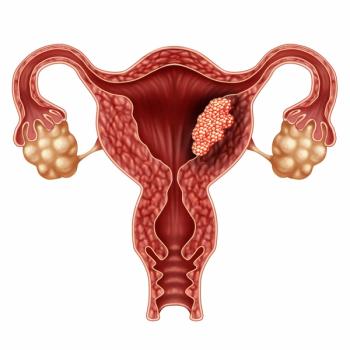
No deaths or significant adverse effects were reported in the screened population among those who received hysteroscopic resection for endometrial cancer.
Cadonilimab plus lenvatinib appeared to have a manageable safety profile in a phase 2 trial.
Adding maintenance olaparib to durvalumab/chemotherapy in pMMR endometrial cancer improved PFS among those with detectable ctDNA at baseline.
Dostarlimab/chemotherapy elicited a 31% decrease in the risk of death compared with placebo/chemotherapy in locally advanced/recurrent endometrial cancer.
Risk factors and biomarker testing in conjunction with cancer staging may better identify ideal treatment for endometrial cancer than cancer staging alone.
Deep and durable responses were observed with lenvatinib plus pembrolizumab in patients with stage III/IV recurrent endometrial carcinoma.

The addition of pembrolizumab to chemotherapy with or without radiation did not improve DFS across the intent-to-treat population of KEYNOTE-B21.
Advertisement
Advertisement
Trending on CancerNetwork
1
FDA Approves SC Amivantamab for Recurrent/Metastatic HNSCC
2
FDA Sets PDUFA Date for Rivoceranib/Camrelizumab Resubmission After Third CRL in Unresectable HCC
3
FDA Grants Priority Review to Zanubrutinib Regimen in Frontline MCL
4
Sacituzumab Govitecan Efficacy, Safety Debated in First-Line Metastatic TNBC
5