
Multiple Myeloma
Latest News
Advertisement
Latest Videos
























































Advertisement
More News
Discourse centered around dosing strategies for selinexor-based therapies.
Dr Caitlin Costello discusses how she adapts treatment to patients with transplant-ineligible NDMM based on fitness level, and why some patients receive doublet therapy.
Experts explain their approaches to maintenance therapy for patients with transplant-ineligible NDMM and when therapy should be reduced.
Dr Matthew James Pianko details how he determines treatment duration and discontinuation for transplant-eligible multiple myeloma.
Joseph Mikhael, MD, spoke about the mechanism of action of bispecific antibody teclistamab relative to other agents in the space such monoclonal antibodies and CAR T-cell therapies in multiple myeloma.
Following the 2022 American Society of Clinical Oncology Annual Meeting, experts in multiple myeloma discuss real-world evidence as it relates to the present-day treatment of patients.
Minimal residual disease negativity might be an important prognostic indicator in patients with newly diagnosed multiple myeloma, investigators say.
Dr Larry Anderson summarizes the study design and updated data of the MAIA trial, and Dr Rebecca Silbermann compares it against the SWOG 0777 trial.
Andrew Cowan, MD, presents the results of the ENDURANCE study comparing two triplet regimens in transplant-ineligible MM.
Caitlin Costello, MD, describes how to determine if a patient with MM is transplant-ineligible, and some factors to take into consideration when choosing a treatment regimen.
The panel explains their opinions on induction therapy approaches for high-risk and standard-risk patients with NDMM.
Drs Nooka and Pianko discuss how they measure a successful treatment response in patients with transplant-eligible multiple myeloma after induction therapy.
An oncologist muses on the potential of real-world data in evaluating the use of a quadruplet regimen for newly diagnosed transplant-eligible multiple myeloma.
The FDA’s Oncologic Drugs Advisory Committee voted against continued use of melphalan flufenamide for the treatment of relapsed/refractory multiple myeloma.

Doris K. Hansen, MD, discussed results of an efficacy analysis examining the BCMA-directed CAR T-cell therapy idecabtagene vicleucel in real-world treatment of patients with relapsed/refractory multiple myeloma.
Dr Andrew Cowan describes how the appropriate duration of therapy for patients with transplant-eligible multiple myeloma, and Dr Caitlin Costello discusses her approach to maintenance therapy.
Larry Anderson, MD, explains the study design and outcomes of the DETERMINATION study, and sparks a discussion on which patients with NDMM should receive stem cell transplants.
Ajay Nooka, MD, explains how he selects treatment regimens for patients with newly diagnosed transplant-eligible multiple myeloma in his clinical practice.
An expert reviews data from the ongoing GMMG HD7 (German) trial investigating isatuximab in combination with bortezomib, lenalidomide and dexamethasone (Isa-VRd) versus VRd in the treatment of transplant-eligible newly diagnosed multiple myeloma.
Results from the phase 1/2 MajesTEC-1 trial highlighted sustained responses when teclistamab was used to treat patients with relapsed/refractory multiple myeloma who are triple refractory.
Dr Rebecca Silbermann discusses the results of studies evaluating MRD-response adapted therapy in patients with transplant-eligible NDMM.
Surbhi Sidana, MD, and Caitlin Costello, MD, introduce the updated evidence regarding induction regimens for patients with transplant-eligible NDMM and how to select the appropriate induction regimen in this population.
Dr Ajay Nooka describes key data from the uniquely-designed MASTER trial investigating daratumumab in combination with carfilzomib, lenalidomide and dexamethasone (Dara-KRd) versus KRd in transplant-eligible newly diagnosed multiple myeloma.
Matthew James Pianko, MD, provides an overview of the recently updated data from the GRIFFIN trial and the role of quadruplet versus triplet regimens in the treatment landscape of transplant-eligible newly diagnosed multiple myeloma.
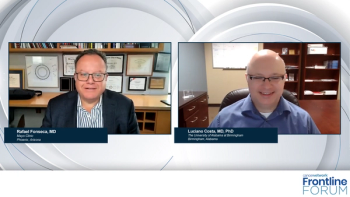
Drs Costa and Fonesca close out their discussion by highlighting the endemic racial disparities in multiple myeloma treatment.
Advertisement
Advertisement
Trending on CancerNetwork
1
Meaning-Centered Therapy, Psychiatry Referrals, and Humanistic Cancer Care
2
How Psycho-Oncology Addresses Existential Distress, Body Image, and Intimacy
3
How to Work With a Patient Who Declines Cancer Treatment
4
Screening for Depression and Starting Antidepressants in Oncology Care
5