



Multiple Myeloma
Latest News
Advertisement
Latest Videos
























































Advertisement
More News

Moving to the last patient profile, expert panelists discuss a patient with triple-class refractory multiple myeloma managed with BCMA-targeting bispecific therapy.
Shared insight on the selection of therapy for patients with transplant-ineligible, newly diagnosed multiple myeloma and high-risk cytogenetics.
Patients with relapsed/refractory multiple myeloma who have received at least 4 prior lines of therapy might benefit from treatment with talquetamab, which was granted breakthrough therapy designation by the FDA.
A phase 2 study investigated the use of cord blood–derived natural killer cells plus elotuzumab, lenalidomide, and melphalan with autologous stem cell transplant for patients with high-risk multiple myeloma.
Expert panelists consider which regimen they would use, and for what duration, in the setting of transplant-ineligible, newly diagnosed multiple myeloma.
The panel moves on to review the profile of a patient with transplant-ineligible, newly diagnosed multiple myeloma managed with dara-Rd on the MAIA trial.
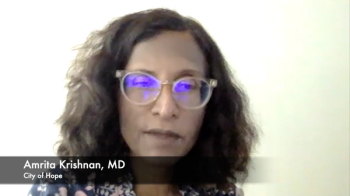
Amrita Y. Krishnan, MD, spoke about where future research in multiple myeloma is headed and a take-home message for her colleagues about teclistamab in heavily pretreated patients.

C. Ola Landgren, MD, PhD, highlights the rationale for the phase 3 DETERMINATION trial, assessing the use of lenalidomide, bortezomib, and dexamethasone plus autologous stem cell transplant and lenalidomide maintenance in patients with newly diagnosed multiple myeloma.
Data presented at the 2022 European Hematology Association Congress demonstrated potential utility of the bispecific antibody RG6234 in a previously treated cohort of patients with multiple myeloma.
Patients with relapsed/refractory multiple myeloma experienced promising responses with REGN5458.
Before closing their discussion on transplant-eligible, newly diagnosed multiple myeloma, experts consider duration of therapy in this setting.
Panelists briefly review factors they use to select induction therapy for patients with transplant-eligible, newly diagnosed multiple myeloma.

The following was recently published in ASTCT’s Nucleus publication. Follow @ATSTCT for the latest on all-things cellular therapy.

A panel of experts from Emory University review several key data updates in multiple myeloma from recent meetings and discuss how the data can be applied to clinical practice to improve patient outcomes.
Patients with heavily pretreated multiple myeloma appeared to benefit from treatment with talquetamab and daratumumab plus hyaluronidase-fihj.
Sex Differences Play a Role in Molecular Risk Factors but do not Impact Efficacy in Multiple Myeloma
Despite women with multiple myeloma being more likely to have certain cytogenetic risk factors vs men, sex did not appear to impact efficacy.
Shared insight on approved quadruplet vs triplet induction regimens for patients with transplant-eligible, newly diagnosed multiple myeloma, evaluated in the GRIFFIN, MASTER and GMMG-HD7 trials.
Experts discuss a patient with transplant-eligible, newly diagnosed multiple myeloma managed with induction daratumumab-RVd and maintenance therapy.

Broad discussion on novel therapies, including bispecifics and CAR-T therapies, that are evolving the treatment landscape of multiple myeloma.
Panelists take a broad look at treatment selection and sequencing through multiple lines of therapy in patients with multiple myeloma.
Transplant following lenalidomide, bortezomib, and dexamethasone with lenalidomide maintenance was superior to the treatment course without transplant, according to data at 2022 ASCO.
Ixazomib Plus Daratumumab Combo Leads to Strong Efficacy in Frail Patients With R/R Multiple Myeloma
Elderly frail patients with relapsed/refractory multiple myeloma treated with ixazomib plus daratumumab experienced favorable response rates.

Data from the phase 2 IFM 2018-04 trial support the use of daratumumab, carfilzomib, lenalidomide, and dexamethasone coupled with tandem autologous stem cell transplant in eligible patients with high-risk multiple myeloma.
Induction/consolidation daratumumab, lenalidomide, bortezomib and dexamethasone (RVd) outperformed RVd alone when it came to minimal residual disease and progression-free survival in patients with newly diagnosed, transplant-eligible myeloma.
A subgroup analysis of the phase 3 MAIA trial showed rapid, deep, and durable responses with daratumumab plus lenalidomide and dexamethasone vs standard therapy for newly diagnosed multiple myeloma across patient subgroups.
Advertisement
Advertisement
Trending on CancerNetwork
1
Meaning-Centered Therapy, Psychiatry Referrals, and Humanistic Cancer Care
2
How Psycho-Oncology Addresses Existential Distress, Body Image, and Intimacy
3
How to Work With a Patient Who Declines Cancer Treatment
4
Screening for Depression and Starting Antidepressants in Oncology Care
5