





Colorectal Cancer
Latest News
Advertisement
Video Series
Latest Videos







Shorts

1:19
What to Expect From the BREAKWATER Trial at ASCO 2026?
22 days ago
by
Nicholas James Hornstein, MD, PhD

1:09
How a Short Exam Identified a Colorectal Cancer in a Patient in Their 40s
3 months ago
by
Marc Lehrer Greenwald, MD

1:17
What Are the Best Treatment Options for Patients with Later-Line mCRC?
4 months ago
by
Marwan G. Fakih, MD

0:41
Testing For Mutational Status Might Improve Colorectal Cancer Survival
7 months ago
by
Rona Yaeger, MD

0:34
Managing Narcotic Use in Perioperative CRC Care
10 months ago
by
Ronald Bleday, MD
Podcasts









































































Advertisement
More News

Adjuvant aspirin did not improve disease-free survival vs placebo in patients with stage III colorectal cancer who received standard adjuvant chemotherapy.

Serial ctDNA assessment after 3 months of adjuvant chemotherapy stratified recurrence risk and identified which patients with resected CRC benefit from extended treatment.

The European Medicine Agency’s CHMP has adopted a positive opinion for encorafenib plus cetuximab and mFOLFOX6 in this treatment-naïve mCRC population.
Updated interim data from a phase 1/2 study of the DR5 agonist ozekibart plus FOLFIRI demonstrated a 20% ORR and 87% DCR in late-line colorectal cancer.

The incidence rates of breast cancer and colorectal cancer have been on the rise in patients under 50 years for the past several years.

Marc Lehrer Greenwald, MD, spoke with CancerNetwork® about how North Shore University Hospital treats young patients with colorectal cancer.

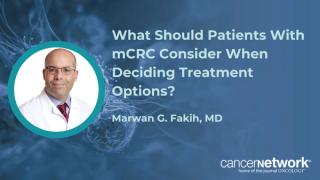
Marwan G. Fakih, MD, discussed many of the factors he considers when deciding on a treatment for a patient with metastatic colorectal cancer.

Development of the oral DHX9 inhibitor, ATX-559, has been halted following adverse events in a phase 1/2 trial of patients with metastatic solid tumors.

Results from the BREAKWATER trial led to the traditional approval of encorafenib plus cetuximab and fluorouracil-based chemotherapy in BRAF-mutated CRC.

Phase 2 CRDF-004 findings show that adding onvansertib to FOLFIRI and bevacizumab improves PFS in first-line RAS-mutated metastatic colorectal cancer.
Encorafenib, cetuximab, and FOLFIRI improved PFS vs in treatment-naive BRAF V600E-mutant metastatic colorectal cancer in the BREAKWATER trial.

Prior phase 1 data support the fast track designation for pelareorep as a treatment for those with KRAS-mutated microsatellite stable colorectal cancer.
Treatment with zanzalintinib plus atezolizumab led to improvements in OS and PFS vs regorafenib alone in patients with metastatic colorectal cancer.
According to investigators of the phase 3 SCOT trial, most patients with colon and rectal cancer should be receiving only 3 months of adjuvant treatment.

People who consumed 14 or more drinks per week experienced a higher risk of colorectal cancer compared with those who consumed one or fewer drinks.
Data from the phase 3 BREAKWATER trial demonstrated that encorafenib plus cetuximab and chemotherapy yields clinical benefit for this patient population.

The Taiwan FDA has approved nivolumab/ipilimumab for patients with MSI-H/dMMR metastatic colorectal cancer based on data from CheckMate 8HW.

Circulating tumor DNA may particularly help adjuvant treatment decision-making in stage II colon cancer, according to Nicholas Hornstein, MD, PhD.
No serious adverse effects were observed with CBM588 in patients at risk of colorectal adenoma recurrence.

Larger-scale and longer-term studies could elucidate the mechanisms underlying quality of life benefits associated with resistance exercise in this group.
The addition of pelareorep to standard-of-care therapy in patients with KRAS-mutated microsatellite-stable CRC exhibited an ORR of 33%.

Melphalan, BCNU, vitamin B12, and ascorbic acid plus ASCT show promise for patients with metastatic PDAC, according to results from the SHARON trial.

The anti–CTLA-4 antibody combination achieved an ORR of 34.8%, with 8 partial responses, in patients with pretreated microsatellite-stable mCRC.
With a median follow-up of 50.1 months, nivolumab plus ipilimumab achieved a median PFS of not reached compared with 60.8 months with nivolumab monotherapy in this CRC population.

Data from the STELLAR-303 trial support zanzalintinib plus atezolizumab as a potential chemotherapy-free option in previously treated metastatic CRC.
Advertisement
Advertisement
Trending on CancerNetwork
1
58 An Evidence-Based Self-Management Planner for Patients With Metastatic Triple-Negative Breast Cancer: A Multi-Channel Dissemination Initiative
2
From Conference to Practice: Top 5 Takeaways From EHA 2026
3
3 Things You Should Know About Using Selective Estrogen Receptor Degraders in Hormone Receptor–Positive, HER2-Negative Advanced Breast Cancer
4
57 Altered Biomechanics Drives Outcome in Breast Cancer: A New Avenue for Oncology Biomarkers
5