
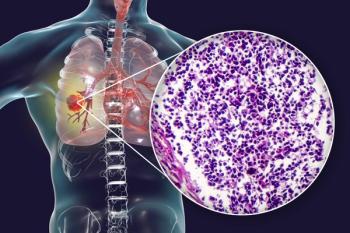
Data from the phase 3 OptiTROP-Lung06 trial also showed a positive trend in overall survival with sac-TMT plus pembrolizumab in patients with NSCLC.
Data from the phase 3 OptiTROP-Lung06 trial also showed a positive trend in overall survival with sac-TMT plus pembrolizumab in patients with NSCLC.
The FDA closed out its manufacturing inspection tied to the third complete response letter for rivoceranib/camrelizumab in unresectable HCC.

Sikander Ailawadhi, MD, says shorter subcutaneous administration times could free up capacity at busy infusion centers.

Geospatial analysis of 77 Miami-Dade zip codes found 49 containing no mammography facilities, with zero-facility areas concentrated in lower-income, majority-Hispanic/Latino and Black neighborhoods.
A Gaussian linear regression model of US county-level data found breast cancer mortality risk highest among African American individuals and those in rural, high-ADI counties.

The FDA has approved the gedatolisib combination for HR+/HER2– PIK3CA wild-type advanced breast cancer post-CDK4/6i, based on the phase 3 VIKTORIA-1 trial.
Efficacy findings from the phase 1/2 LIBRETTO-001 and LIBRETTO-021 trials supported the regulatory approval of selpercatinib in RET gene fusion-positive solid tumors.
The subcutaneous isatuximab approval gives patients “many more options” for anti-CD38 therapy, according to Sikander Ailawadhi, MD.

Agenus is halting financial support for the phase 3 BATTMAN trial in late-line metastatic MSS colorectal cancer to prioritize neoadjuvant development of the same regimen.

Mature overall survival data from the INSIGHT-003 trial compare favorably with historical benchmarks in frontline NSCLC therapy.
Data from the phase 2 RECLAIM trial demonstrate the feasibility of a multimodal strategy in a patient population with limited therapeutic options.
In a nationally representative cross-sectional analysis of 6774 women aged 40 to 49 years, overall mammography prevalence was 60.3% with no significant change from 2019 to 2023, while Hispanic women showed a 6.5-percentage-point decline and insurance status remained the strongest enabling factor for uptake.
In 77 biopsy-proven cystic breast lesions, radiologists achieved significantly higher diagnostic accuracy than the KOIOS DS™ AI tool for malignant cystic lesions (92% vs 76% BI-RADS/suspicious classification).

Mayo Clinic oncologists weigh first-line ADC options in metastatic TNBC, tackling biomarker timing, sequencing, and real-world toxicity management from fatigue to ocular events.

Interim data from the phase 2 AZUR-1 trial showed sustained clinical complete responses with dostarlimab monotherapy in dMMR/MSI-H locally advanced rectal cancer.

The trial will confirm findings from the phase 3 IT-MATTERS study subgroup with newly diagnosed head and neck cancer who received leukocyte interleukin.

The FDA has assigned a Prescription Drug User Fee Act date of May 13, 2027, for the mezigdomide regimen in relapsed/refractory multiple myeloma.

The approval of Orca-T validates many years of work dedicated to manipulating the graft to improve outcomes among patients undergoing allogeneic transplant.

Experts discuss diagnosing and treating insomnia in patients with cancer through methods like sleep hygiene, CBT-I, and pharmacotherapy.
A 2-phase U-Net trained on abnormality-focused patches achieved a mean Dice coefficient of 0.58 and detected 77.8% of mammographic lesions on a 55-image test set, with 100% detection of large lesions but resolution-dependent failures for small abnormalities.
GBD 2023 data analysis found India’s age-standardized breast cancer incidence at 28.7 per 100,000 women, with national mortality tripling from 33,151 to 101,621 between 1991 and 2023 and DALYs quadrupling, with the steepest increases in Jharkhand and the highest incidence in Delhi.

ARTEMIS-008 is the first phase 3 trial to show positive overall survival data for a B7-H3–targeted antibody-drug conjugate in any tumor type.
Amer Zeidan, MBBS, MD, discusses whether the expanding lower-intensity arsenal has narrowed the definition of a patient with AML who is unfit.
This TIP study aims to validate Artera’s MMAI prognostic model—which integrates digital pathology images with clinical data from H&E slides—in patients with early-stage HR+/HER2− breast cancer, with enrollment at UAB anticipated to complete by April 2026.
Using the DISCERN tool, LLMs (ChatGPT and OpenEvidence) scored significantly higher than Google on breast pathology health information quality and reliability, with mean total DISCERN scores of 62.2 and 64.8 vs 35.9, supporting integration of AI tools for patient education.
Orca-T is a “big advance” that must be studied further among patients with acute leukemias and myelodysplastic syndromes.
Amer Zeidan, MBBS, MD, discusses how mutation status and physical fitness factor into frontline AML regimen selection.
A prospective subsidized breast biopsy and navigation program at a Kenyan referral hospital achieved same-day CNB in 100% of 104 patients with invasive breast carcinoma, revealing high rates of aggressive subtypes and median 8-month prediagnostic delays, with 16.35% mortality during follow-up.
Intraoperative surgeon-performed PECs block during mastectomy resulted in only 16.6% of patients requiring postoperative opioids, supporting this technique as a fast and effective method of regional analgesia.
Whether Orca-T competes with post-transplant cyclophosphamide for GVHD prevention must be studied prospectively, said Wendy Stock, MD.