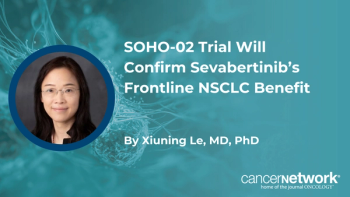
Xiuning Le, MD, PhD, discusses the confirmatory SOHO-02 trial needed to convert sevabertinib’s accelerated approval to full approval.
Patients with HER2-mutant NSCLC who were naïve to systemic therapy for advanced disease experienced positive results following treatment with sevabertinib.
Sevabertinib (Hyrnuo) has earned breakthrough therapy designation from the FDA and China’s Center for Drug Evaluation (CDE) for the first-line treatment of patients with locally advanced or metastatic HER2-mutant non–small cell lung cancer (NSCLC), according to a press release from the developer, Bayer.1
Supporting evidence for the designations came from cohort F, the treatment-naïve cohort, of the phase 1/2 SOHO-01 trial (NCT05099172) evaluating the safety and efficacy of sevabertinib in patients with HER2-mutant NSCLC.
Among the patients in cohort F, with a median follow-up of 5.6 months, the objective response rate (ORR) and disease control rate (DCR) were 59.0% (95% CI, 42.1%-74.4%) and 84.6% (95% CI, 69.5%-94.1%), respectively. Complete responses were observed in 0% of patients, partial responses in 59.0%, stable disease in 30.8%, and progressive disease in 7.7%. One patient’s data were not available.
At the time of presentation, 82.1% of patients were still undergoing treatment, and the median duration of treatment was 5.6 months (range, 0.3-6.9 months).
“The breakthrough therapy designation granted by the US FDA and the CDE in China for sevabertinib as a potential first-line therapy in advanced HER2-mutant NSCLC, further underscore its potential to transform the lives of patients affected by this devastating cancer, which has limited treatment options and poor prognosis," Christian Rommel, PhD, head of research and development at Bayer’s Pharmaceuticals Division, said in the press release.1 “These latest regulatory milestones closely follow the recent accelerated FDA approval for sevabertinib in previously treated advanced HER2-mutant NSCLC and highlight Bayer’s commitment to develop precise and personalized health care solutions that address critical unmet needs and help improve outcomes and extend survival for these patients.”
A total of 39 patients with advanced NSCLC with HER2 mutations were included in the analysis of cohort F. Notably, those in cohort F were naïve to systemic therapy for advanced disease. Treatment consisted of the recommended dose for expansion of sevabertinib, which was 20 mg twice daily in 21-day cycles.
The median age of patients was 65.0 years (range, 31-80), 64.1% were female, 71.8% were Asian, 76.9% had an ECOG performance status of 1, and 79.5% did not have a history of smoking. NSCLC histology was adenocarcinoma, mixed, or not otherwise specified in 100%, 94.9% had HER2 ex20ins, and 97.4% had HER2 TKD mutations. While 94.9% of patients did not receive any prior systemic anti-cancer therapies, 5.1% of patients had received two; 5.1% of patients had also received platinum-based chemotherapy and immunotherapy.
The primary end points of the trial were safety and tolerability, as well as pharmacokinetics. Secondary end points included ORR, duration of response, DCR, and progression-free survival.
Regarding safety, the most common treatment-related adverse events (TRAEs) in cohort F were diarrhea (82%), rash (56%), stomatitis (23%), hypokalemia (21%), vomiting (21%), and anemia (21%). Grade 3 TRAEs were vomiting (10%), hypokalemia (8%), nausea (5%), diarrhea (3%), anemia (3%), alanine aminotransferase increased (3%), and aspartate aminotransferase increased (3%).
Notably, no patients experienced a TRAE of grade 4 or higher. One patient in cohort F experienced a TRAE leading to treatment discontinuation, which was abnormal hepatic function.
Previously, based on results from the same SOHO-01 trial,