
A panel of experts review a case of a 55-year-old mom and high school teacher who received lorlatinib for ALK+ NSCLC with brain metastases.

Your AI-Trained Oncology Knowledge Connection!
A panel of experts review a case of a 55-year-old mom and high school teacher who received lorlatinib for ALK+ NSCLC with brain metastases.
This segment explores factors influencing patient candidacy for CAR-T therapy, including age, fitness, and relapse specifics, and evaluates key findings from the KarMMa trials to compare ide-cel with other second-line treatment options for multiple myeloma.
This segment explores the treatment journey of a 55-year-old mother and high school teacher with ALK-positive NSCLC and brain metastases, focusing on her experience with lorlatinib therapy.

Dr Nadeem to summarize the clinical evidence supporting talquetamab use in relapsed/refractory multiple myeloma, including key efficacy outcomes from the monumenTAL trials.
68-year-old male construction worker with a long history of multiple myeloma, managing multiple lines of treatment including BCMA-directed CAR T therapy, alongside a history of hypertension, respiratory infections, and type 2 diabetes, now receiving talquetamab.

Panelists discuss how clinical data and treatment selection in later-line HER2+ metastatic breast cancer are informed by the latest therapeutic advancements, including targeted therapies like trastuzumab deruxtecan (T-DXd) and tucatinib, to optimize patient outcomes and manage progression.
Panelists discuss advice for nurses collaborating with oncologists in treating patients with HER2+ breast cancer, as well as closing messages for patients receiving treatment and clinicians involved in the care of those with advanced HER2+ breast cancer.
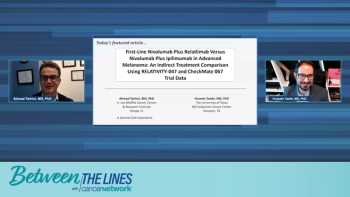
Panelists discuss how the ITC analysis of first-line dual-IO treatments in advanced melanoma highlights the potential for nivolumab plus relatlimab to offer similar efficacy to nivolumab plus ipilimumab, with a more favorable safety profile, particularly in terms of lower rates of severe immune-related adverse events.
Panelists discuss emerging regimens and agents being explored for the future treatment of advanced HER2+ breast cancer, highlighting the potential innovations that may improve patient outcomes.
Panelists discuss how first-line targeted therapy for advanced melanoma, particularly BRAF and MEK inhibitors, may offer significant benefits in patients with BRAF-mutant tumors, emphasizing rapid response and the potential for combination with immunotherapy to improve long-term outcomes.
Performance status, age, and comorbidities may impact benefit seen with immunotherapy vs chemotherapy in patients with breast cancer.
Developing odronextamab combinations following CAR T-cell therapy failure may help elicit responses in patients with diffuse large B-cell lymphoma.
An “avalanche of funding” has propelled the kidney cancer field forward, says Jason Muhitch, PhD.
Panelists discuss how early-line chimeric antigen receptor T-cell therapy studies, including recent data from trials of cilta-cel (Popat et al) and ide-cel (Ailawadhi et al), are showing promising results in patients with relapsed/refractory multiple myeloma, suggesting potential benefits of moving these treatments into earlier therapeutic settings.

Panelists discuss how the treatment paradigm for newly diagnosed multiple myeloma (NDMM) has evolved from conventional chemotherapy to modern regimens incorporating novel agents like proteasome inhibitors, immunomodulatory drugs, and monoclonal antibodies while highlighting persistent challenges including optimizing treatment sequencing and addressing high-risk disease.
Panelists discuss the data surrounding the use of CAR-T therapy in earlier lines of treatment for relapsed/refractory multiple myeloma (R/R MM), including findings from the cilta-cel (Popat R, et al. ASH 2024 No. 1032; Mateos MV, et al. IMS 2024 No. OA-65), and Idel-cel (Ailawadhi S, et al. Blood 2024) studies, and share their thoughts on the implications of these results.
Panelists discuss how emerging data on chimeric antigen receptor T-cell therapies ciltacabtagene autoleucel and idecabtagene vicleucel for earlier treatment lines in relapsed/refractory multiple myeloma influence institutional decision-making factors for their implementation.
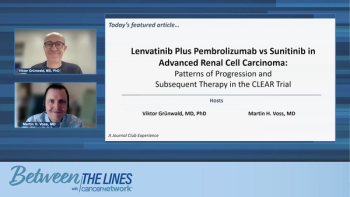
Panelists discuss how the evolving first-line treatment landscape for advanced renal cell carcinoma is shaped by novel immunotherapy combinations, including lenvatinib plus pembrolizumab, and the impact of these therapies on patient outcomes and progression patterns.
Panelists discuss how any patient receiving a bispecific antibody should be given IVIG for their hypogammaglobulinemia and patients should be treated with this monthly for the first 6 months of treatment.
Panelists discuss how to monitor and manage adverse effects, particularly chimeric antigen receptor (CAR) T cell–specific reactions, in patients receiving this therapy and how to collaborate with the CAR T-cell therapy team during the treatment phase, emphasizing the most critical aspects of patient care at this stage.
According to Jason Luke, MD, FACP, there is still room to improve response rates in CSCC treatment, but there is excitement surrounding future of treatment outcomes.
Panelists discuss how an early adverse event for this drug class no matter what the mechanism or target is, is cytokine release syndrome (CRS), and it tends to occur on a timescale that is predictable. When treating patients in the outpatient setting, they receive dexamethasone, given at the first fever, which is the first sign of cytokine release syndrome (CRS) and helps mitigate it.
Panelists discuss the key considerations in preparing patients for chimeric antigen receptor (CAR) T-cell therapy and how the treatment process differs when CAR T-cell therapy is used in earlier vs later stages of multiple myeloma.
Medical experts examine the factors that make Sarah an ideal candidate for CAR-T therapy in the second-line setting, focusing on how her age, fitness, and early relapse influence treatment decisions and exploring alternative options.
This video episode follows the journey of a 55-year-old female tech CEO with multiple myeloma, highlighting her treatments, relapse challenges, and transition to ide-cel, supported by her active lifestyle and strong support network.
Cytokine release syndrome was primarily low or intermediate in severity, with no grade 5 instances reported among those with diffuse large B-cell lymphoma.
Panelists discuss how emerging therapies like bispecific antibodies, chimeric antigen receptor (CAR) T cells, and novel drug combinations are reshaping treatment options for patients with relapsed/refractory multiple myeloma (R/R MM) who have exhausted standard approaches.
Panelists discuss how Brandi first noticed symptoms leading to her paroxysmal nocturnal hemoglobinuria (PNH) diagnosis, highlighting the challenges of the initial diagnostic process, and explore the impact of fatigue and brain fog on her daily life. They also address how clinicians assess the severity of these symptoms during consultations and what they indicate about disease progression or treatment needs.

Panelists discuss advanced renal cell carcinoma (RCC), including its epidemiology, typical disease presentation, and the common patient profile in terms of age, gender, and family history, while also addressing the risk stratification for advanced RCC, highlighting the differences between favorable and poor/intermediate risk categories.

Kidney cancer advocacy efforts have spread the urgency and importance of funding research in the field to members of Congress.