
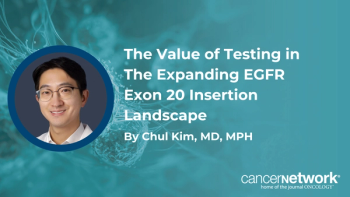
Clinicians must think a lot about how to make testing and novel treatment advances available for patients globally, according to Chul Kim, MD, MPH.
Clinicians must think a lot about how to make testing and novel treatment advances available for patients globally, according to Chul Kim, MD, MPH.

Estelamari Rodriguez, MD, MPH, of Sylvester Comprehensive Cancer Center presents the final overall survival data from the phase 3 FLAURA2 study of osimertinib plus chemotherapy in epidermal growth factor receptor (EGFR)-mutated advanced non–small cell lung cancer (NSCLC), at more than 47.5 months versus approximately 38 months for osimertinib alone, and asks how the panel handles cross-trial comparison.
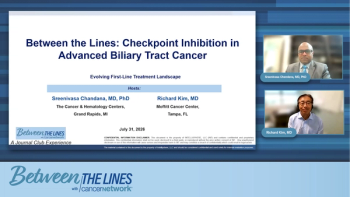
In the closing discussion, the faculty address how they choose between the available chemoimmunotherapy regimens and where the field is heading.
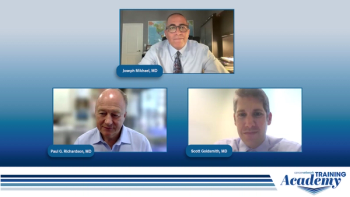
The closing discussion brings together the emerging clinical evidence and future development of CELMoDs in multiple myeloma.
Matthew Gumbleton, MD, PhD, of Huntsman Cancer Institute and Siddhartha Devarakonda, MD, of Providence Swedish Cancer Institute discuss how they translate grade 3 or higher adverse event rates into a conversation a patient can actually use in epidermal growth factor receptor (EGFR)-mutated advanced non–small cell lung cancer (NSCLC).
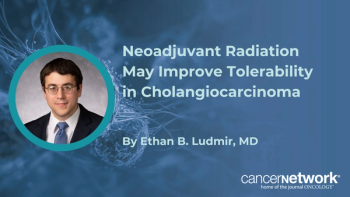
Ethan B. Ludmir, MD, explains the rationale for moving radiation into the neoadjuvant setting for borderline resectable cholangiocarcinoma.

C. Ola Landgren, MD, PhD, discusses how MRD-driven strategies may eliminate the transplant-eligible vs transplant-ineligible framework in multiple myeloma.

Hans C. Lee, MD, discussed how community oncologists with limited access to MRD testing can think about the new IMS/IMWG definition of cure in myeloma.

C. Ola Landgren, MD, PhD, discusses disparities in myeloma care access between academic and community practices and how his center works to bridge that gap.
Hans C. Lee, MD, discussed how he monitors patients with multiple myeloma who achieve deep, sustained MRD negativity after coming off therapy.
Time to worsening of symptoms was improved with amivantamab plus chemotherapy compared with chemotherapy alone in the phase 3 PAPILLON trial.
Xiuning Le, MD, PhD, discusses the confirmatory SOHO-02 trial needed to convert sevabertinib’s accelerated approval to full approval.
David R. Gandara, MD, discusses how EMPOWER-Lung 1’s findings in KRAS G12C-mutated disease should inform the design of combination trials.

The panel examines how emerging endocrine doublets and earlier biomarker monitoring could reshape treatment sequencing for patients with hormone receptor-positive, HER2-negative metastatic breast cancer (HR+/HER2− mBC).

This episode makes the case for moving HER2-targeted therapy into the first-line setting.
Meletios A. Dimopoulos, MD, explored how anselamimab’s benefit in kappa light chain amyloidosis fits into the evolving role of anti-fibril therapy.
This episode follows the path from a positive HER2 result to a patient starting treatment.
The panel discusses the patient experience when transitioning between therapies and routes of administration in hormone receptor-positive, HER2-negative metastatic breast cancer (HR+/HER2− mBC).
Meletios A. Dimopoulos, MD, discussed where bispecific antibodies such as teclistamab may fit for patients with relapsed Waldenström macroglobulinemia.
David R. Gandara, MD, explains what makes KRAS G12C biologically distinct from other KRAS subtypes in NSCLC immunotherapy response.

In this segment, Isabel Curtin, LCSW, emphasizes the importance of open communication between patients, families, and healthcare teams throughout the relapsed/refractory multiple myeloma journey.

COPERNICUS updates suggest subcutaneous amivantamab plus lasertinib fits real-world EGFR lung cancer care, with skin and clot prophylaxis.
New data show subcutaneous amivantamab plus lasertinib simplifies EGFR-mutant lung cancer care with proactive skin and clot prevention.
Xiuning Le, MD, PhD, weighs sevabertinib against zongertinib and trastuzumab deruxtecan in HER2-mutant non–small cell lung cancer.
In this segment, Isabel Curtin, LCSW, discusses how healthcare teams can reduce stigma and create a supportive environment where patients feel comfortable discussing sensitive concerns such as fatigue, bowel changes, body image, and emotional distress.
Xiuning Le, MD, PhD, explains how oncologists should approach HER2 biomarker testing following sevabertinib’s frontline approval in non–small cell lung cancer.
Estelamari Rodriguez, MD, MPH, of Sylvester Comprehensive Cancer Center walks through the mature overall survival data from the phase 3 MARIPOSA study of amivantamab plus lazertinib in epidermal growth factor receptor (EGFR)-mutated advanced non–small cell lung cancer (NSCLC).
The second clinical scenario considers a 72-year-old patient with multiple myeloma who is triple-class exposed and has experienced disease progression after a BCMA-directed T-cell-engaging therapy.
The faculty synthesize the evidence into clinical positioning and outline the questions that remain open.
The discussion continues with the first clinical scenario involving lenalidomide-refractory multiple myeloma.