

Pope Leo XIV’s lung adenocarcinoma diagnosis may increase awareness and combat stigma surrounding lung cancer screening.
Pope Leo XIV’s lung adenocarcinoma diagnosis may increase awareness and combat stigma surrounding lung cancer screening.
Helena A. Yu, MD, discusses the background of REZILIENT3 and her key takeaways on zipalertinib in EGFR exon 20-mutated NSCLC.
Oana Danciu, MD, explained why phase 1 breast cancer trials are moving earlier in the treatment course and how disease stability guides patient selection.
The faculty turn to the safety and practical aspects of using belantamab mafodotin, drawing on earlier experience with the drug. They discuss how lines of therapy are defined and whether the definition needs refinement, and how efficacy endpoints translate into clinical relevance. Health-related quality of life is reviewed, with the view that good disease control is a driver of better quality of life. The panel describes holding the drug for eye symptoms, restarting at a lower dose, and adjusting dosing frequency to keep responding patients on therapy. They also note the overall response rate and MRD negativity in the study and discuss their interpretation of the data.

The panelists describe the first 6 weeks for this patient, including twice-weekly labs, weekly EKGs early on, and which checks can be done locally vs at the academic center.

The moderator asks whether any of the patient’s baseline comorbidities from the clinical scenario in the previous episode are a concern.
Luis E. Raez, MD, of Miami Cancer Institute, reports that with extended COPERNICUS follow-up, rash in the first 4 months of subcutaneous amivantamab plus lazertinib was lower than in MARIPOSA, similar across age groups, and less often grade 2 or higher, with lower cumulative incidence by 1 year.
Wade T. Iams, MD, of Tennessee Oncology, presents extended COPERNICUS follow-up: 274 US participants have received subcutaneous amivantamab plus lazertinib, and 214 enrolled at least 4 months before the data cutoff.
One panelist addresses neuropathy in a patient who has received bortezomib, describing a symptom-driven approach.
The moderator presents Clinical Scenario 1, the panelists then proceed to discuss how various factors that have been brought up in earlier episodes within this program impact their decisions for the patient in this clinical scenario.
Training AI on data without good representation of underserved populations may unintentionally widen disparities in lung cancer care.
Nikolai Strusberg, MD, discussed other toxicities of proton vs photon breast RT, practice implications, and next steps in capsular contracture research.
Nikolai Strusberg, MD, explained the clinical hypothyroidism endpoint and how thyroid dose should guide proton vs photon choice in breast cancer.
Frederick Howard, MD, explored the evolving intersection of artificial intelligence (AI), computational pathology, and precision breast oncology.
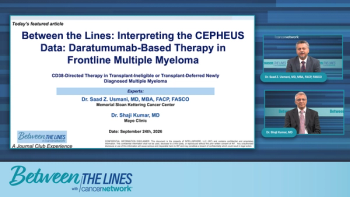
Dr. Saad Usmani and Dr. Shaji Kumar examine the CEPHEUS findings on response depth and durability in newly diagnosed multiple myeloma, with particular emphasis on MRD negativity and its potential implications for treatment duration.
Dr. Saad Usmani reviews the design of the phase 3 CEPHEUS study in patients with transplant-ineligible or transplant-deferred newly diagnosed multiple myeloma, highlighting the importance of patient fitness and age in defining the study population.
Leah Katz, MD, MPH, discussesed NeoORB data on neoadjuvant radiotherapy and why radiation timing may open new treatment paradigms in breast cancer.
Asked about the biggest misconception community providers hold about the referral process, Matthew J. Frigault, MD, clinical director of the Cellular Immunotherapy Program at Mass General Brigham Cancer Institute, emphasized that CAR T-cell therapy is a co-management strategy.
Matthew J. Frigault, MD, clinical director of the Cellular Immunotherapy Program at Mass General Brigham Cancer Institute, asked what practical steps referring oncologists can take and what an ideal interaction with an academic medical center looks like.
Adam D. Cohen, MD, director of Myeloma Immunotherapy and professor of medicine at the Hospital of the University of Pennsylvania, asked whether patients lose the chance to receive CAR T-cell therapy if referral comes too late.
Adam D. Cohen, MD, reviews 5-year data from cohort A of CARTITUDE-2 for cilta-cel and how bridging therapy may lower the risk of late neurotoxicity.
Estelamari Rodriguez, MD, MPH, of Sylvester Comprehensive Cancer Center presents long-term resistance data from the phase 3 MARIPOSA study in epidermal growth factor receptor (EGFR)-mutated advanced non–small cell lung cancer (NSCLC), where amivantamab plus lazertinib reduced acquired MET amplification approximately fourfold and secondary EGFR resistance mutations approximately fivefold compared with osimertinib.
With both CAR T-cell therapy and bispecific antibodies now available in early relapse, Adam D. Cohen, MD, director of Myeloma Immunotherapy and professor of medicine at the Hospital of the University of Pennsylvania, asked how clinicians should decide which modality comes first.
Matthew J. Frigault, MD, and Adam D. Cohen, MD, outline how updated NCCN guidelines position CAR T-cell therapy in early relapsed multiple myeloma.
Siddhartha Devarakonda, MD, of Providence Swedish Cancer Institute says he sees no remaining role for intravenous amivantamab in epidermal growth factor receptor (EGFR)-mutated advanced non–small cell lung cancer (NSCLC), with subcutaneous administration taking 10 to 15 minutes and easing chair time and scheduling.
Matthew J. Frigault, MD, clinical director of the Cellular Immunotherapy Program at Mass General Brigham Cancer Institute, explained that some toxicities of CAR T-cell therapy emerge within the first 30 days, while others can appear 90 days or later after infusion.
Leah Katz, MD, MPH, explained how an intraoperative tumor bed boost in TARGIT-B may reduce distant relapse in young patients with breast cancer.

Erik Bengtsen, MD, discussed meaning-centered therapy at the bedside, framing psychiatry referrals, and a more humanistic approach to care.
Ursula A. Matulonis, MD, surveyed the exploitable genetic changes driving the next wave of ovarian cancer trials, from CDK2 and WEE1 inhibitors to PARG inhibitors.
Ursula A. Matulonis, MD, broke down the trial design, backbone regimen, and preclinical rationale that she believes made KEYNOTE-B96 a positive study.